



SRAS offers a wide range of programming in the Caucasus. Click here to find out more.
The South Caucasus region (Azerbaijan, Georgia, and Armenia) is a key corridor between European markets and the energy-rich Caspian Basin. The region itself is also a rich source of green energy that, if fully developed, could give these states energy independence and considerable electricity exports. Wedged between Russia and Iran, and with complex interregional relationships, the region has seen rapid change in recent years as it has navigated wars, sanctions, and changing energy relationships.
The following resource documents recent events and modern actors that are affecting the fast-changing infrastructure and security of this corridor. We hope that this will be of use as a case study to classrooms teaching energy security and policy.
A Geopolitical Introduction to Caucasus Energy
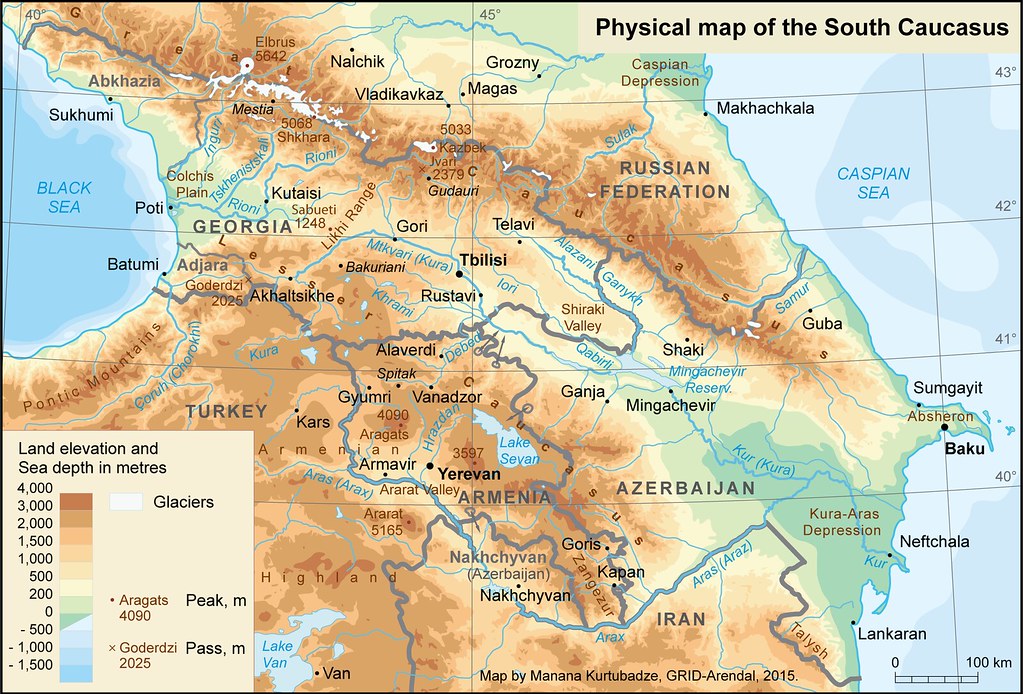
A map of the South Caucasus. The river system that runs through Tbilisi has been a trade route since ancient times. Today, the region’s major connecting roads, rails, and pipeline systems still follow this same path. Map from Grid Arendal.
The South Caucasus offer a narrow band connecting Europe and Asia while bypassing Russia and Iran. The region also has strong potential in hydro, solar, and wind power. Hydropower has been developed since the 1920s and, along with solar, is valued as a localized energy source for communities isolated by the Caucasus’ dramatic geography. Solar is only beginning to expand, while wind development is limited by the difficulty of transporting large infrastructure through rugged mountains. Hydrocarbon reserves are concentrated mainly in the Caspian Basin, while valleys between the Greater and Lesser Caucasus enable transport networks through Azerbaijan and Georgia to international markets via the Black Sea and overland routes to Turkey. Geopolitically, the three Caucasus states are notable for largely separating political disputes from economic relations; trade has usually continued despite crises or strained relations.
Georgia is a transit country for Caspian energy, hosting several ports on the Black Sea. It is the world’s most hydro-dependent country, with roughly 75–80% of its electricity generation coming from hydroplants. Two gas-powered plants supply most of the remaining power, but Georgia relies on gas imports from Azerbaijan and Russia and seasonal electricity imports from Turkey, Azerbaijan, and/or Russia. In 2016, Georgia signed the Energy Community Treaty with the EU, integrating with European energy markets and committing to EU energy standards and regulations.
Azerbaijan is the region’s main producer of hydrocarbons. Oil, gas, and related products and services account for roughly 30–50% of GDP and 80–90% of exports. Much of this wealth is concentrated in the state-owned company SOCAR, which has also heavily invested in infrastructure in Georgia, Turkey, and the EU, giving Azerbaijan a wide geopolitical footprint. Azerbaijan’s oil industry, as one of the world’s oldest, is facing structural declines in oil output and challenges sustaining long-term gas growth. To meet increasing Europe demand, Azerbaijan is investing heavily in renewables, and also importing Russian gas for domestic use to free more Azerbaijani gas for export.
Armenia has no major fossil fuel reserves and depends on imports for natural gas and nuclear fuel. The rapid expansion of hydro and solar projects has raised the share of renewables to 30% and there are plans to raise this to 60% by 2040. Most trans-national infrastructure bypasses Armenia. Most energy imports come from Russia. Geopolitical shifts following the Third Karabakh War could significantly reshape the country’s energy landscape.
The Third Karabakh War of 2023 lasted one day and ended with a decisive Azerbaijani victory over Armenia, displacing more than 100,000 Armenians from what Armenians consider their historic homeland in Karabakh. Russia, which had peacekeepers in Armenia, did not intervene, severely damaging Armenian trust. Despite the humanitarian crisis, the conflict’s resolution could open new international trade and energy routes for Armenia through the Zangezur Corridor and diversify Armenia’s trade routes and energy supplies. Although Russia remains Armenia’s largest energy supplier, plans to integrate Armenian and Azerbaijani energy systems and talks to diversify sources of nuclear fuel and technology may change this in the long term.
The Zangezur Corridor crosses the long-closed Armenia-Azerbaijan border. Its reopening to southern shipments from Azerbaijan to Turkey and onward to Europe is being facilitated by the “Trump Route for International Peace and Prosperity,” negotiated as part of the US-mediated peace talks between Azerbaijan and Armenia. Azerbaijan has expressed interest in making major upgrades to the existing electric connections, rail, and road systems that travel this route. Iran, fearing loss of trade routes to Armenia, strongly opposes the corridor .
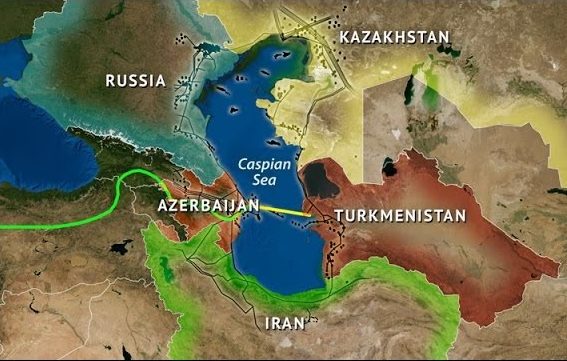
A map of the Caspian showing major fields, pipeline routes, and the Caspian states. Still from a somewhat dated but still relevant Stratfor video.
The Caspian Sea is the world’s largest enclosed body of water and contains vast oil and gas reserves beneath its seabed. After the collapse of the USSR in 1991, new maritime boundaries had to be negotiated among Russia, Iran, Azerbaijan, Kazakhstan, and Turkmenistan. The Caspian, however, can be classed as a lake because it is landlocked but can also be considered a sea because of its size, salinity, and oceanic crust. By international agreement, seas are divided into national sectors, while lakes are often jointly managed. Although the 2018 Convention on the Legal Status of the Caspian Sea clarified many of these issues, some bilateral boundary disputes remain unresolved, particularly over individual fields. This has hindered progress on the Trans-Caspian Pipeline .
Iranian-Azerbaijani relations have been economically close but politically tense. Energy swaps have allowed Iran to supply gas and electricity to Nakhchivan, which is separated from mainland Azerbaijan by Armenia, while Azerbaijan supplies Iran’s northern regions, where aging infrastructure and sanctions limit domestic supply. Tripartite swaps have also allowed Turkmenistan to send gas via Iran into Azerbaijan’s South Caucasus Pipeline, which has seen rising demand as Europe reduces reliance on Russian energy. However, Azerbaijan accuses Iran of repressing its large Azerbaijani minority, which is concentrated along the two countries’ shared border. Some Azerbaijani political groups advocate incorporating northern Iran into Azerbaijan, increasing distrust. Iran is particularly wary of Azerbaijan’s close political and cultural ties with Turkey, which could make the perceived threat at Iran’s northern border much more powerful. More recent infrastructure built to Nakhchivan from Turkey and the opening of the Zangezur Corridor will likely erode economic ties between Iran and Azerbaijan, which could increase the likelihood of conflict.

Study abroad with SRAS to better understand the geopolitics of the Caucasus.
The Iranian-Turkmen-Azerbaijani gas swap agreement, signed in 2021, allows Turkmenistan to send gas to Iran and Iran to send an equivalent amount to Azerbaijan. The agreement was expanded from 2 bcc to 5.5 bcc in 2023 as Azerbaijan tried to meet more European demand after the invasion of Ukraine. The surge represented about half the amount transmitted to Europe that year. The Iran War of 2026 may put the swap in jeopardy.
The Iran War of 2026 has further increased the strategic importance of trans-Caucasus energy routes. At the same time, Iran has been accused of targeting Azerbaijani infrastructure and planning attacks on facilities including the BTC pipeline, though Tehran denies this. Even without direct attacks, Iran could significantly disrupt Azerbaijani and European energy interests by unilaterally ending the Turkmenistan swap arrangement that currently feeds part of Azerbaijan’s pipeline network.
Iranian-Armenian relations have historically been close. Iran supported peace efforts during the Karabakh conflict and has provided Armenia with arms and tactical assistance. Tehran sees Armenia as a key buffer against the Turkish-Azerbaijani axis. Iran has proposed additional pipelines through Armenia to Georgia and possibly Russia, though sanctions have largely blocked these plans. It also opposes opening the Zangezur Corridor, fearing the loss of its own potential trade route to Armenia and beyond.
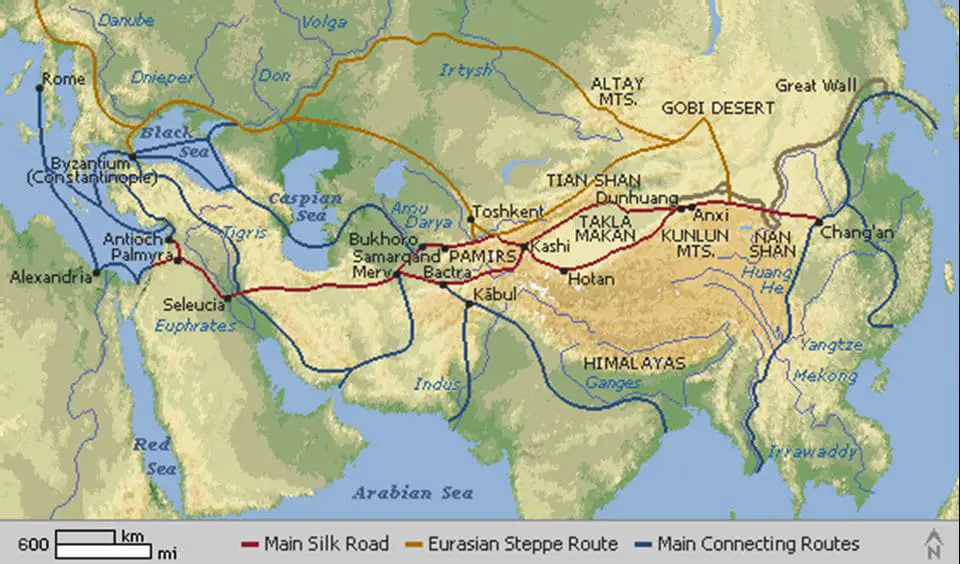
The Silk Road and other major transport routes show how human migrations once brought the influences of several civilizations through Central Asia. These are still major transport routes.
Kazakhstan and Turkmenistan, both Central Asian hydrocarbon exporters, help supply Azerbaijan’s pipelines, with Kazakhstan supplying oil via tankers and Turkmenistan natural gas via Iran. Both countries are also playing important roles in the future electricity grid integration linking Europe and Asia through the South Caucasus. All three countries share Turkic heritage and largely cooperate on energy issues. Turkmenistan has the world’s fourth largest natural gas reserves while Kazakhstan ranks 14th for natural gas and 10th for oil. Because no pipeline crosses the Caspian, these resources flow across Russia, Iran, or east to China. Turkmenistan and Kazakhstan have made progress on their Caspian Sea disputes through expanded cooperation in the jointly managed Dostluk Oil and Gas Field . Another Central Asia country, Uzbekistan, also holds substantial fossil fuel reserves but has recently become a net importer as it prioritizes domestic consumption for its growing economy.
Russia is strongly integrated with the region’s pipelines and electrical grids as both were originally built by the Soviets. Georgia diversified to more Azerbaijani energy after explosions in Russia’s North Ossetia region disrupted energy flows at a time when Moscow was pressuring Tbilisi against boosting relations with the West. Russian support for Georgia’s breakaway regions has further strained relations. Azerbaijan and Russia increasingly view each other as competitors. A diplomatic crisis ensued after Russia mistakenly shot down an Azerbaijan Airlines plane in 2024, subsequently accused a group of ethnic Azerbaijanis in Russia of forming a criminal gang, then was accused of contaminating BTC pipeline exports to Europe with chlorine in 2025. Retaliatory measures by Baku deepened the diplomatic rift. Despite the above, Azerbaijan and Georgia are now buying more Russian gas to meet domestic needs and maintain export flows to Europe. Azerbaijan still participates in the Middle Corridor and maintains roughly $5 billion in annual trade with Russia. Russia was once Armenia’s main ally, but relations have changed dramatically since The Third Karabakh War .
International Electricity Markets
Although pipelines attract more attention, electric grid integration is increasingly central to geopolitical infrastructure as electricity takes a larger role in decarbonized energy systems. Interconnections require technical and regulatory cooperation and allow states to trade electricity, stabilize supply, and support renewable expansion. They also create new dependencies and avenues for political influence.
Energy systems in Armenia, Georgia, and Azerbaijan were first built by the Soviets and interconnected in 1960. They were linked to Moscow in 1970 with authorities in Tbilisi managing the three South Caucasus systems and their connection to Russia. Since independence, the system remains interconnected, helping Russia retain influence in the region long after the USSR’s collapse.
Today, new integration projects are rapidly expanding across Eurasia, with considerable competition taking shape between Russia, the European Union, China, India, Turkey, and Iran. As a result, the once-peripheral Caucasus are becoming a competitive hub where infrastructure development reflects broader geopolitical rivalries and shifting centers of power across Eurasia.
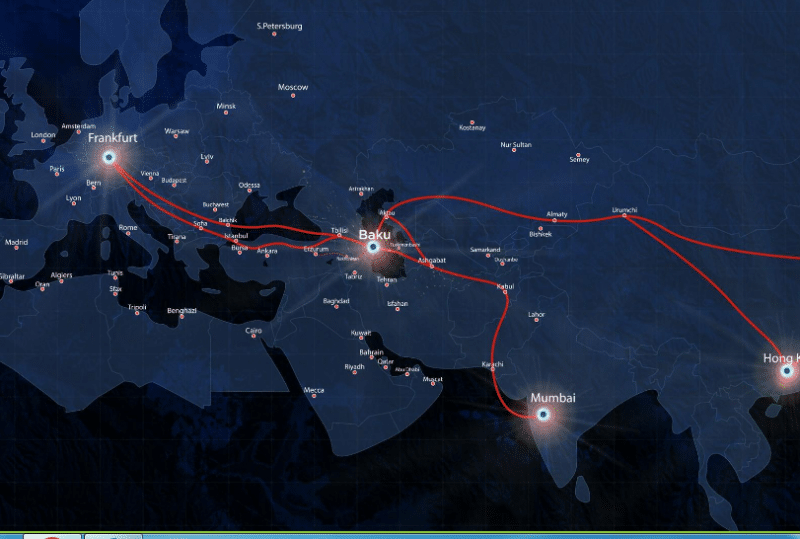
Planned electric grid integration routes for Eurasia as of 2026.
Armenia and Azerbaijan are today both net electricity exporters. Georgia is a seasonal exporter, sending power abroad in summer when hydropower flows are strongest but relying on imports from Russia, Turkey, or Azerbaijan in winter. Georgia could become a net exporter with fully developed renewable potential. Greater regional integration and renewable development could significantly benefit all three countries.
Azerbaijan’s exclave of Nakhchivan has received electricity through a swap arrangement with Iran since the 2000s, while Azerbaijan supplies power to northern Iranian regions in return. Since the end of the Third Karabakh War in 2023 , Azerbaijan has sought to build a direct connection through the Zangezur Corridor and further link Nakhchivan to neighboring Turkey as part of broader efforts to integrate the region with European energy networks. Iranian electricity exports to Nakhchivan could be jeopardized by the 2026 Iran War .
All international sales of electricity are handled by state-owned companies in Georgia, Azerbaijan, and Armenia.
The AGT Power Bridge Project was established with support from the US and, as of 2015, links the power grids of Georgia, Turkey, and Azerbaijan.
The Black Sea Transmission Network is a developing project which intends to create direct electricity connections from Azerbaijan and Georgia to Romania and Hungary. The intent of the project is to create a power transmission network that unites China, Hong Kong, India, and the EU via Central Asia and the Caucasus. The focal point of this new network will be Azerbaijan.
The Iran-Russia Power Corridor has reached a final agreement to synchronize Iranian and Russian grids via Azerbaijan. It has not yet been implemented.
Hydropower, Solar, and Wind
Hydropower is a favored energy source in the South Caucasus, a region with considerable rainfall, glacier-fed rivers, and dramatic elevation changes. Many modern projects are small-scale and designed to address local capacity shortages, taking advantage of the very mountainous terrain that can make extending centralized infrastructure difficult. At the same time, several medium and large projects have been proposed, especially in Georgia, that could displace villages and significantly alter local ecosystems.
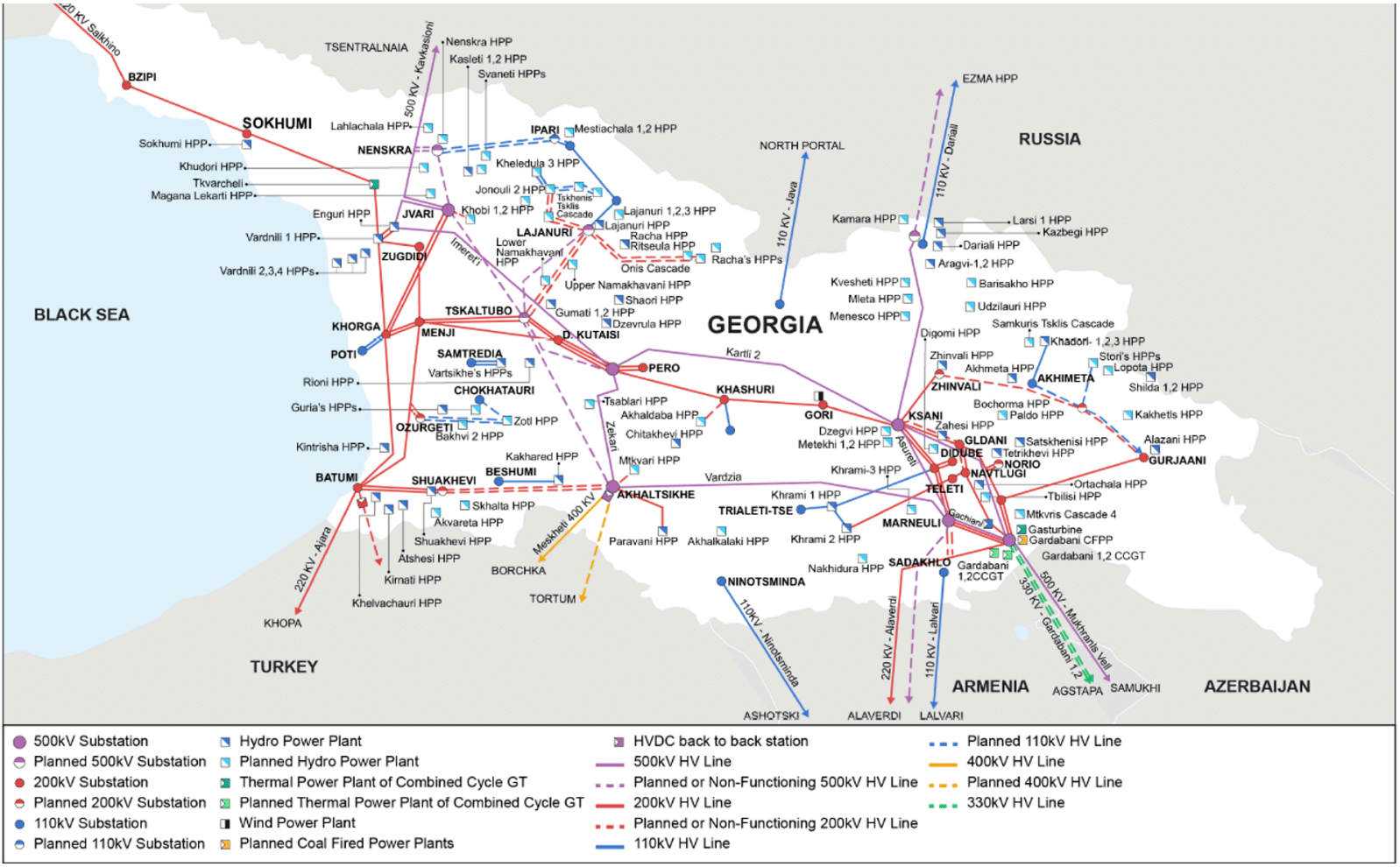
Map of Georgia’s transmission network as of 2022, showing major existing and planned hydropower sources, gas-fired plants, and other infrastructure. Source: International Energy Agency
Environmental and over-development concerns are frequently raised as renewable energy projects expand at remarkable speed. Although these initiatives are promoted as green sources that strengthen local energy security and independence, expanding electricity grid integration could eventually allow Georgia and Armenia—despite lacking major fossil fuel reserves—to become significant energy exporters. The temptation to overdevelop “green” energy at the expense of the Caucasus’ striking and highly biodiverse landscapes will likely remain a long-term concern.
Hydropower may become less effective overtime due to global warming. The glaciers that feed many of the Caucasus Mountains’ rivers are retreating at an alarming rate, losing over 23% of their total area between 2000 and 2020 due to rising temperatures and decreased snowfall. This rapid decline, among the highest globally relative to volume, has increased flood risks and caused smaller glaciers to vanish entirely.
Solar and wind resources are also abundant across the region. Hydropower output declines in winter when waterflows freeze, while solar and especially wind can provide more stable production. However, expanding these sources has been slow and sometimes controversial. The region has extensive local experience with hydropower but relies on imported materials and expertise for solar and wind development. Transporting the large equipment required for wind turbines is particularly difficult and costly in the Caucasus’ rugged terrain, and turbines can significantly alter landscapes, raising concerns in historic and tourist areas.
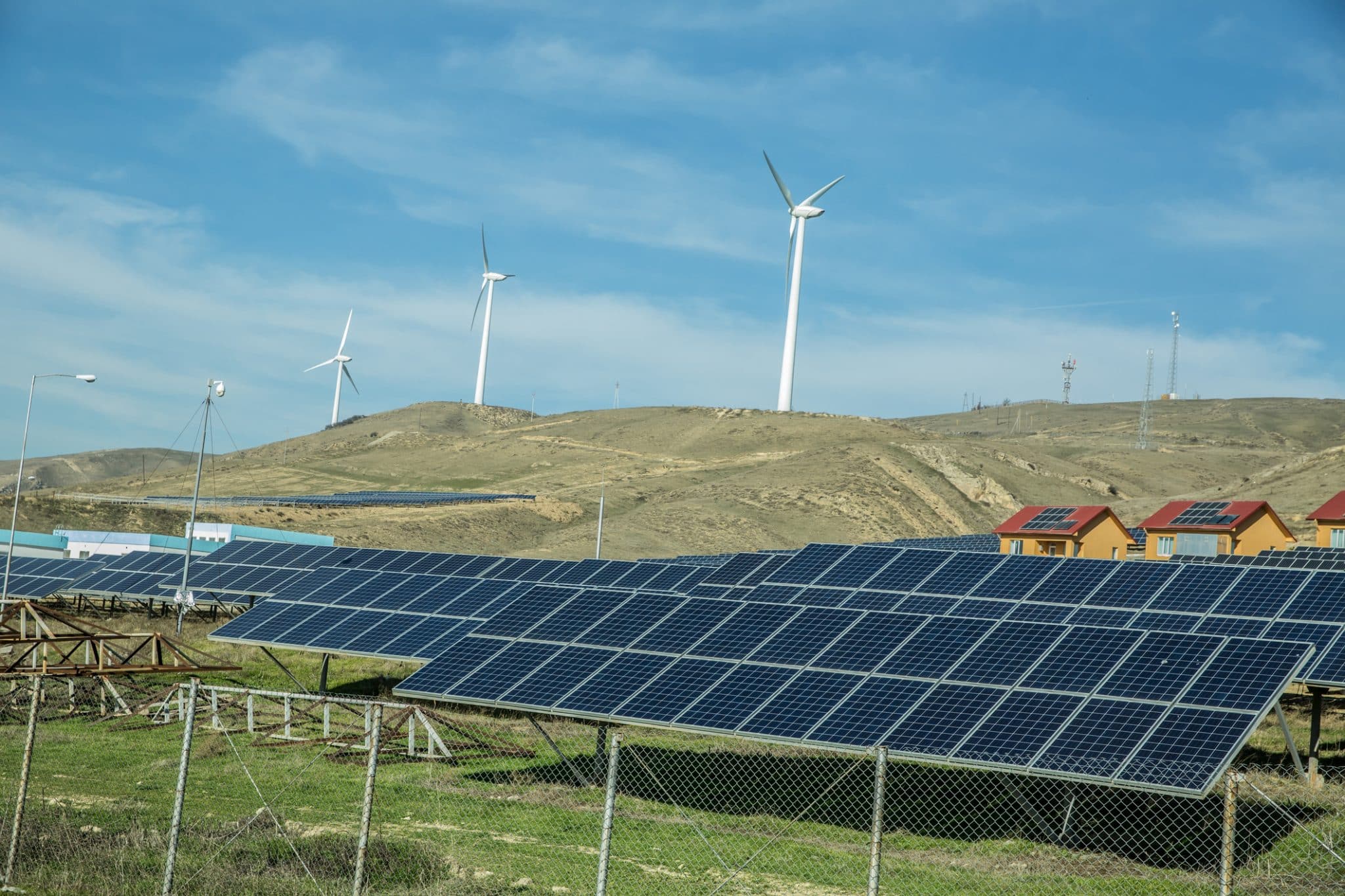
This alternative power farm in Gobustan, Azerbaijan covers almost 100 acres with solar, wind, and biogas plant powered by sugar beets. Planned expansions would see it power much of the region of Gobustan.
Azerbaijan’s renewables are being spearheaded by AzerEnerji, the state-owned electricity producer and distributor. The company operates several Soviet-era hydropower plants along the Kura River and, especially since 2023, has launched multiple smaller hydropower projects while initiating the country’s first large solar and wind developments. Major international firms, particularly from the UAE and Saudi Arabia, have invested heavily in solar and, to a lesser extent wind, while private local capital has supported smaller hydropower projects. As a result, renewables increased from about 6% of Azerbaijan’s electricity generation in 2023 to about 14% in 2025, part of a broader strategy to free hydrocarbons for export. Azerbaijan aims to meet 30% of domestic electricity demand with renewables by 2030.
Georgia’s renewables are dominated by hydropower, which generates roughly 75–80% of the country’s electricity. The largest facility is the state-owned Enguri Dam, completed in 1978, which typically produces about 40% of Georgia’s electricity. The dam sits in Georgian-controlled territory while the power station lies in Abkhazia, making it one of the few remaining areas of cooperation between Georgians and Abkhazians since the civil war. The electricity is split roughly 60/40 between them. Georgia has more than 100 hydropower plants under a mix of state and private ownership, with additional projects regularly coming online. Although studies suggest solar and wind could be more effective than expanding hydropower, Georgia still prioritizes hydro and currently has only one utility-scale wind farm. Its first utility-scale solar plant is due to come online only in 2026.
Armenia’s renewables account for about 30% of electricity production, though output varies significantly depending on waterflows. The country operates more than 200 hydropower stations of varying size. Most major plants are controlled by Armenia’s privately held Tashir Group or the American investment firm KKR, while smaller stations belong to various private investors. Armenia also has more than 70 utility-scale solar farms and three utility-scale wind farms developed through private investment or public–private partnerships. The government aims to increase the share of renewables to 60% by 2040.
Nuclear
The Metsamor Nuclear Power Plant in Armenia, first opened in 1980, supplies 30 to 40 percent of Armenia’s electricity. It is the only nuclear plant in the Caucasus. The facility is wholly owned and managed by the Armenian government. Russia’s Rusatom Service JSC is responsible for major upgrades to extend the plant’s life until 2036. Previously reliant on Russia for nuclear fuel and plant maintenance, Armenia has been seeking to diversify its sources of fuel and future replacements for the plant. Discussions are underway with Russia, the United States, China, France, and South Korea. Although Armenia considers nuclear energy to be essential to its energy security, many voice concerns at nuclear’s use in a seismically active area.
Gas and Gas Pipelines

Interns like you help create resources like this for our sites. Apply here.
Azerbaijan’s natural gas reserves rank 12th by size in the world. Its major field, the Shah Deniz gas and condensate field, was the largest single field in the world with more than 1 trillion cubic meters of natural gas. It too, however, is aging and new extensions are being explored. Absheron, active since 2023, holds about 350 billion cubic meters. The Karabakh field, due to come online in 2029, holds 13 billion cubic meters.
The Southern Gas Corridor is an interconnected flow system of three pipelines that became fully operational in 2020. Comparable in length to the US-Mexico border, it delivered about 4% of Europe’s energy needs in 2025. An agreement to boost deliveries to 7% for 2026 will likely fill the pipeline to its limit. However, the agreement itself may be hampered by the 2026 Iran War .
- The South Caucasus Pipeline (SCP) connects Azerbaijan’s Shah Deniz gas field in the Caspian to Turkey via Georgia, running largely parallel with the BTC Oil Pipeline. It is operated by BP and owned by a consortium that includes BP, Lukoil (a publicly traded Russian oil company), as well as Azerbaijani, Iranian, and Turkish state-owned energy companies.
- The Trans-Anatolian Gas Pipeline connects the SCP at the Georgian border with Greece via Turkey. It is operated by and 58% owned by entities controlled by the Azerbaijani government. Minority shares are held by Turkish state-owned BOTAŞ (30%) and BP (12%).
- The Trans-Adriatic Pipeline (TAP) is the final leg, connecting Turkey to Italy via Greece and Albania. It is run by its own management company, which is owned by SOCAR and four European energy companies, with each holding 20%.
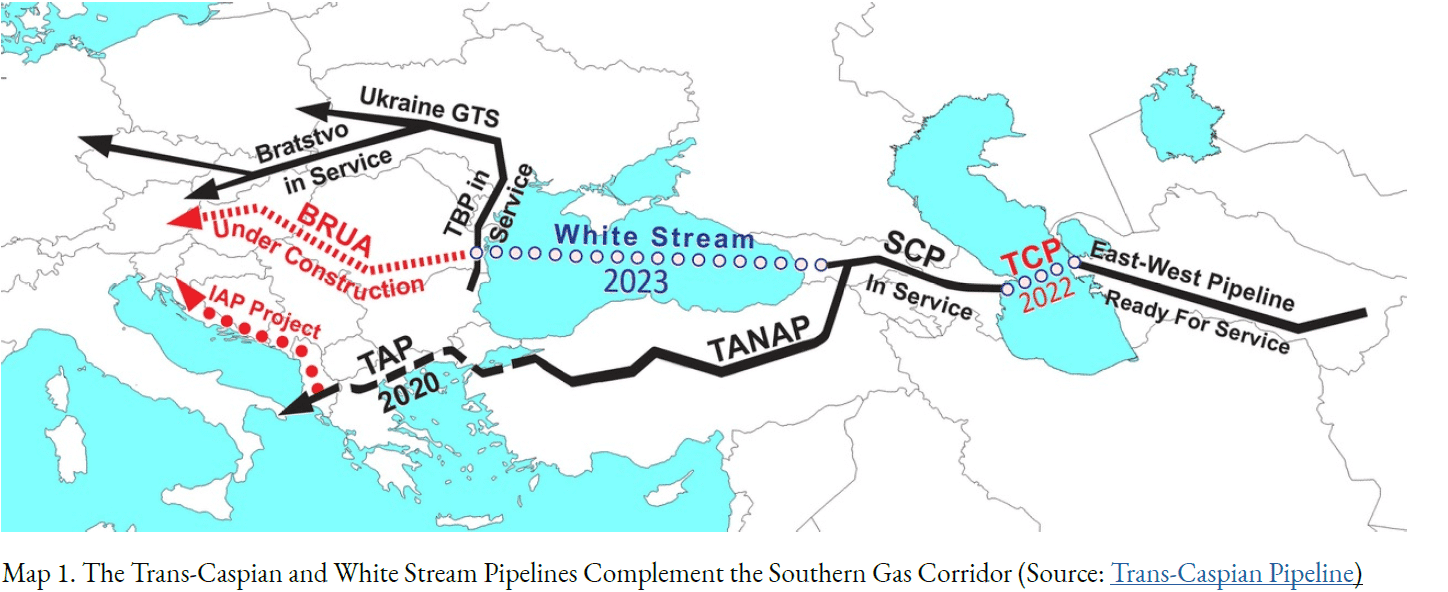
A 2018 map showing existing and proposed pipelines connecting the South Caucasus to Europe. The BRUA and East-West Pipelines are both fully online today. At the time, it was hoped that resolutions in Caspian Sea status disputes could bring the Trans-Caspian online by 2022 and the White Stream soon after. Both pipelines remain in question as of 2026. This map is from the now-defunct Trans-Caspian website.
The Trans-Caspian Pipeline is a proposed subsea project that would connect Turkmen and Kazakh gas to the Southern Gas Corridor , bypassing Russia and Iran. Azerbaijani routes, with further pipeline expansions, could then supply 17% of Europe’s needs. Strongly supported by the EU and Azerbaijan, the project has faced delays due largely to the unresolved legal status of the Caspian Sea particularly between Azerbaijan and Turkmenistan, the two countries likely to benefit most from the project. The project has also faced political resistance from Russia and Iran, both of which have raised environmental and legal objections while also seeking to protect their own transit roles.
The White Stream Pipeline is a proposed natural gas project that would transport up to 32 bcm annually from Georgia to Romania across the Black Sea. It is designed to complement the proposed Trans-Caspian Pipeline and will likley not progress until that pipeline is cleared.
The Iran–Armenia Gas Pipeline delivers gas to Armenia in a swap for electricity sent back to Iran. The route was to be extended to Georgia’s Black Sea ports as part of Iran’s efforts to diversify routes away from the Strait of Hormuz. However, Georgian concerns about sanctions and the comparative expensiveness of Iranian gas over Russian has so far scuttled the plans. The pipeline is owned by Gazprom Armenia, a wholly owned subsidiary of Russia’s Gazprom.
The Iğdır-Nakhchivan Gas Pipeline connects the Azerbaijani exclave of Nakhchivan to Azerbaijani gas via the Trans-Anatolian Gas Pipeline. It was opened in 2025 to provide an alternative to a gas swap agreement in which Nakhchivan was supplied by Iran in exchange for Azerbaijani deliveries to Iran’s underserved northern regions.
Transcaucasia Gas Pipeline connects Armenia to Russia via Georgia. It is Armenia’s primary source of natural gas, which accounts for approximately 40% of the country’s electricity generation as well as most urban residential heating. Running through the North Caucasus, it has been frequently damaged by rock slides and was bombed in 2006. Russia says this was done by separatists, but Georgia in particular accused Russia of engineering the blast to place political pressure on the South Caucasus countries.
The Russia-Iran Pipeline is a proposed connection between the world’s two largest gas producing states. It would flow through Azerbaijan. Most analysts agree that the line makes little economic sense. Although it would potentially provide additional export routes and support Iranian and Azerbaijani ambitions to become gas hubs, the line’s proposal is more a show of political solidarity. So far, only a preliminary agreement has been signed. The project is part of a broader energy cooperation plan, which includes Russian investment in Iranian oil and gas fields.
Oil and Oil Pipelines
Azerbaijan’s oil reserves rank 19th in size in the world. Baku is facing a structural decline in oil production, with marketable crude output falling from 50.7 million tons in 2010 to about 28 million tons in 2025. Oil production is dominated by the Azeri-Chirag-Gunashli (ACG) field, which started at a jaw-dropping 5 billion barrels of reserves, but is now past its peak and delivering diminishing product. An extension to reach deeper reserves in ACG is being explored but will take several years to bring online. The Absheron oil and gas field was brought online in 2023 and brought in 4.3 million barrels in 2024. The much smaller Karabakh field, with 140 million recoverable barrels, is being developed in partnership with BP and due to come online in 2029. Other fields are being explored. However, overall hydrocarbon output is expected to stagnate post-2025. The government is pushing for economic diversification, investing in renewables, and seeking new partnerships to mitigate declining oil revenue, as production remains 40% lower than a decade ago.
The Dostluk oil and gas field holds an estimated 50–100 million barrels of oil and significant natural gas. Its main significance, however, is its potential to bridge Azerbaijani and Turkmen energy interests and provide a pathway for the Trans-Caspian Pipeline. The countries signed a memorandum agreeing to jointly develop the field and split its resources 30/70, respectively. However, the legal framework and final intergovernmental agreement are still being finalized. As of 2024, no major international energy company has officially committed to investing in the project and likely won’t until agreements are finalized.
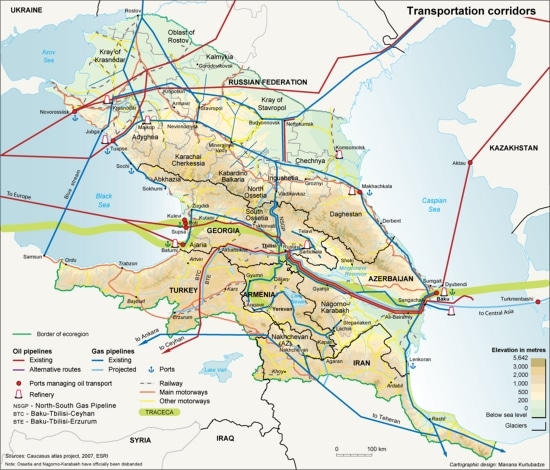
Oil and gas pipelines in the Caucasus as of 2007. The Iran-Armenia gas route is shown as proposed but is now complete. Map from Grid Arendal.
The Baku-Tbilisi-Ceyhan (BTC) Pipeline is the world’s second longest oil pipeline. Opened in 2006 and running from Azerbaijan to Turkey, it is directly fed via Azerbaijani fields as well as Turkmen and Kazakh fields via tankers. With a 1.2 million barrels a day capacity, it has been functioning at only a fraction of that capacity due to Azerbaijan’s oil industry’s structural decline. In 2025, just 206 million barrels traveled the pipe. The pipeline is operated by BP and owned by BP (30%), the Azerbaijani state energy company (33%), and a consortium of eight other global energy companies.
Baku-Supsa Pipeline is an idled pipeline between Azerbaijan and the Georgian port of Supsa. In 2015, a section of the pipeline was claimed by South Ossetia in its ongoing conflict with Georgia. However, it continued to function until 2022 when the War in Ukraine disrupted Black Sea traffic. Flows today are minimal. Operated by BP since its opening in 2006, it will likely be transferred to a consortium run by Georgia, Turkey, and Azerbaijan as of 2026. It is owned by BP (30.37%), SOCAR (25%), and a consortium of 7 other major energy firms.
The Baku-Novorossiysk Pipeline connects Baku to the Russian Black Sea coast. Because Black Sea shipping has been disrupted by the War in Ukraine, the pipeline is currently using only 15% of its 100,000 barrel-a-day capacity. It is co-owned and co-operated by SOCAR and Russia’s Transneft, with each company controlling the pipeline within their respective countries.
Coal
Georgia has small, low-quality coal deposits, estimated at about 200 million tons nationwide. Proposals have periodically suggested building a coal-fired power plant to use these domestic reserves. Supporters argue it could improve energy and economic security by using local fuel instead of imported gas while revitalizing the struggling Tkibuli mining sector and creating jobs. However, environmental groups and policy analysts have criticized the idea as both economically questionable and environmentally harmful. They warn burning the low-quality coal in such great amounts would increase pollution and create large waste dumps. With a second natural-gas power plant now operating and Georgia nearing energy self-sufficiency using cleaner—though imported—gas, the coal plant is unlikely to be built.
Major Energy Companies
SRAS offers a wide range of programming in the Caucasus. Click here to find out more.
The following are several Caucasus-based major companies involved in energy markets. A great many foreign companies are also present on the market including Chevron, TotalEnergies, Equinor, TPAO, ExxonMobil, Lukoil, ITOCHU, INPEX, and others.
SOCAR is short for “State Oil Company of the Azerbaijan Republic.” Founded in 1992, it is responsible for every stage of the energy industry in Azerbaijan, from exploration and extraction to transportation, refining, and domestic natural gas distribution. It is by far Azerbaijan’s largest company, contributing as much as 40% of the country’s GDP through direct and indirect activities. SOCAR is heavily invested in Georgia, Turkey, and the EU, where it owns pipelines, refineries, gas stations, and other assets.
SOCAR Georgia is a subsidiary of SOCAR and is, by far, Georgia’s largest company. It runs residential natural gas networks throughout most Georgian regions and is also a major importer, wholesale distributor, and retail seller of petroleum products such as gasoline, diesel, and aviation fuel. SOCAR Georgia also runs a chain of gas stations as well as the Kulevi Oil Terminal, which connects petroleum products delivered to it via rail to oceanic transport on the Black Sea. SOCAR entered the Georgian market in 2006 under a massive privatization program led by then-president Mikhael Saakashvilli. Its investments in Georgia as of late 2025 amounted to $2.1 billion.
GOGC is short for “Georgian Oil and Gas Corporation.” Founded in 2006 to retain certain elements of state ownership under Georgia’s privatization drive, GOGC is 100% state owned and manages a 1,940 km gas pipeline system connecting Georgian regions (regional networks are generally privatized). GOGC also regulates international pipeline transit through Georgia and represents Georgia’s interests in Production Sharing Agreements with investors. Additionally, GOGC owns and operates both a thermal power facility located at Gardabani and is engaged in the development of renewable energy sources.
ENERGO-PRO is Georgia’s largest fully privately held company. It controls about 85% of Georgia’s electric grid. It also owns and operates 15 medium sized hydro plants and a natural gas fired electrical plant in Georgia. The company is fully owned by Czech businessman Jaromír Tesař.
British Petroleum (BP) has been active in Azerbaijan continuously since 1992 and has become the largest foreign oil producer and operator. BP operates ACG and holds a 30.37% equity position in ACG, along with an investment in the Shah Deniz field and participation in a number of pipeline projects (BTC, SCP, and TANAP).
Gazprom Armenia is Armenia’s importer and distributor of natural gas, controlling Armenia’s national gas transmission and distribution system. Established in 1997 as a joint Armenian-Russian venture, Gazprom gradually increased its ownership and became the 100% owner in 2014. It also built and operates Unit 5 of the Hrazdan Thermal Power Plant, a major gas-fired electricity generator. Because Armenia produces almost no natural gas domestically, Gazprom Armenia functions as the country’s national gas utility, making it one of the most strategically important companies in Armenia’s economy and energy system.
Electric Networks of Armenia is Armenia’s monopoly electricity distributor. The company was previously owned by Russian Inter RAO UES before being acquired by the Tashir Group, owned by the Russian-Armenian billionaire businessman Samvel Karapetyan. As of March 2026, the Armenian government is moving to fully nationalize the company, alleging mismanagement and corruption under Tashir. The state is apparently hoping to use the nationalized network to allow multiple companies the ability to sell electricity at more competitive rates.
Rails and Roads
In terms of energy, roads and rails have been used primarily for transporting refined hydrocarbon products that cannot be shipped via pipeline. Most of this shipping is currently domestic, although some international trade exists.
Following the Third Karabakh War Azerbaijan began exporting fuel, for the first time in 30 years, to Armenia in December 2025. Part of regional peace efforts, these shipments, transported via multimodal transport through Georgia by private companies and SOCAR , have been credited with reducing Armenian fuel prices by up to 15%.
Between Armenia and Azerbaijan, two direct rail connections and several roads have been disused for many years. Their reopening is now being negotiated for direct shipments. Anticipating greater regional interconnection, Georgia has announced plans for new highway connections between all three countries that will additionally feed both the Middle and North-South Corridors . Azerbaijan has plans to invest heavily in the Zangezur Corridor, now opening in southern Armenia, to connect to its exclave of Nakhchivan and onwards to Turkey.
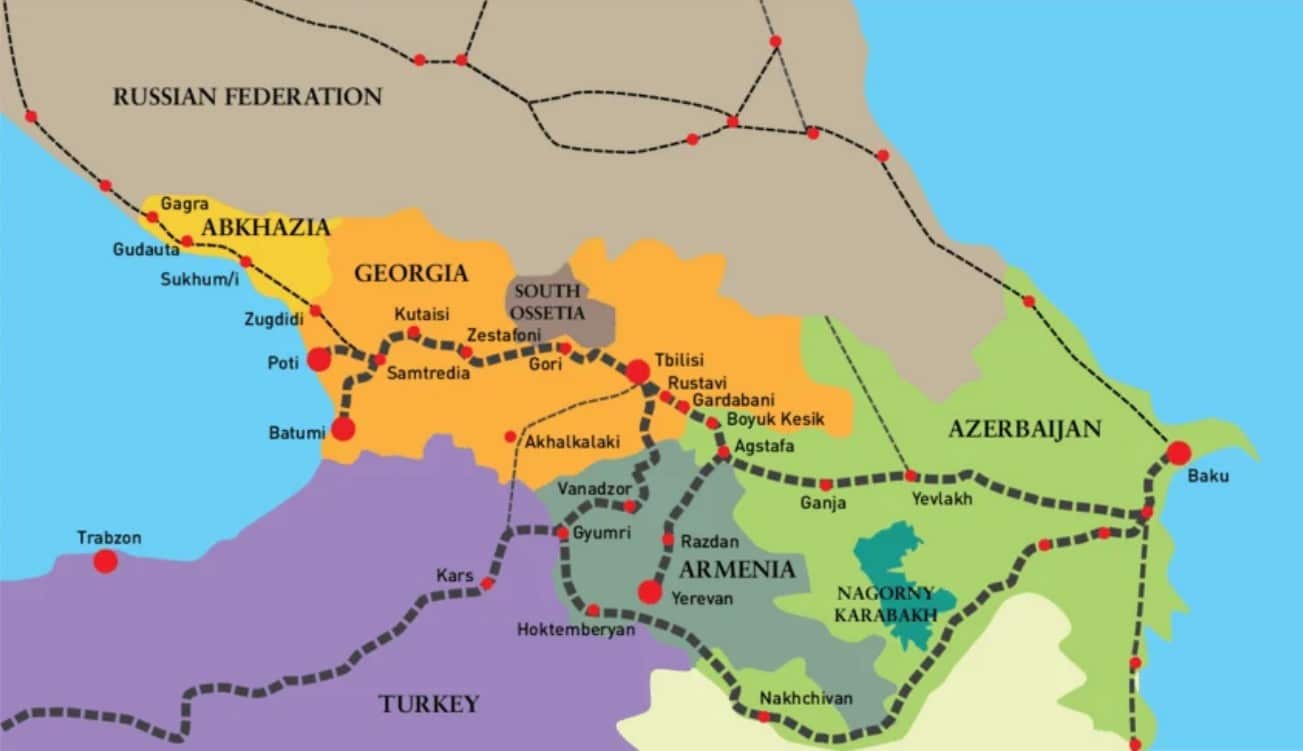
Major rail lines of the South Caucasus. Major roads run along similar routes with two additional roads running to Russia from Georgia (with one passing through South Ossetia).
Railroads, including Georgian Railways and Azerbaijan Railways, are all operated as state-owned monopolies in the South Caucasus. Armenia’s railway infrastructure is also state-owned but operated under a 30-year concession agreement (running until 2038) by the South Caucasus Railway, a wholly-owned subsidiary of state-owned Russian Railways. While the Armenian government owns the assets, Russia controls the network’s management, operations, and modernization. The Baku-Tbilisi-Kars Railway runs between Baku and Turkey along a similar route as the South Caucasus Pipeline, and was recently upgraded to increase its capacity by about 500%.
The Main Highway for the South Caucasus, the M2/S4 system, connects Georgia and Azerbaijan to Turkey, following the approximate route as the main rails and pipelines. Georgia, Azerbaijan, and Turkey are significantly upgrading and expanding their respective ends, with construction expected to be complete by 2030, anticipating rapidly growing traffic in the coming years. A northern route via Balakan (Azerbaijan) and Lagodekhi (Georgia) also exists, with new construction planned for the Tsnori-Lagodekhi section to improve this connection.
The Middle Corridor is a growing multimodal trade network linking China and Europe through Central Asia and the South Caucasus. It provides a faster and politically safer alternative to northern routes dominated by Russia and bypasses both Russia and Iran.
The North-South Corridor in the Caucasus is a multimodal trade network connecting Russia with India through Azerbaijan and Iran. The corridor is intended to shorten transport times and strengthen economic ties among participating states.
More Information
Caspian Policy Center is an independent, nonprofit research think tank based in Washington D.C. focused on economic, political, energy, and security issues of the Caspian region.
Guide to Russia’s Natural Resources, also from this site, takes a wide view of Russia’s resources, markets, and companies as well as covers some of the political implications of these topics.
Forum Energii is an interdisciplinary think tank from Poland researching and supporting a European transition to green energy.
The Hague Research Institute studies Europe’s interactions with Eastern Europe, the South Caucasus, and Central Asia, including in energy security.

