


This resource examines how the status of the Russian language and its speakers has changed across the former Soviet space from the fall of the USSR to the present. For each regional and political unit, it considers five areas: legal status, demographics, citizenship, education, and mass media.
The data are sometimes surprising. Countries that never had large ethnic Russian populations have not necessarily been the first to see Russian decline. In some cases, Russian has remained widely spoken, sustained by economic and geopolitical factors.
State citizenship, education, and media policies have shaped how Russian-speaking communities and the societies and governments around them interact. These policies have contributed to migration and generational change that have produced very different outcomes from country to country. Examining these factors together reveals a spectrum of how policy and history can affect the fabric of multi-lingual societies.
Below is part one of a two-part series. Part two will appear in the November issue of Eurasian Corridor Perspectives and will include the Caucasus and Eastern Europe.
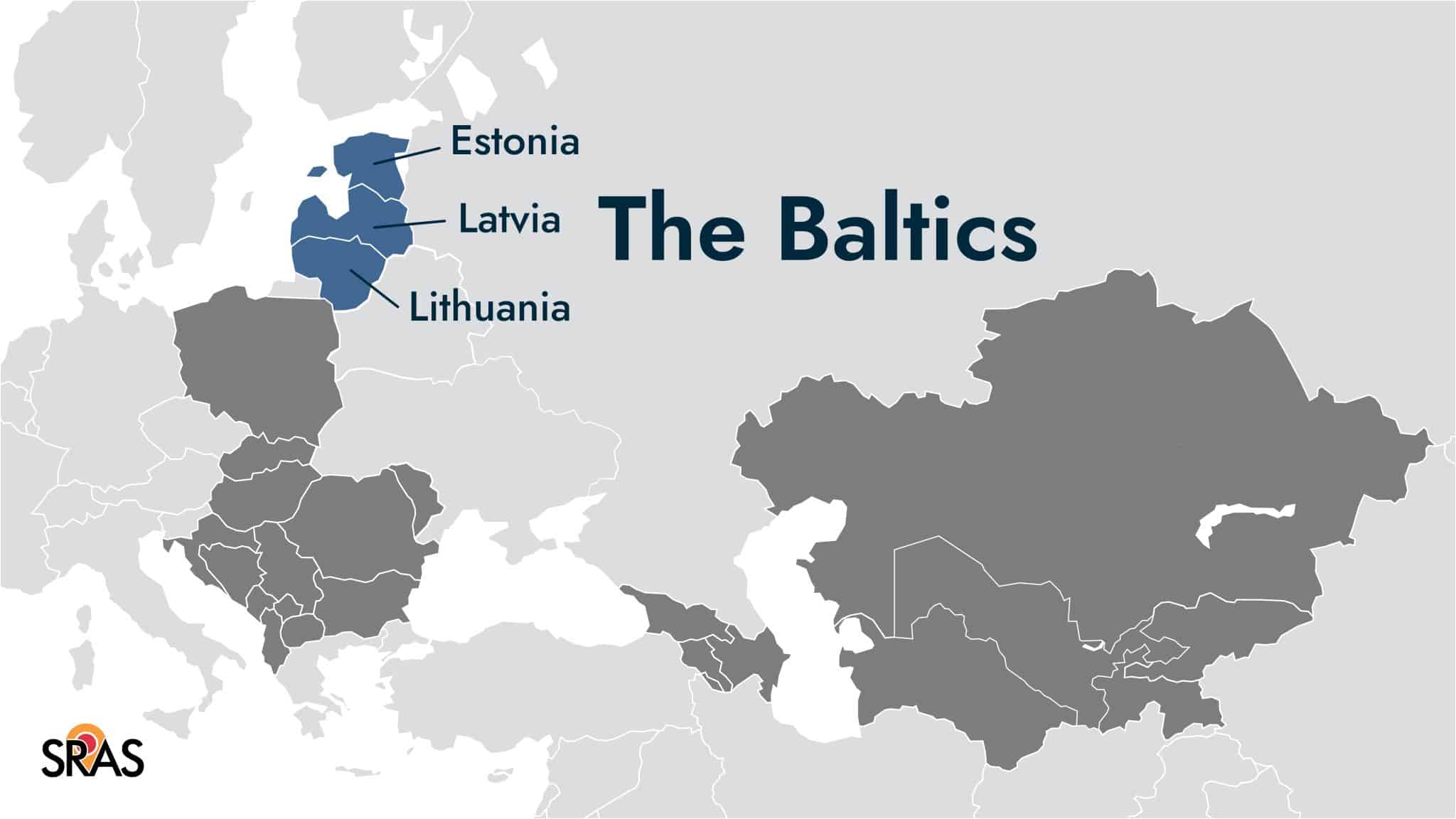
The Baltics
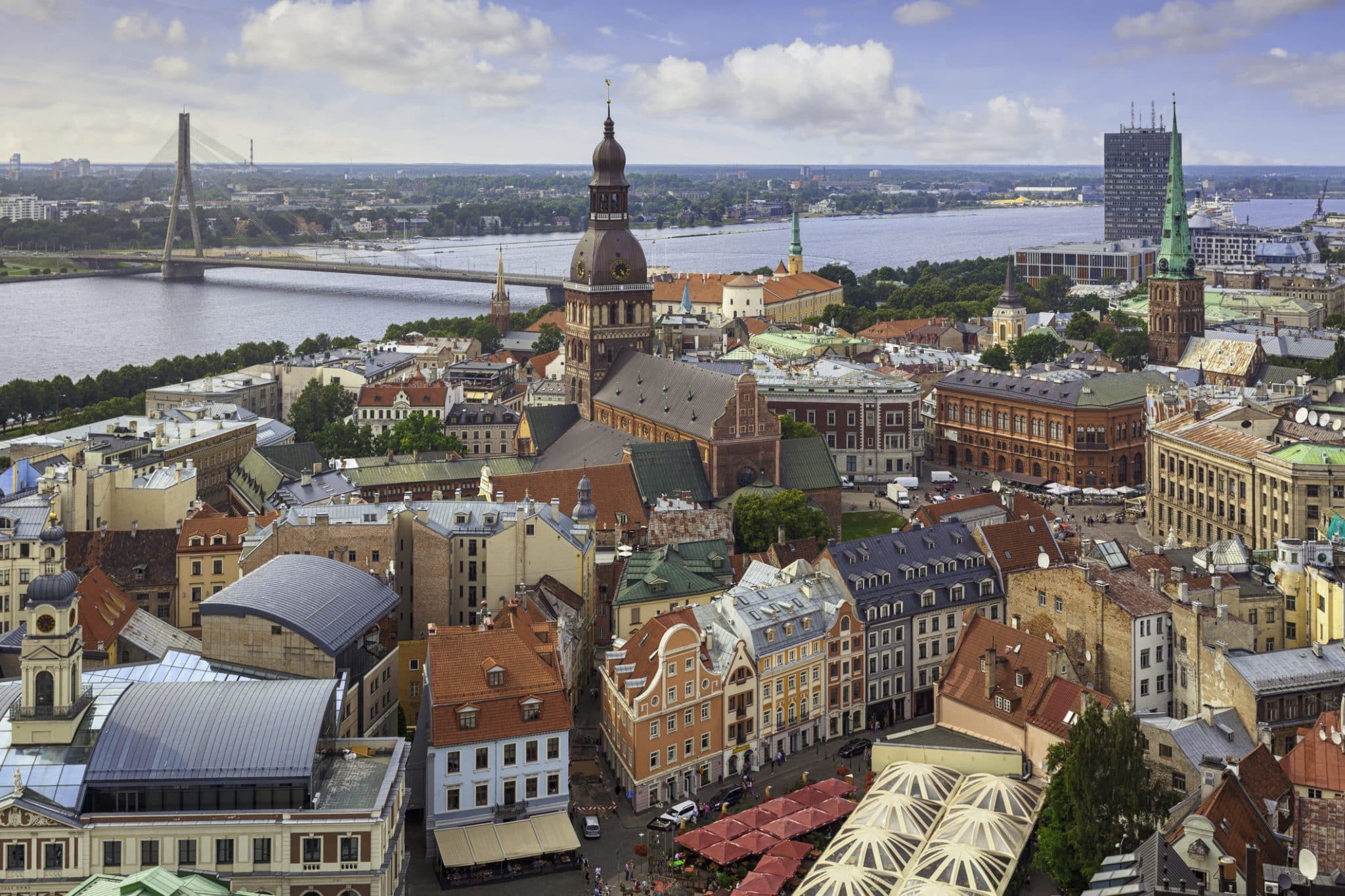
The old town district of Riga, Latvia. The Baltics have long been integrated with Europe via Baltic Sea trade routes.
Following independence, all three Baltic countries moved quickly to anchor themselves politically and economically in Europe, joining NATO and the EU while promoting their national languages, often at the expense of Russian.
Significant ethnic Russian and Russian-speaking populations had settled in the Baltics during the Soviet period, particularly in Estonia and Latvia. Exclusionary citizenship laws and increasing restrictions on Russian-language education and media have fueled debates between advocates of state sovereignty and those emphasizing minority rights.
These trends have accelerated since 2022, with Russia’s invasion of Ukraine, heightening security concerns and sparking fears of a possible new Russian occupation of the geopolitically valuable Baltic states. All three Baltic states have implemented EU sanctions restricting access to dozens of Russia-based television channels and roughly 200 Russian websites.
Starting on September 19, 2022, Estonia, Latvia, Lithuania, and Poland enacted a joint ban preventing Russian citizens holding short-stay tourist visas from entering. The Baltics thus saw minimal influxes of Russian citizens fleeing mobilization.
Latvia
Status: Latvian is Latvia’s sole official language under Article 4 of the Constitution. Under the Official Language Law, Livonian and Latgalian are protected as indigenous languages, while all other languages, including Russian, are legally classified as foreign languages. In a 2012 referendum, 74.8% of voters rejected a proposal to make Russian a second official language.
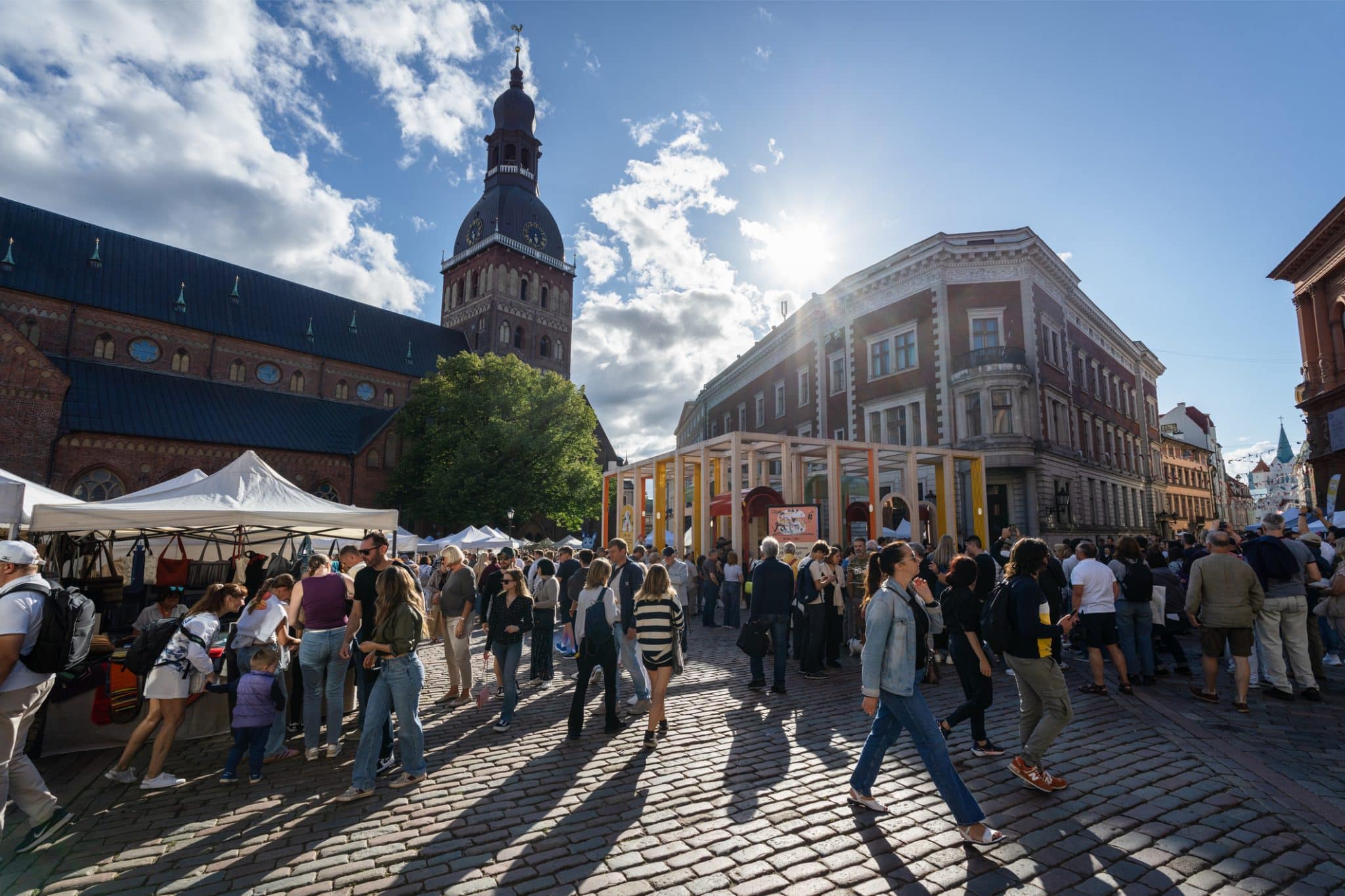
People at the Dome Square Market during a city festival in Riga, Latvia, 2025.
Ethnic Demographics: Ethnic Russians make up around 23% of the population of Latvia as of 2026. Russians are concentrated in Riga (where the population is about 38% ethnic Russian) Daugavpils (50%), near the Russian border, and the resort town and port city of Liepāja (27%).
Language Demographics: Russian is the mother tongue of 37.7% of Latvia’s population aged 18–69, compared with 64.3% for Latvian; 34.6% report using Russian at home. Russian is commonly the mother tongue of Belarussian, Ukrainian, and other minorities in Latvia, especially those educated under the USSR. It is particularly prevalent in the urban areas of Riga and Latgale, where it is the mother tongue of 57.4% and 56.1% of residents, respectively.
A 2023 survey by Latvia’s Central Statistics Bureau shows that Russian remains “spoken or understood” by 91.3% of the population, indicating that most Latvians also have basic knowledge of Russian.
Citizenship: After restoring independence in 1991, Latvia automatically granted citizenship primarily to those who were citizens of the independent Latvian state before the Soviet occupation and their descendants. Most Soviet-era immigrants—including Russians, Ukrainians, and Belarusians—therefore had to naturalize. The process requires at least five years of living on a permanent residence permit, showing Latvian-language proficiency, and passing tests on Latvian, history, culture, and law. Latvia forbids dual citizenship except in specific cases – and almost never grants dual citizenship for Russian citizens.
As of 2026, 8.7% of Latvia’s population held non-citizen status. Non-citizens receive special passports and may live and work in Latvia but cannot vote in national elections or hold certain public positions.
Some former non-citizens obtained Russian citizenship in addition to full Latvian residence permits. In 2022, Latvia passed a new law requiring these Russian citizens to demonstrate A2-level Latvian proficiency when renewing their residence status, with exemptions including people aged 75 and older and certain people with health conditions. Extensions were granted to those applying to retake failed language tests. By October 2025, the residence permits of 841 Russian citizens expired; they were required to leave Latvia or obtain another legal basis for residence.
Education: After independence, Latvia continued the practice of offering education in Russian or Latvian in segregated schools. The 1998 Education Law originally mandated that all public secondary schools (grades 10–12) switch entirely to Latvian instruction by 2004. Following intense protests, the government amended the requirement to 60% of the curriculum being taught in Latvian, leaving up to 40% open for minority languages. 2018 reforms extended this requirement to all state-accredited private schools. A 2022 law required all state-accredited schools to transition to Latvian-only instruction within three years. Despite additional protests, the transition was completed on September 1, 2025. Latvia’s Constitutional Court specifically upheld the reform in 2024, finding that it did not prevent minority students from learning their language and culture at home or through extracurricular programs.
Two foreign languages are required to graduate from Latvian schools. Starting September 2026, students must generally choose an EU/EEA language for these. This will effectively exclude Russian as a second language from the curriculum.
Media: Latvia has effectively banned broadcast media originating in Russia. Russian-language television once held a significant audience, with RBK (a localized version of Russia’s Pervyi Kannel) even topping Latvia’s viewer ratings for a time. Further, Latvia’s public broadcaster, previously required to provide programming in Latvia’s minority languages, switched to exclusively Latvian-language broadcasting after a 2025 ruling by the Constitutional Court found the requirement unconstitutional. The court argued that Latvia’s focus should be on preserving Latvian and that Russian was “self preserving” both without and within Latvia’s borders.
Russian-language television outlets such as Nastoyashcheye Vremya (funded by the US Department of State) and TV3 Plus (a paid cable and satellite entertainment channel), attract relatively small audiences. Russian media is still accessed through VPN, satellite, and other services, despite Latvia imposing fines for this of up to 700 euros. Latvia has also proposed phasing out free state frequency licenses for Russian-language radio stations, a process that would end the last such broadcasts by 2034.
Latvia’s Mass Media Law states that any television broadcast not in Latvian must be accompanied by subtitles or dubbed dialogue. Radio stations, if not registered as foreign-language stations, must also provide Latvian translations for any spoken foreign language on air, excluding live phone-ins or language-learning shows. Major Russian-language newspapers such as MK-Latviya continue to operate.
Lastly, Latvia regulates literature with a scaled taxation system. Books published in Latvian, Latgalian, Livonian, and official languages of EU or OECD countries qualify for a reduced 5% VAT rate. Meanwhile, books published in non-EU minority languages—most notably Russian and Belarusian—are charged the maximum standard 21% VAT rate.
Estonia
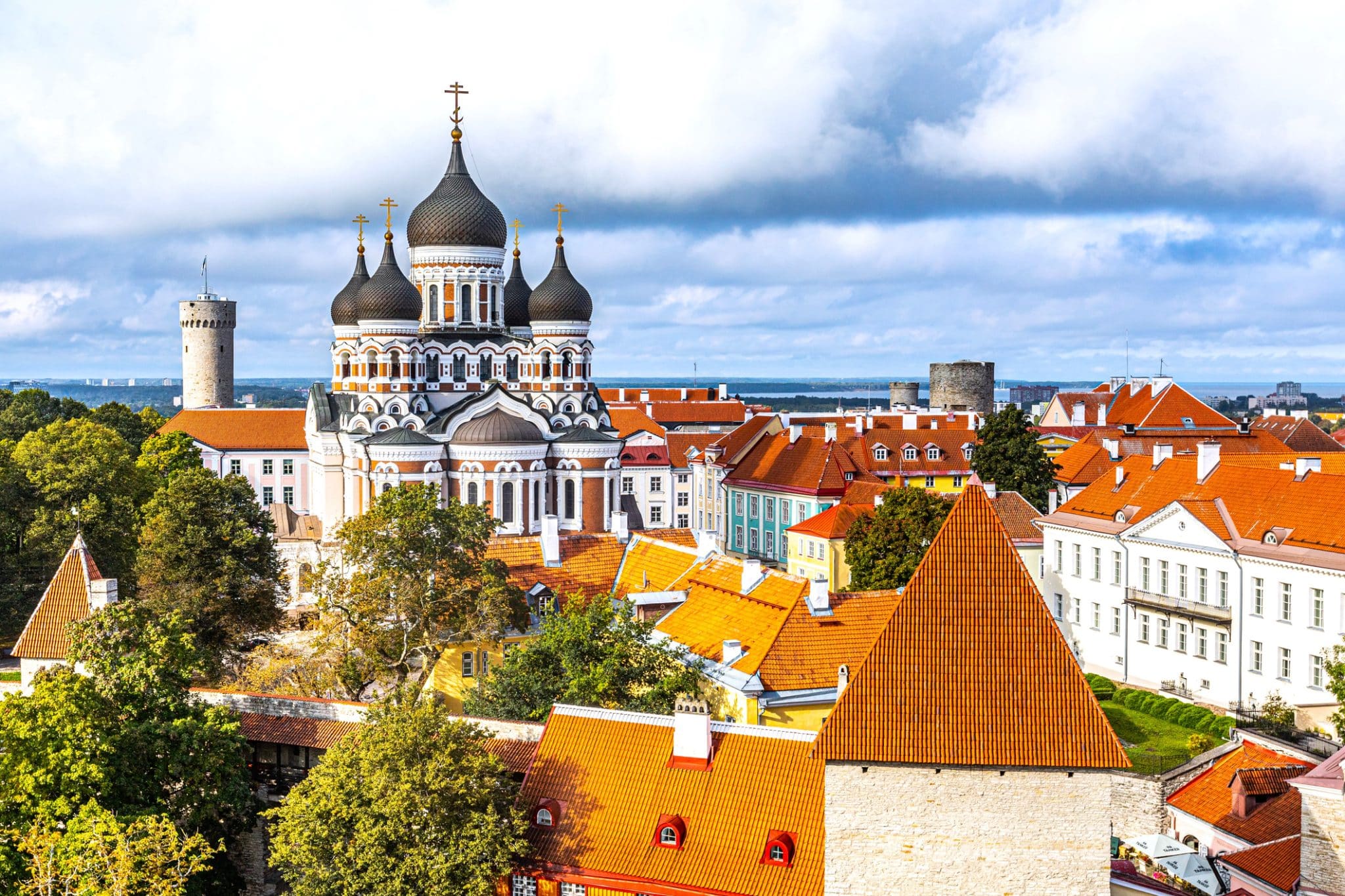
The Russian Orthodox Alexander Nevsky Cathedral in old town Tallinn, Estonia.
Legal Status – Estonian is Estonia’s sole official language under Article 6 of the Constitution. The Language Act defines every language other than Estonian and Estonian Sign Language as a foreign language. While Russian is considered a minority community language, provisions protecting it do not supersede those protecting and supporting Estonian.
In July 1993, the predominantly Russian-speaking cities of Narva and Sillamäe held votes on establishing autonomy within Estonia. Organizers reported 54% turnout in Narva and 60% in Sillamäe, with 97% and 98.6%, respectively, supporting autonomy. Estonian authorities disputed the turnout figures and Estonia’s Supreme Court invalidated the city-council resolutions authorizing both votes, ruling that national-territorial autonomy was outside local-government authority as provided for by the Constitution. The votes therefore had no legal effect.
Ethnic Demographics – Ethnic Russians comprised 20.2% of Estonia’s population in 2026, down from 30% in 1989. They are concentrated in Tallinn, where they comprise roughly 37% of the population, and in the northeastern cities of Narva and Sillamäe, whose populations are 87.7% and 86% ethnically Russian, respectively.
Language Demographics – The 2021 census found Russian to be the mother tongue of 29% of Estonia’s population and a second language for another 38%, meaning roughly 67% could speak it. Russian remains concentrated in Tallinn and northeastern Estonia. English has now surpassed Russian as Estonia’s most widely spoken foreign language, particularly among younger people; Russian proficiency is strongest in those educated under the Soviet period. Among younger native Russian speakers, knowledge of Estonian is also increasingly common.
Citizenship – In February 1992, Estonia re-enacted its pre-war 1938 Citizenship Act, granting citizenship only to those who were citizens of the Republic of Estonia prior to the June 1940 Soviet occupation, and to their direct descendants. Most Soviet-era immigrants, predominantly Russian-speaking, were required to naturalize. To do so, applicants had to first live in Estonia for at least eight years on the basis of a residence permit or right of residence, including five years on a permanent basis, demonstrate B1-level Estonian proficiency, pass exams on Estonian law, and relinquish any other citizenships not acquired at birth.
As of 2026, 4.3% of Estonia’s population, the vast majority Russian-speaking, is still stateless.
65% of these stateless individuals desire Estonian citizenship, but feel they cannot meet the requirements. Estonia issues these stateless individuals special “grey passports” for international travel.
About 16% of Russians in Estonia (5.5% of Estonia’s population) hold Russian citizenship, with a majority of those additionally holding Estonian residence permits.
In 2016, the Estonian Citizenship Act was amended to automatically grant citizenship to certain stateless children born in Estonia whose parents have legally resided there for at least five years, subject to limited parental opt-out provisions. A government bill introduced in June 2026 would nullify this right if using it would leave a child stateless. If passed, the law will come into effect on January 1, 2027.
In March 2025, Parliament amended the Constitution to remove local-election voting rights from third-country nationals and, beginning with the local elections after 2025, from stateless residents. The change reduces the local-election electorate by approximately 72,000 people, most of them Russian-speaking.
Education (availability in Russian) – After independence, Estonia initially maintained the two-track Soviet public school system, which offered instruction in either Estonian or Russian in segregated schools.
The 1993 Education Act guaranteed access to education in Estonian while permitting instruction in other languages such as Russian. In 1997, the Ministry of Education announced that all schools would eventually transition to Estonian. Since 2007, upper-secondary schools have been required to provide at least 60% of instruction in Estonian, while Russian remained more available in basic education and in approved bilingual programs. Estonian has also been compulsory in schools and kindergartens where the language of instruction is not Estonian.
Since 2024, schools are transitioning fully to Estonian, starting with the first and fourth grades and advancing sequentially from there. The transition should be completed by 2033.
Russian as a foreign language is still available in some schools and native Russian speaking students can receive two weekly Russian lessons if at least ten students request it at a school and a teacher is available.
Media (availability in Russian) – Major Russia-based TV channels were popularly distributed by commercial providers before 2022. Since then, Estonia has banned more than 50 channels and blocked nearly 200 websites. However, these can still be accessed via satellite or VPN and streaming services. Some local channels, such as TV3+, went out of business after sanctions led to difficulties in sourcing Russian-language entertainment from Russia.
The decline of Russian-produced programming has increased demand for locally produced Russian-language media. In 2023, the government allocated €1 million in grants to four private media organizations to produce locally-created, Russian-language journalism. Many continue to access Russia-based channels via VPNs, satellite dishes, and other means, however.
Estonia also maintains substantial public Russian-language broadcasting through Estonian Public Broadcasting (ERR), including Raadio 4, launched in the early 1990s, and ETV+, launched in 2015 as ERR’s Russian-language television channel. Commercial Russian-language television also remains available, including Kanal 7, which also produces news content. Estonia also has a number of other Russian-language radio and television broadcasters focused on entertainment.
Estonia’s Public Broadcasting Act states that any television programming not in Estonian must be accompanied by Estonian subtitles or dubbed dialogue with certain exceptions, such as for language-learning programs. Radio stations are limited to 10% foreign language content unless they are registered specifically as foreign language stations.
Russki Delfi is the most popular Russian-language news portal published in Estonia, offering comprehensive, real-time coverage of local, regional, and international news. The Postimees, Estonia’s leading daily newspaper, also maintains a Russian-language site. Tallinn’s municipal Russian-language newspaper Stolitsa ceased publication in May 2024 when the city discontinued its municipal media operation.
Lithuania
Legal Status – Lithuanian is the sole state language of the Republic of Lithuania under Article 14 of the Constitution. Russian is legally defined as a foreign language. The State Language Law requires that customer-facing workers and service providers must be able to communicate with clients in Lithuanian.
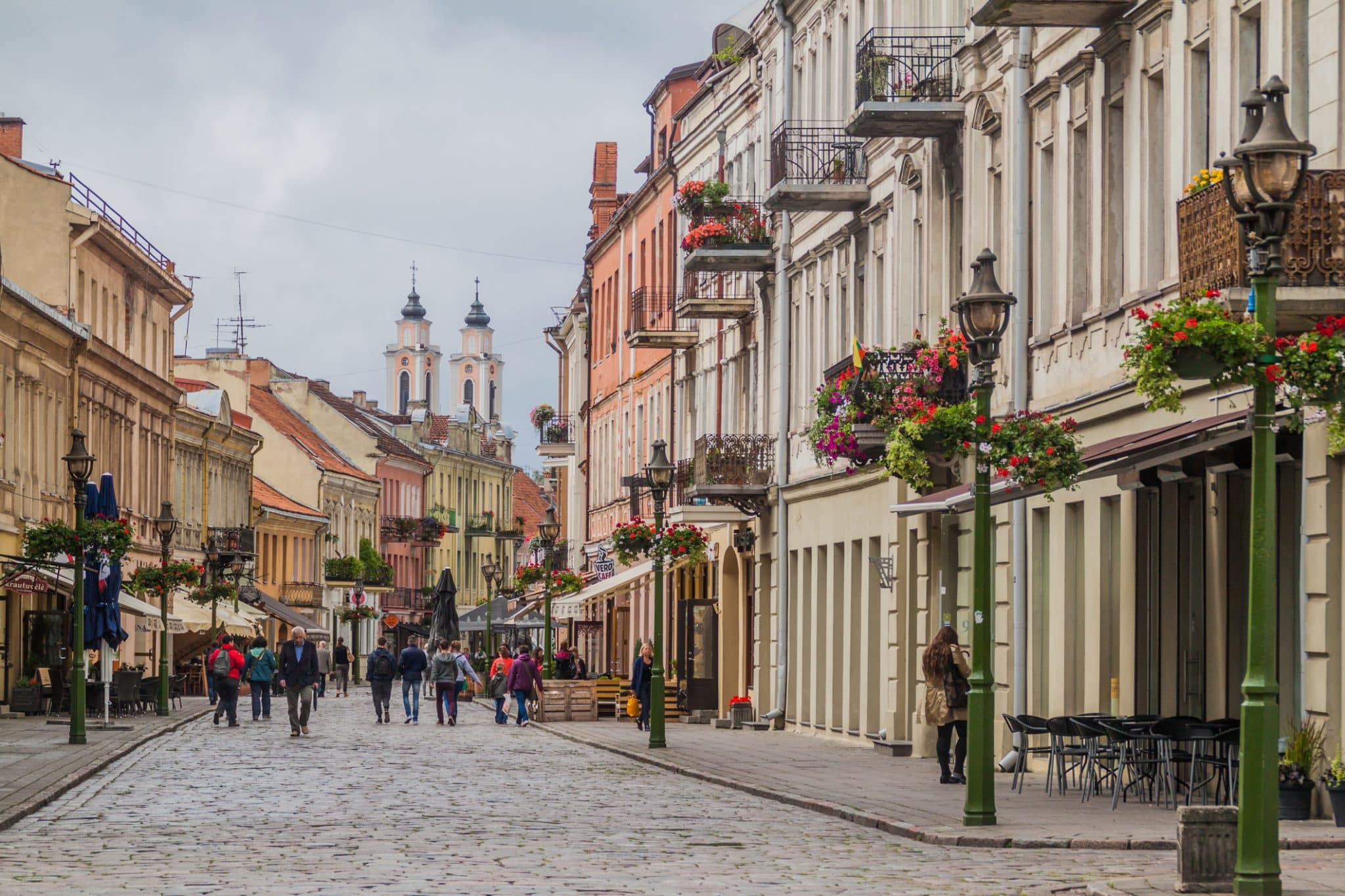
A street scene in central Kaunas, Lithuania.
Ethnic Demographics – According to the official 2021 Lithuanian census, ethnic Russians made up 5.0% of Lithuania’s total population. Most are concentrated in urban areas such as the capital Vilnius (where Russians make up about 10% of the population), the port city and resort town of Klaipėda (~16%), and Visaginas (~47.4%), a town of about 20,000 which still hosts a Soviet-built nuclear power plant. Russians are the third largest minority, after Poles (who make up 6.5% of the population).
Language Demographics – On the same census, 6.7% of the population, including many Belarusian, Polish, and Ukrainian minorities, named Russian as their mother tongue. Further, 60.6% of Lithuania’s population reported having working knowledge of Russian in 2021. Russian proficiency is particularly widespread among older residents, while English is increasingly dominant among younger Lithuanians.
Citizenship – Lithuania’s economy remained comparatively agricultural and rural, with families maintaining high fertility rates. This reduced the demand for imported Soviet labor, leaving Lithuanians as a strong majority at independence. In the 1989 census, approximately 80% of the population was ethnically Lithuanian and 9% ethnic Russian. This demographic balance allowed Lithuania to adopt the Baltic’s most inclusive citizenship policies.
After restoring independence, Lithuania’s 1991 citizenship law granted citizenship to people who had been Lithuanian citizens before June 15, 1940, and to their children and, under specified conditions, grandchildren. Residents who did not meet the birth criteria but who had lived in the Lithuanian SSR for more than 10 years could receive citizenship simply by signing a loyalty oath to the Republic of Lithuania.
For other residents, naturalization was available after ten years of legal permanent residence, provided applicants had the right to permanent residence, passed examinations in the Lithuanian language and the fundamentals of the Constitution, demonstrated a legal means of financial support, and generally renounced other citizenship.
Lithuania offered the simplest path to citizenship of any Baltic state. Stateless individuals make up just .1% of the population today.
Education (availability in Russian) – Lithuania supports 25 schools instructing entirely in Russian, alongside 18 mixed schools that provide parallel curriculum paths in languages including Russian. These schools collectively serve roughly 14,000 students, primarily concentrated within the major minority hubs of Vilnius, Klaipėda, and Visaginas. Messaging has been mixed with the Lithuanian Minister of Education saying that closing these schools is “not on the table” but also saying that the schools could incorporate more Lithuanian and/or focus on EU languages.
The government has also moved to reduce the role of Russian as a foreign language. Russian remains an officially permitted second foreign language, alongside English, French, German, Spanish, Polish, and Ukrainian, but its popularity has fallen sharply. The share of sixth-grade students choosing Russian as their second foreign language declined from 81.7% in 2014–15 to 43.5% in 2024–25. The government has expanded opportunities to study Spanish and other European languages, while the state-level Russian-language school-leaving examination was discontinued in 2025. Proposals to remove Russian entirely from the list of second foreign languages have been discussed but had not been implemented as of 2026.
As of autumn 2026, Vilnius is mandating that children of non-EU foreign nationals arriving in the city enroll in primary schools offering instruction in Lithuanian rather than minority languages. This does not apply to long-term residents and those children already enrolled in local schools.
Media (availability in Russian) – Lithuanian law now generally prohibits the retransmission or online distribution of radio and television programs produced by entities established, owned, controlled, or financed by Russia or Belarus, subject to limited exceptions. They are still accessed via satellite or through VPNs by some, however.
Locally produced Russian-language television news is available from the commercial TV3 Plus and Lithuania’s state-funded public broadcaster, Lithuanian National Radio and Television (LRT) and Current Time, financed by the US State Department. OTV, launched in 2022 by the Estonia-registered PN International OÜ, provides additional Russian-language entertainment programming.
Russian-language radio remains available through commercial stations, including Radio R, which broadcasts in Vilnius and online with Russian-language music, news, and talk programming. It has changed its name twice – from Ruskoje Radio Baltija to Radiorus to Radio R. The major Russian-language newspaper in Vilnius is Litovsky Kurier, which remains a longstanding Russian-language publication providing local, cultural, and political coverage.
Eastern Europe
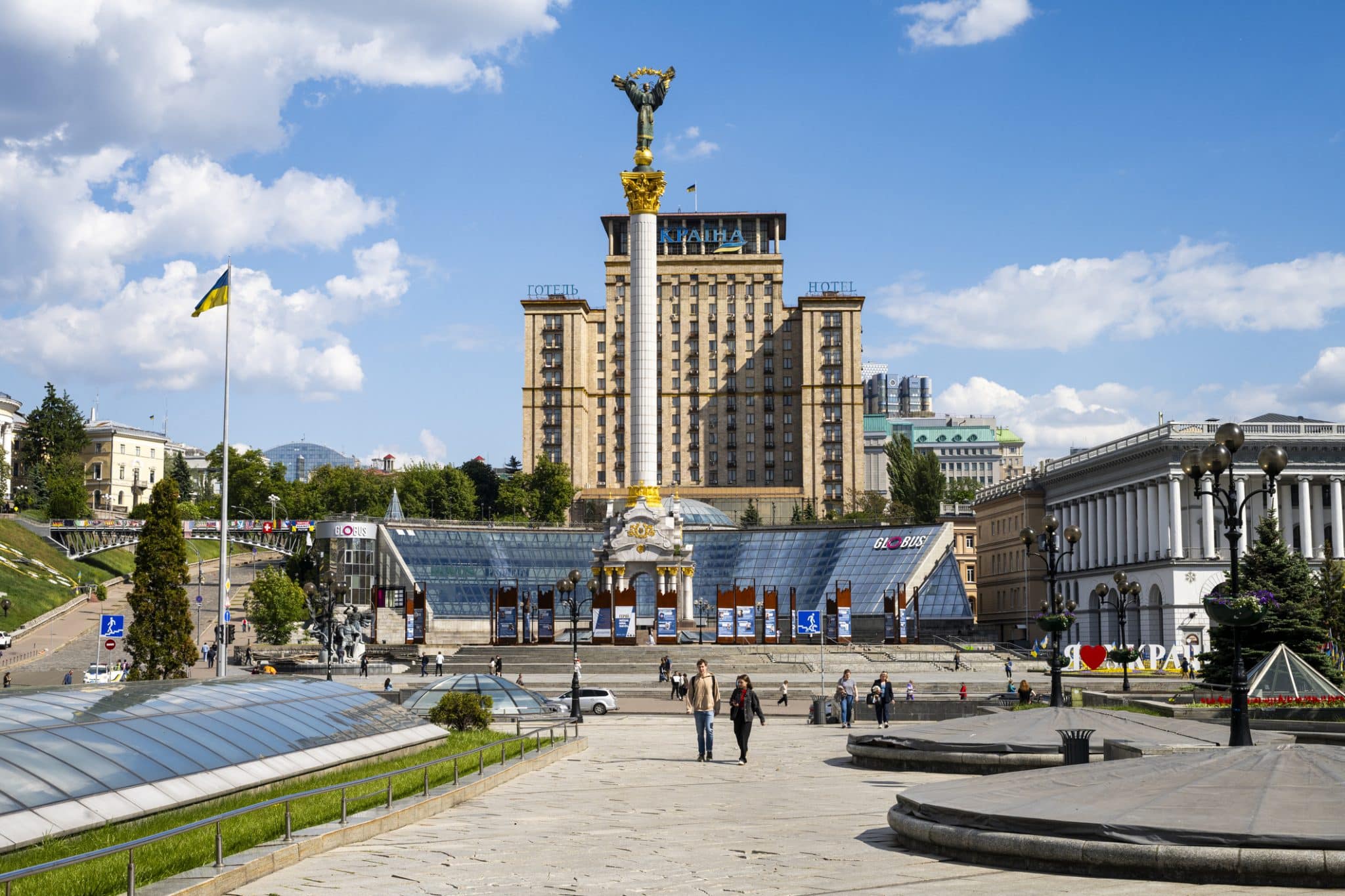
Maidan Nezalezhnosti (Independence Square) in Kyiv was the site of Eastern Europe’s most dramatic and consequential pro-European protests.
Belarus, Moldova, and Ukraine, the USSR’s republics in Eastern Europe, present some of the most widely varied outcomes for the Russian language since the Soviet collapse.
Under the Russian Empire and, later, the USSR, extensive numbers of Russians arrived as administrators, soldiers, and settlers. Colonization was especially extensive under Soviet efforts to develop mining and industry, particularly in Ukraine’s Donbas region, as well as through agricultural settlement and collectivization in the black earth regions of Moldova and Ukraine.
At independence, all three countries had a significant Russian minority (ranging from 13% to 22%) and extensive media infrastructure in Russian. They have also each had very different histories since independence.
Belarus has retained Russian as a co-official language, making it unusually resilient despite the country’s formal support for Belarusian. Meanwhile, Ukraine initially adopted an inclusive approach toward Russian, but has increasingly seen language as an important part of national identity and national security. Especially since open conflict with Russia broke out in 2014, Russian language use has rapidly declined and Ukraine has adopted increasingly restrictive language policies. Moldova has maintained Romanian as its official language while preserving significant roles for Russian in society, education, and media.
Although all three countries had visa-free travel with Russia during the exodus of Russians after mobilization, none of the three saw significant inflows of Russians at the time. Belarus has been a close military ally of Russia through the war while Ukraine’s land border was an active military front at the time, making both unattractive destinations. Moldova, sharing no land border with Russia and with all direct flights suspended over safety concerns, was also a logistically more complicated choice than the Caucasus or Central Asia. The vast majority of the relatively small influx of 3802 Russians arriving to Moldova after mobilization were dual Russian-Moldovan citizens.
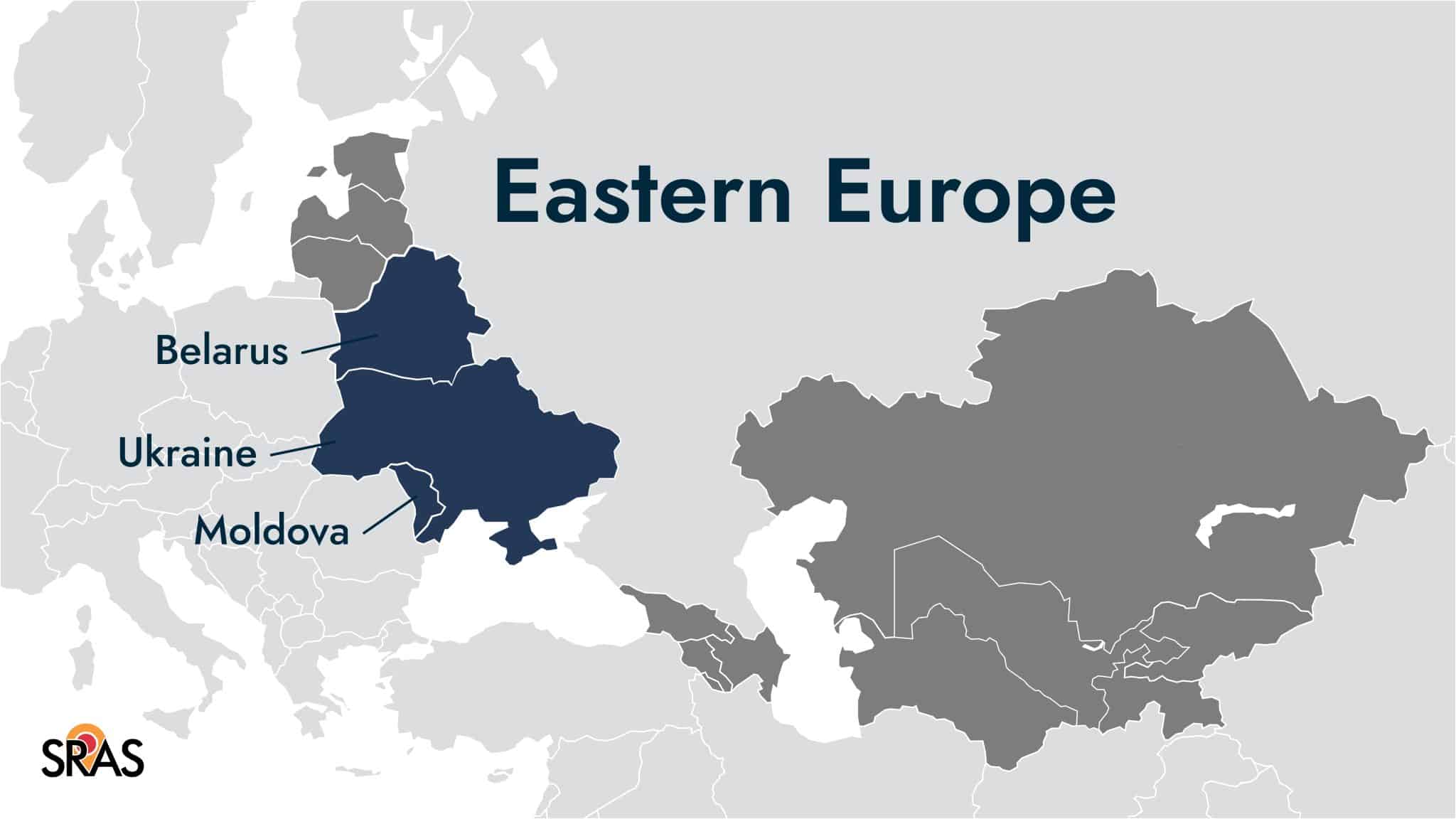
Belarus
Legal Status – Under Article 17 of the Belarusian Constitution, Belarusian and Russian are both official state languages with equal status. A 1990 language law initially designated Belarusian as the sole official language. In a 1995 constitutional referendum, however, 83.3% of voters approved granting Russian equal official status.
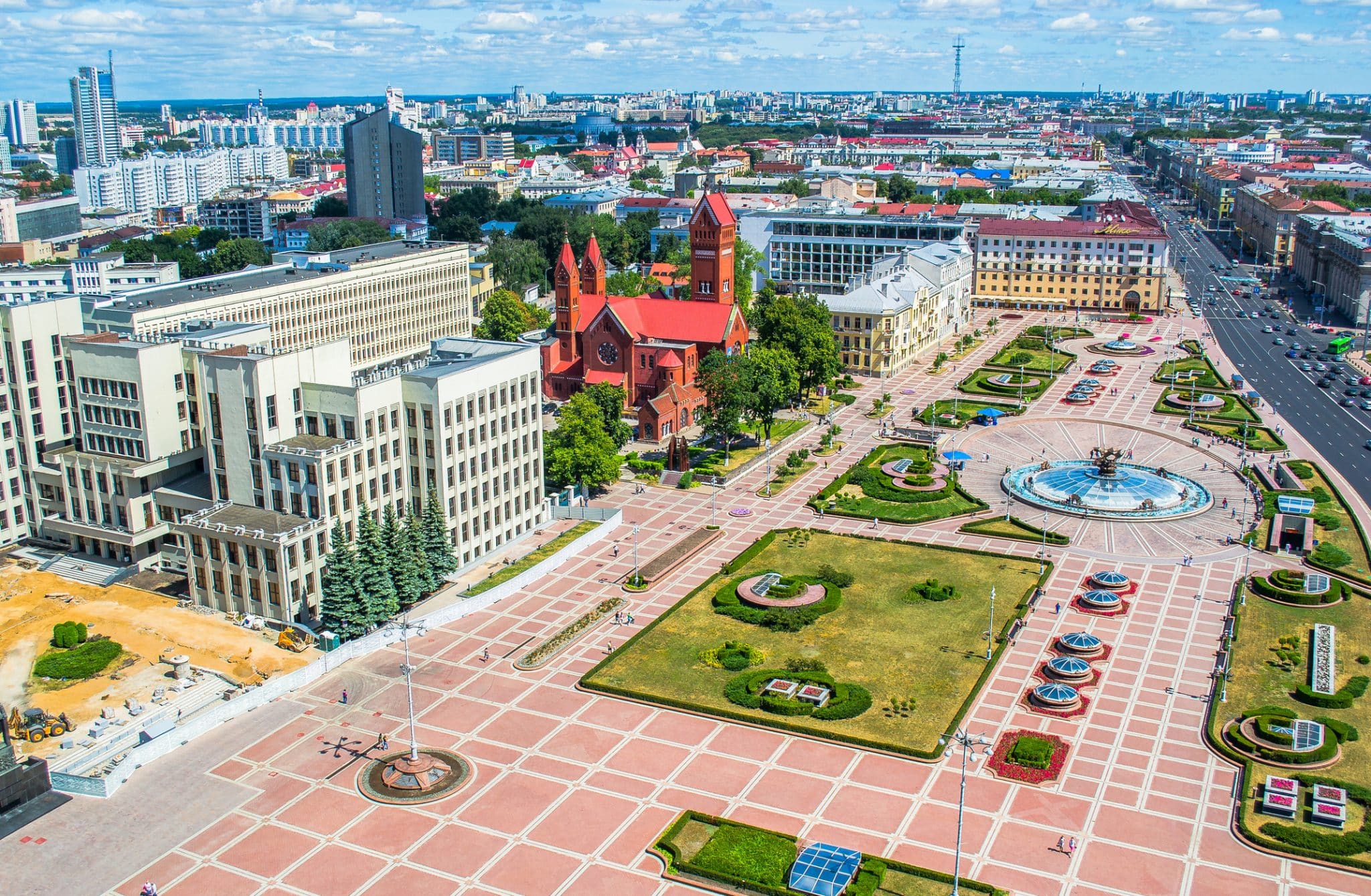
In Minsk, the Soviet-era Lenin Statue and constructivist White Government Parliament Building stand in front of the Catholic Church of Saints Simon and Helena, built in the late Tsarist period.
Ethnic Demographics – According to the 2019 census, ethnic Russians account for 7.5% of Belarus’s population, down from just over 13% at independence. Belarus has one of the most even distributions of ethnic Russians among the former Soviet states. Russians are represented in every district, with 104 of 118 reporting concentrations of 2.5% to 10.5%. Greater concentrations reside in concentrations near the northeastern border with Russia. In Minsk, ethnic Russians account for about 7.4% of the population.
Language Demographics – The 2019 census found that 72% of the population claimed to speak Russian on a high level while 42% were native speakers of the language. Many, if not most, Belarusians are thus bilingual, with some activists arguing that the pervasiveness of Russian is endangering the Belarussian language.
Citizenship – Belarus’s Citizenship Act, passed shortly after the country declared independence in 1991, granted citizenship to former Soviet citizens who were permanently residing in Belarus when the law was adopted.
Education – In 2025, the Belarusian government reported that more than 90% of students in public schools in Belarus are taught in Russian. Most higher education institutions conduct classes and academic programs primarily in Russian.
Media – Most television broadcasting in Belarus, including news programming, is primarily in Russian. Some channels, including Belarus 3 and the international broadcaster Belarus 24, feature more Belarusian-language content but also use Russian. Most major national newspapers are likewise published in Russian. As a result, Russian remains the dominant language of daily news consumption for most Belarusians.
Moldova
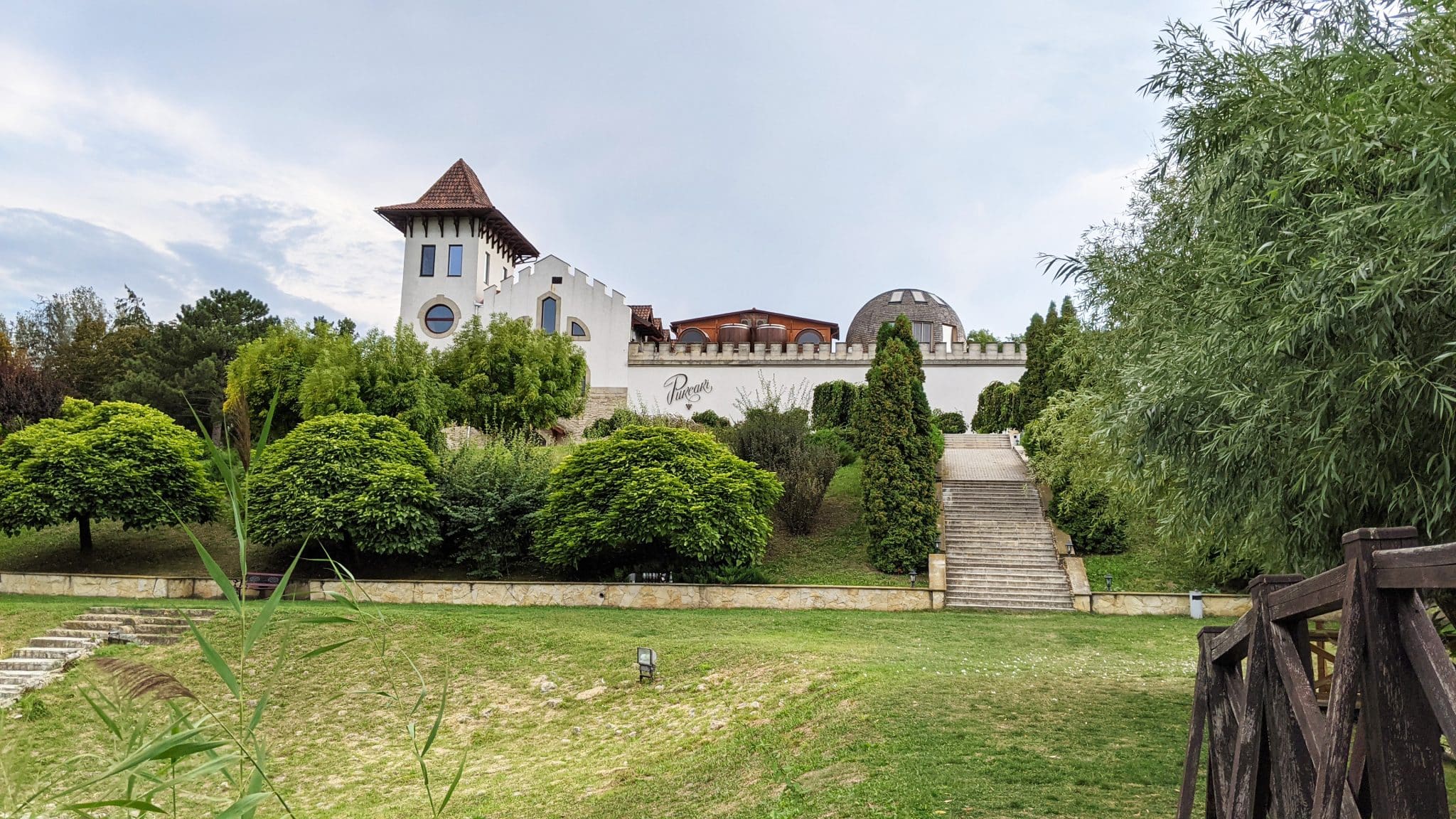
Château Purcari, a historic winery in shows architecture typical of Moldova. Wine is considered a major part of the culture’s heritage.
Legal Status – Romanian is Moldova’s sole official language, as established by its Declaration of Independence from the Soviet Union. In 2013, the Constitutional Court ruled that the Declaration of Independence took precedence over the Constitution in determining the language’s official name. The Declaration uses “Romanian,” while the Constitution then referred to “Moldovan.” The latter was used by the Soviet government, while Moldova’s pro-independence movement increasingly favored “Romanian.”
Russian has no official status at the national level. Moldova switched from the Cyrillic to the Latin alphabet for Romanian in 1989, while still part of the Soviet Union.
In Transnistria, Romanian (written in the Latin alphabet), Russian, and Ukrainian are all official languages. Transnistria is internationally recognized as part of Moldova but has operated as a de facto breakaway territory since 1992. Moldova does not include statistics from the region in any of its state data. The region is therefore considered separately in each section below.
Ethnic Demographics – According to Moldova’s 2024 census, ethnic Russians account for 3.38% of the population, down from about 13% recorded by the 1989 census. They are concentrated primarily in urban areas, accounting for 5.9% of the population of the capital, Chișinău, and 10.1% of the population of Bălți, a major city in northern Moldova.
According to the 2015 Transnistrian census, the region’s population is roughly split between Russians (29.1%) Moldovans/Romanians (28.6%) and Ukrainians (22.9%). Russians are concentrated in urban areas, making up around 41% of the population of the capital, Tiraspol.
Language Demographics – According to Moldova’s 2024 census, 15.9% of the population reported Russian as their “usually spoken language,” while 11.6% identified it as their mother tongue. A further 51.2% reported knowing Russian without identifying it as either their usual spoken language or mother tongue. Taken together, these figures indicate that at least 67.1% of the population has some knowledge of Russian.
In Transnistria, no official statistics exist but estimates of the percentage of the population that speaks Russian range from over 50 to nearly 100 percent.
Citizenship – Moldova’s Citizenship Act, passed shortly after independence in 1991, granted citizenship to people permanently residing in Moldova when the law took effect, provided they had a permanent job or other source of income in the country. Eligibility also extended to people currently living outside the country who had been born in Moldova, were deported from Moldova during the Soviet period, or who could claim at least one parent or grandparent born in Moldova.
Moldova initially prohibited dual citizenship, citing concerns about threats to national autonomy despite its broad citizenship provisions. The country lifted the restriction in 2000.
Education (availability in Russian) – Public Russian-language education is available at all levels, from kindergarten through postgraduate studies.
According to 2025 statements by Moldova’s Minister of Education, about 21% of schools provide instruction primarily in Russian. Further, Moldova’s National Statistics Office reported that, for the 2024–2025 school year, 19.0% of primary and general secondary students studied in Russian. In Moldova’s Gagauzia Autonomous Region, 91.8% of students study in Russian.
Russian is also the third most studied foreign language in Moldova, with nearly 25% of public school students choosing to study Russian. English and French ranked first and second.
According to statements made in 2025 by Moldova’s Bureau for Reintegration Policies, which tracks data points in Transnistria, 82.5% of public schools teach in Russian. Another 10% offer teaching in Romanian using Cyrillic script and another 6.3%, with financial support from Moldova’s Ministry of Education, teach in Romanian using Latin script. Ukrainian is the language of instruction for the remaining 1.2%. Transnistria’s school system receives heavy funding and support from Russia, which uses education as a key tool of geopolitical soft power in the breakaway region.
Media (availability in Russian) – Moldova declared a nationwide state of emergency on February 24, 2022, two days after the start of the war in Ukraine. This activated the 2004 Law on the Regime of the State of Emergency, Siege, and War, granting the government the ability to make “special rules for the use of telecommunications, the fight against misinformation, fake news and hate speech.”
In June 2022, Moldova enacted the Informational Security Law, banning news and information programs from countries that have not ratified the European Convention on Transfrontier Television (including Russia). Moldova has blocked some 70 websites and revoked the licences of dozens of rebroadcasters in Moldova. Some Russia-based entertainment-only channels remain operational in Moldova.
Some print publications, such as Komsomolskaya Pravda v Moldove and Vedemosti, the Moldovan editions of the Russian newspapers with same names, are still produced and distributed in Moldova. Rebroadcasts of Russia-based radio stations such as Love FM and Retro FM (neither carry news or analysis) are also available.
Russian-language television news and programming are produced by several domestic broadcasters. TV8, an independent television network based in Chișinău, operates in both Romanian and Russian. Regional broadcasters, including Teleradio-Gagauzia (GRT) in the autonomous region of Gagauzia, and Moldova’s national public broadcaster, Teleradio-Moldova, also provide news and other programming in Russian and minority languages. Moldova’s national news agency publishes in Romanian, Russian, and English. Ziarul de Gardă, a prominent Moldovan investigative newspaper, also publishes content in both Romanian and Russian.
In Transnistria, Russian is the primary language for daily news, talk shows, and entertainment programs.
Ukraine
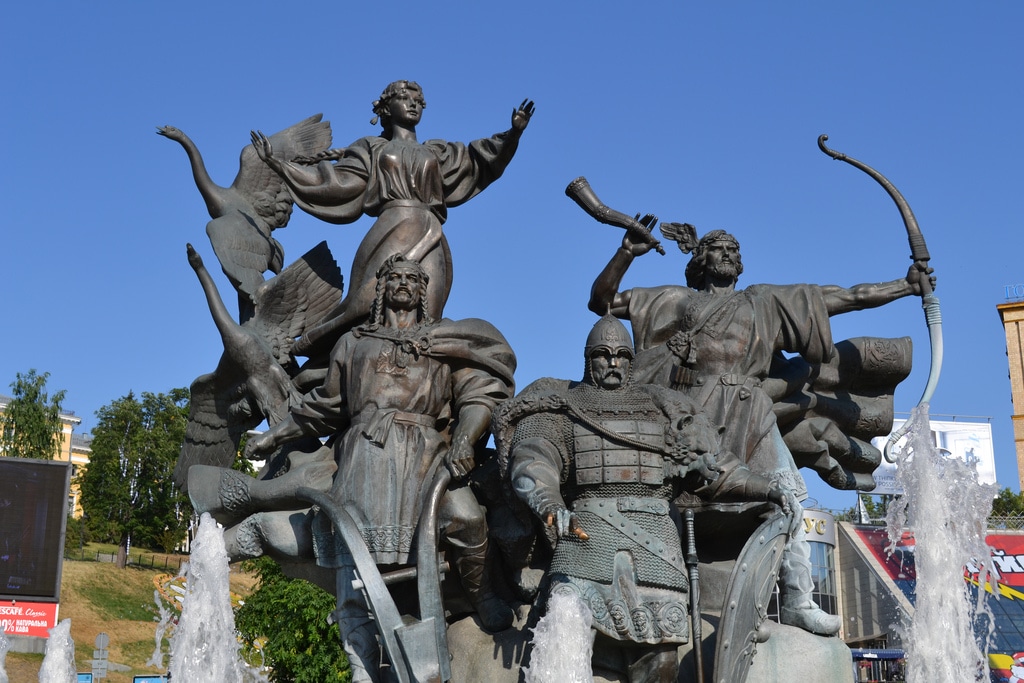
A monument in Kyiv to the city’s legendary sibling founders. The Ukrainian language and culture has become more dominant in Ukraine since the start of its conflict with Russia.
Legal Status – Article 10 of Ukraine’s Constitution establishes Ukrainian as the country’s sole official state language while guaranteeing the “free development, use, and protection of Russian and other languages of national minorities of Ukraine.” Adopted in 1996, the article remains unchanged.
In 2012, the Kivalov-Kolesnichenko language law allowed minority languages to gain regional status in areas where at least 10% of the population spoke them. Ukraine’s Constitutional Court declared the law unconstitutional in 2018, eliminating this framework for regional language status.
In 2019, Ukraine’s parliament passed a comprehensive language law making Ukrainian mandatory across all public sectors, government, and official documents.
Ethnic Demographics – The 1989 Soviet census recorded Ukraine’s population as 22.1% ethnic Russian and 72.7% ethnic Ukrainian. In the country’s only post-independence census, conducted in 2001, the respective figures were 17.3% and 77.8%. Ukraine’s largest minority at the time, ethnic Russians were concentrated in urban areas and in Crimea, Donetsk, Luhansk, Kharkiv, and Odesa. In Crimea, they accounted for 58.3% of the population in 2001.
A planned 2020 census was postponed, due in part to Covid-19, and Ukraine’s legislation currently prevents it from conducting a census under wartime martial law. Consequently, surveys by the respected Razumkov Centre and Rating Group provide the best available evidence of more recent changes in ethnic self-identification.
Rating Group surveys found that roughly 15% of respondents identified as Russian between 2008 and 2014. This share declined as conflict with Russia intensified, falling to about 11% after the 2014 conflict and 5% in April 2022. In a June 2024 survey, the Razumkov Centre recorded 94.7% of respondents identifying as Ukrainian, 1.9% as Russian, and 1.9% as another ethnicity; 1.5% did not or could not answer.
Both surveys have excluded parts of Ukraine behind Russian frontlines since 2014. Based on what we know of demographic concentrations of ethnic Russians in these areas before the conflict, the change in area surveyed can account for some of the difference, but the precipitous fall in self-indentification, if accurate, would indicate wide-spread changes in areas under Ukrainian government control as well.
Language Demographics – The 1989 Soviet census recorded Russian as the native language of 32.8% of Ukraine’s population. By 2001, 67.5% identified Ukrainian as their native language and 29.6% Russian. Russian was more prevalent in urban than rural areas: 39.5% of urban residents identified it as their native language, compared with 9.5% of rural residents. Russian predominated in Crimea, Sevastopol, Donetsk, and Luhansk, while Ukrainian and Russian were spoken in more similar proportions in Kharkiv, Odesa, and Zaporizhzhia.
Russian speakers have historically included members of other minorities as well as ethnic Ukrainians who adopted Russian as their primary language under Russian and Soviet rule.
Surveys by Rating Group show the share of respondents identifying Ukrainian as their mother tongue rose from 57% in 2012 to 76% in March 2022. Over the same period, the share identifying Russian as their mother tongue fell from 42% to 20%. The proportion reporting equal use of Ukrainian and Russian at home also increased, from 15% to 32%, while the share reporting Russian as their primary household language declined.
Surveys by Rating Group found that the share naming Ukrainian as their mother tongue rose from 57% in 2012 (before the first territorial conflict) to 76% in March 2022 (just after the start of the current war). Russian, meanwhile, fell from 42% to 20%.
A June 2024 Razumkov Centre survey found that 70.5% of respondents spoke only or mostly Ukrainian at home, 18% used Ukrainian and Russian equally, and 11% spoke only or mostly Russian. Outside the home, 72% used only or mostly Ukrainian, 20% used both languages equally, and 8% used only or mainly Russian.
Cultural identification has also shifted toward Ukrainian traditions. Razumkov Centre surveys found that the share of ethnic Russian respondents who said they followed Ukrainian traditions rose from 21% in 2006 to 49% in 2021 and 53% in 2023. Over the same period, the share identifying primarily with Russian traditions fell from 35% to 18%, then to less than 1% in 2023.
On Ukrainians who have fled abroad, a March 2022 Razumkov survey found that 63.4% of Ukrainian refugees surveyed had primarily spoken Russian at home before leaving the country, although only 21.8% identified Russian as their mother tongue.
Overall, Ukrainian has become increasingly important to national identity, particularly over the past 15 years, as language policy and perceptions of Russia have changed. However, Ukraine remains substantially bilingual: Russian is still widely understood and used by a significant minority, particularly in parts of the south and east and among older urban residents.
Citizenship – Ukraine’s 1991 Law on Citizenship, adopted shortly after independence, granted citizenship to former Soviet citizens permanently residing in Ukraine when the law took effect, provided they were not already citizens of another state. The law explicitly prohibited discrimination on the grounds of ethnicity or language.
Since 2014, Ukraine has considered those who held Ukrainian citizenship in areas taken by Russia to remain Ukrainian citizens. Although Russia has issued citizenship to most of these individuals, and Ukraine prohibits dual citizenship with Russia, Ukraine also does not consider the Russian citizenship granted valid or even voluntary in most cases.
In July 2022, Ukraine suspended its visa-free travel agreement with Russia, formally terminating the agreement in January 2023. Wartime measures extending the validity of expired residence permits have generally excluded Russian citizens, leaving some unable to rely on these extensions to remain legally in Ukraine.
Since August 2024, Ukraine has suspended the processing of citizenship applications from Russian citizens until 12 months after martial law ends, subject to exceptions for individuals with outstanding service or whose admission is considered to be in Ukraine’s national interest.
Legislation adopted in 2025 expanded the instances in which Ukrainians may hold dual citizenship, specifically with EU and other allied states. It also expanded mechanisms for ethnic Ukrainians abroad to retain or acquire Ukrainian citizenship. This was largely an effort to draw support from the large Ukrainian diaspora abroad for the war effort. Dual citizenship with Russia remains prohibited in most cases.
Education – At independence, about 16% of Ukraine’s public schools used Russian as their language of instruction. This fell to about 10% in 2001 and 5.5% in 2011. The Ministry of Education also reported that 1.24 million pupils studied Russian as a subject. Smaller and declining numbers of schools offered instruction in other minority languages, including Romanian, Hungarian, Crimean Tatar, and Polish.
The 2017 Law on Education accelerated the shift toward Ukrainian as the language of instruction. It retained minority-language education at the preschool and primary levels while requiring progressively greater use of Ukrainian in secondary education.
By 2021, the Ministry of Education announced that only 0.3% of schools nationwide, serving about 2% of students, still provided instruction in Russian.
The Ministry excluded Russian from the list of approved foreign language and minority language classes in 2024, ending state support for Russian-language instruction as a subject. In the 2024–2025 school year, just 345 pupils either studied in Russian or studied Russian as a foreign language, nearly all in the Kharkiv region. In May 2025, the State Language Commissioner reported that Ukrainian was the language of instruction in 99% of general secondary education.
In June 2026, parliament removed Russian from the list of languages covered by Ukraine’s obligations under the European Charter for Regional or Minority Languages, further reducing its formal protection. Russian is not specifically prohibited, but it has largely disappeared from state-supported public education.
Private schools that do not receive public funding may provide secondary education in other languages, but they must still ensure that students acquire Ukrainian to the level required by state standards.
Media – Under the USSR, Ukraine had a large state-controlled media sector operating in both Russian and Ukrainian. After independence and the privatization of media, the languages continued to coexist, with Russian remaining dominant in many outlets for years.
In 2014, following Russia’s annexation of Crimea, the Kyiv District Administrative Court and the National Council for TV and Radio Broadcasting ordered cable operators to suspend transmissions of certain Russian state channels.
In 2016, amendments to the Law on Television and Radio Broadcasting mandated that radio stations ensure at least 35% of their daily songs and 60% of their daily informational/host programs were in the Ukrainian language. In 2017, national TV broadcasters were required to air at least 75% of their programming in Ukrainian between the hours of 7 a.m. and 10 p.m., with regional channels required to reach 60% during the same period.
In January 2024, television quotas rose to 90% for national and regional broadcasters and 80% for local broadcasters. News programming must be at least 90% Ukrainian. Radio stations must conduct at least 90% of their informational and hosted programming in Ukrainian and meet a 40% quota for Ukrainian-language songs.
By June 2026, Ukraine’s National Council on Television and Radio Broadcasting had reported blocking more than 5,200 websites, citing links to the Russian state or a determination that the sites spread propaganda and disinformation. Nearly all Russia-based television and radio is banned from rebroadcast in Ukraine.
Publishers must issue at least 50% of their annual book titles in Ukrainian and 50% of titles available in bookstores and warehouses must be in Ukrainian. Print publications in a language other than Ukrainian or an exempted language, must publish an equal number of copies in Ukrainian. Online publications must likewise offer all information in Ukrainian if publishing in a non-exempted language. Exempted from these rules are EU languages, English, and indigenous languages of Ukraine. These exemptions mean that the only language significantly impacted by the legislation is Russian.
Major Russian-language print newspapers and magazines are virtually non-existent in Ukraine today. Some publications have shifted to Ukrainian while others have shifted to purely digital publication. Examples of surviving online publications that feature Russian-language material include Korotko Pro, formerly Ukraine’s version of Komsomolskaya Pravda, a soviet-era publication, and NV.
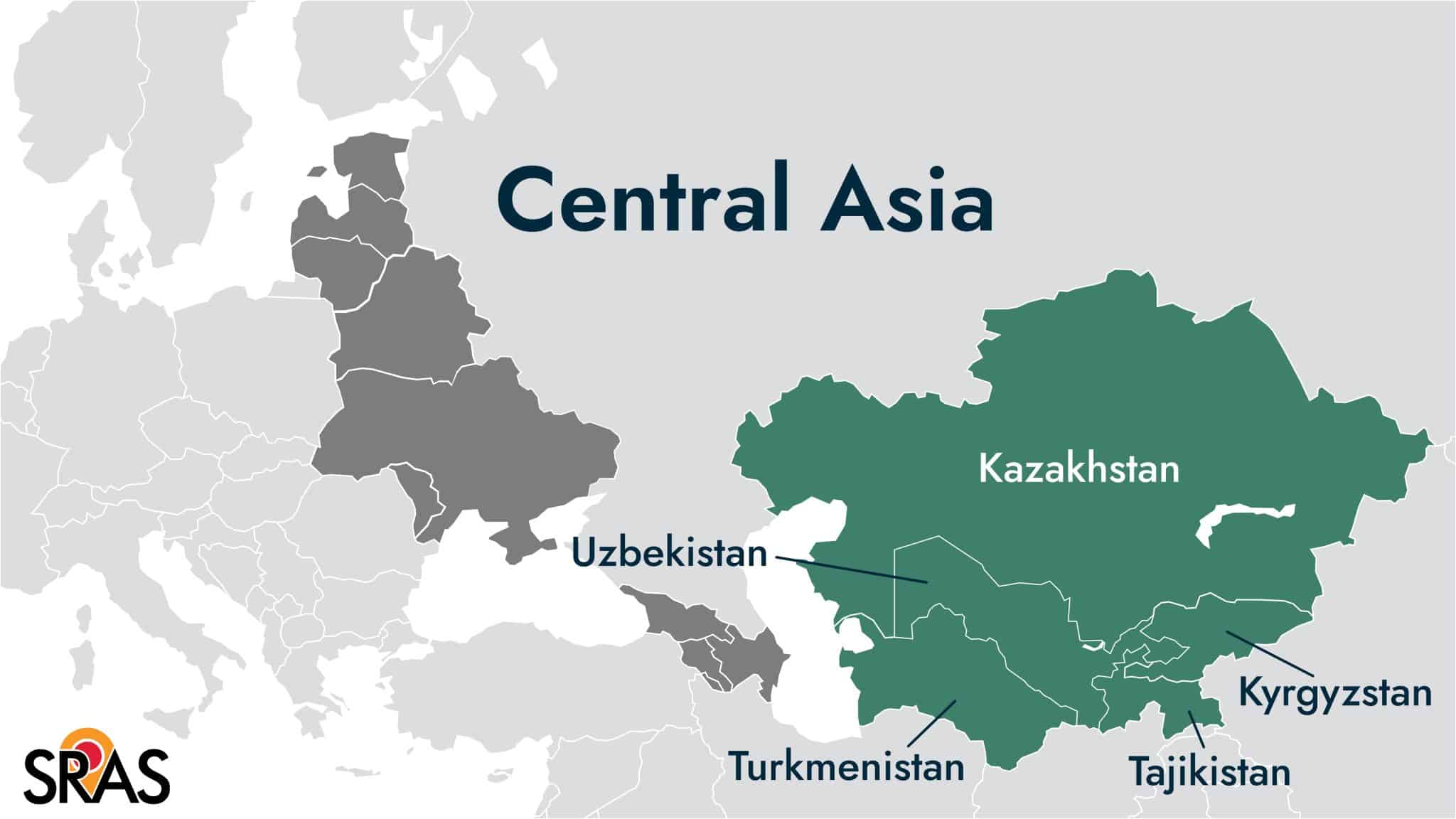
Central Asia
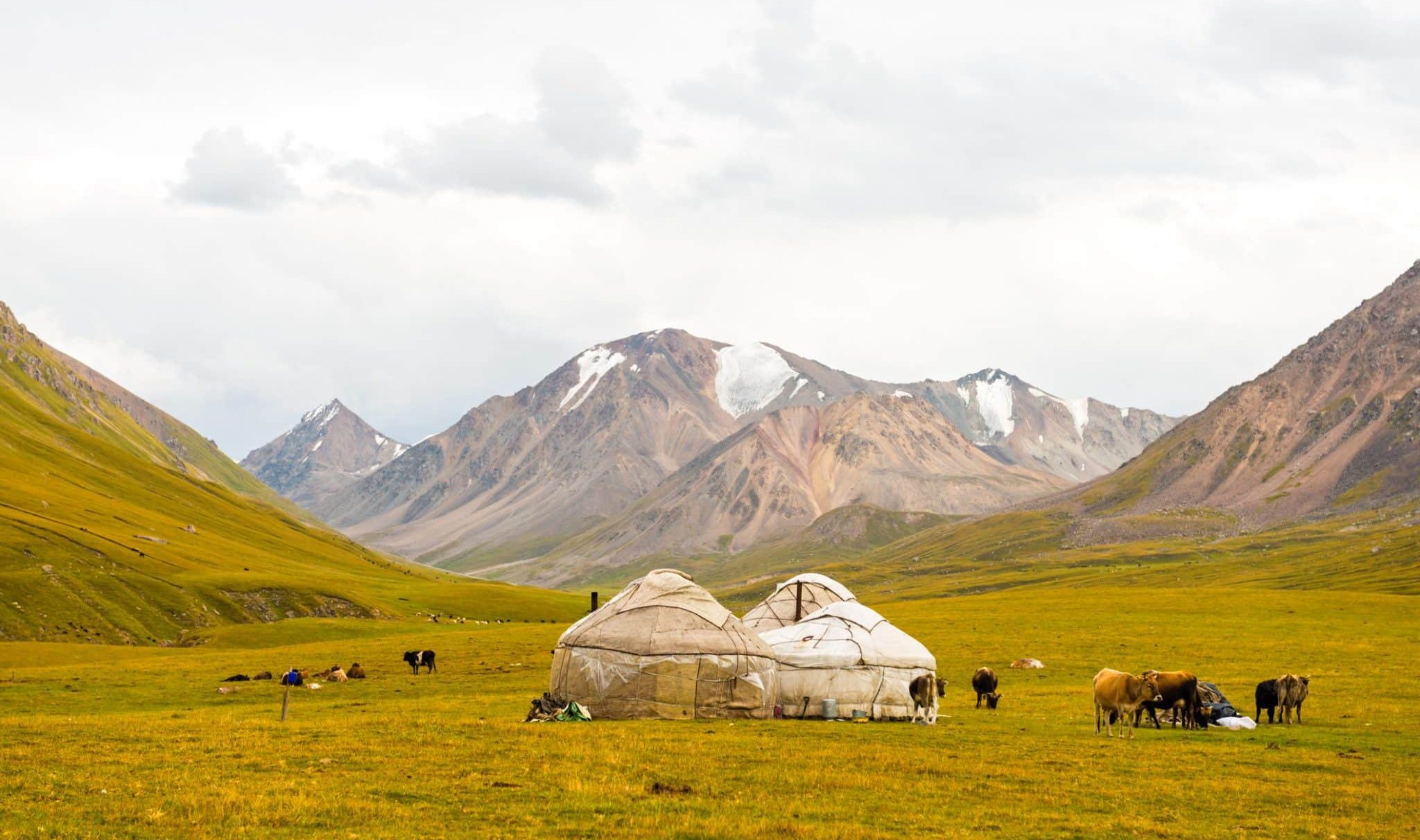
Much of Central Asia has strong nomadic traditions, which has made their cultures both independent and highly adaptable.
All five Central Asian states now have relatively small ethnic Russian minorities, but have also maintained comparatively large Russian-speaking populations. This reflects the region’s continued economic and diplomatic ties with Russia. In particular, the poorer Central Asian states have large migrant populations in Russia, whose remittances have historically been an important contributor to national GDP. Russian Interior Ministry estimates for 2024 placed the number of Central Asian guest workers in Russia above 10 million.
Russian generally remains an important language of instruction or study in schools and universities. Russian support for Russian-language education has been an important source of Russian soft power in the region. Russian-language television and other media likewise remain widely accessible.
Visa-free travel between Russia and much of the region meant that hundreds of thousands of Russians entered Central Asia in the mass exodus that followed Russia’s 2022 mobilization. Although many fairly quickly moved on or returned home, the sudden influx brought economic and social shocks that helped accelerate existing debates about migration, national identity, and the balance between Russian and local languages and cultures.
These debates intensified again after the March 2024 Crocus City Hall attack, for which four Tajik nationals were arrested and charged. Russian authorities subsequently tightened controls on Central Asian migrants, while documented cases of ethnic profiling, xenophobic violence, deportation, and other harassment increased. Russian authorities and recruiters have also sought to enlist Central Asian migrants in the war in Ukraine, sometimes using financial incentives, expedited citizenship, or, according to human-rights reporting, coercive measures.
This has negatively impacted migrant flows from Central Asia to Russia, which have been redirected in part to Turkey and the European Union. Central Asian officials have periodically described Russia as an unsafe destination in public addresses and warnings.
Despite these pressures, Russia is likely to remain a major destination for Central Asian labor migrants for the foreseeable future, and Russian is likely to remain widely spoken throughout the region. The economic advantages of migration, the depth of existing Russian-language education and media infrastructure, and the large communities already established in Russia will continue to sustain the language even as Central Asian governments increasingly promote their national languages.
Kazakhstan
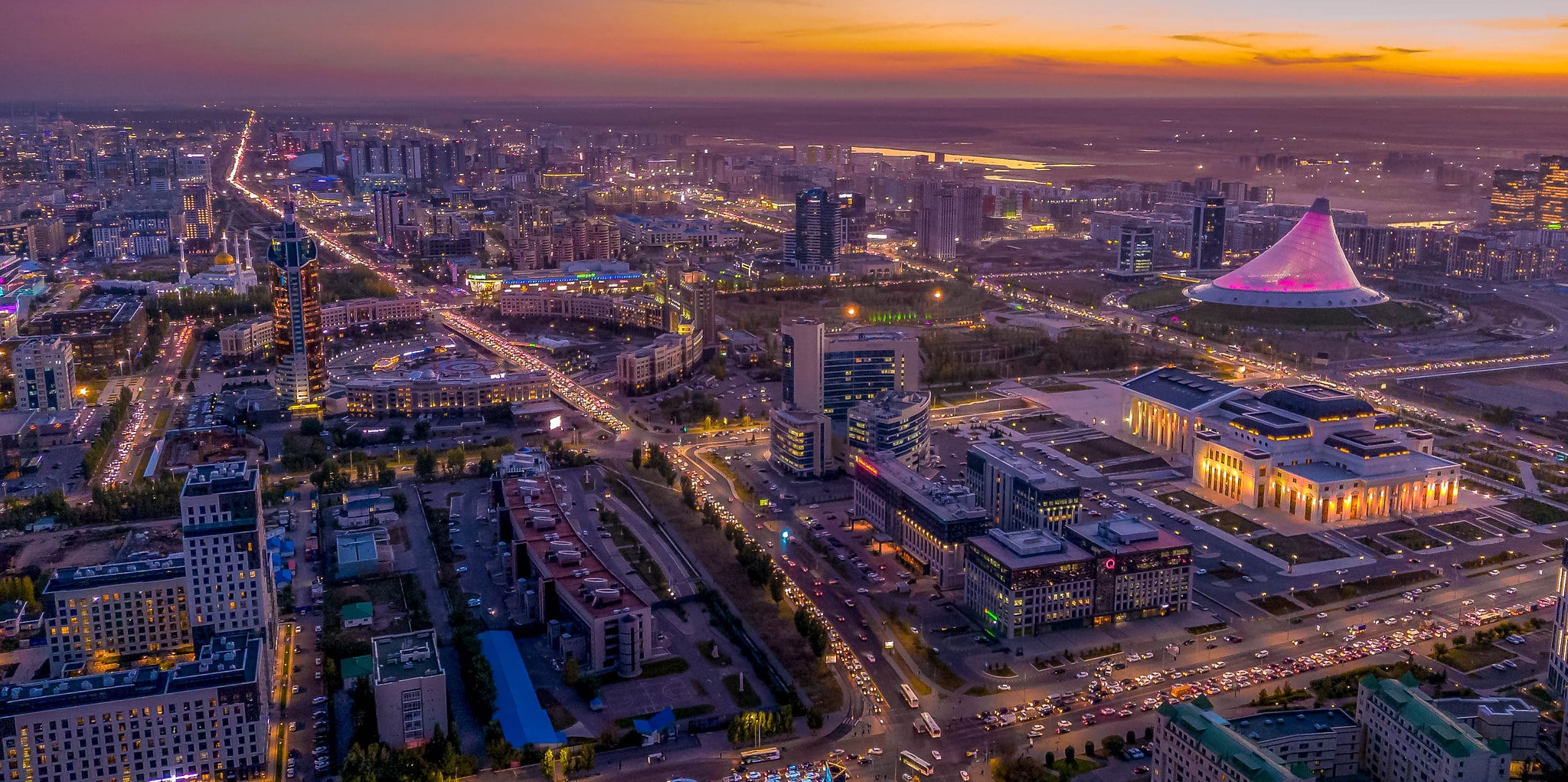
Astana, Kazakhstan is an almost entirely new city built since independence with Kazakhstan’s considerable resource wealth.
Legal Status: Kazakhstan’s 1993 Constitution designated Kazakh as the state language and Russian as the “language of interethnic communication.” The 1995 Constitution provided that Russian be officially used “on equal grounds” with Kazakh. For nearly all purposes, this effectively made Russian a second state language.
The 2026 Constitution, which took effect July 1, changed this wording to say that Russian is officially used “alongside” Kazakh. Although the government has described this as a minor terminological change, legal experts argue that it will grant the state greater flexibility to provide Russian-language documents and services only on demand and emphasize Kazakh-language proficiency in public-sector hiring.
Kazakhstan began transitioning the Kazakh language from Cyrillic to a Latin-based alphabet in 2017 in a phased transition through 2031. Government statements have presented the reform as part of the modernization and development of Kazakh. The government has cited international development and greater alignment with other Turkic languages as the primary reasons for the shift.
Kazakhstan’s Law on Consumer Rights Protection continues to require that all product labels be printed in both Kazakh and Russian.
Ethnic Demographics: 2026 estimates from Kazakhstan’s statistics agency show that Kazakhs comprised 71.5% of the country’s population, while Russians comprised 14.4%. This is a dramatic change from 1989, when they comprised 39.7% and 37.8%, respectively. Russians remain concentrated in northern and northeastern Kazakhstan, near the Russian border, as well as in major cities such as Astana (~14% of the population) and Almaty (~20%).
An estimated 400,000 to 500,000 Russians entered Kazakhstan in 2022 following the start of the war and the autumn mobilization. Those who stayed to the present day are estimated at about 50,000.
Language Demographics: Russian has long been perceived as a driver of economic benefit, both under Russian rule and today. As of the country’s 2021 census, 83.7% of Kazakhstan’s population is Russian speaking, compared to 80.1% Kazakh speaking, with most of the population being bilingual. However, only 49.3% of the population uses the Kazakh language daily, including 63.5% of ethnic Kazakhs. This persistent discrepancy between the rise in ethnic Kazakh population and the stagnant number of daily Kazakh speakers has helped fuel the rise in state protections for the language.
Citizenship: At independence, Kazakhstan granted citizenship to all permanent residents. Dual citizenship was banned in 1991, however, and many ethnic Russians subsequently chose to emigrate to Russia, rather than give up Russian citizenship.
Following the influx of Russian nationals after 2022, Kazakhstan tightened immigration controls. In 2023, it ended a loophole allowing visa-free visitors, including citizens of Eurasian Economic Union countries, to reset their permitted stay by leaving and reentering; the general limit became 90 days within 180. Language requirements have also become stricter: since 2024, applicants for Kazakh citizenship, and since 2026, applicants for permanent residency, must demonstrate basic proficiency in Kazakh.
Education: In 2020, about 51% of Kazakhstan’s schools provided instruction exclusively in Kazakh, 17% exclusively in Russian, and 31% in both languages. The share of students studying entirely in Russian fell from 66.1% in 1991 to about 31.5% in 2020, while the share studying in Kazakh rose from 32.4% to 65–66%.
Kazakhstan’s 2026 Constitution requires the state to create conditions for the study and development of minority languages. Education policy has thus promoted a “Trinity of Languages” model emphasizing Kazakh, Russian, and English. Kazakh and Russian are compulsory subjects in all public schools, with English increasingly prominent as a third language, although shortages of qualified teachers have complicated implementation.
According to data from the Ministry of Science and Higher Education, approximately 65% of all university students in Kazakhstan now complete their degrees in programs taught in Kazakh. In contrast, Russian-medium enrollment has declined to roughly 26%, while English-medium instruction accounts for about 9%. Russian remains particularly important in scientific fields where academic materials and instructors are more readily available in Russian. Kazakhstan also hosts branches of Russian universities, including the Lomonosov Moscow State University branch in Astana.
Media: Kazakhstan’s 2024 Media Law increased the required share of Kazakh-language programming on domestic television and radio from 50% to 55% in 2025 and 60% beginning in 2027. This is measured within six-hour blocks, preventing broadcasters from concentrating Kazakh-language programming in off-peak periods. The law simultaneously reduced the permitted share of foreign television and radio programming retransmitted by domestic broadcasters from 20% to 10%.
Much of Kazakhstan’s major media remains state-owned or state-affiliated and operates in both Kazakh and Russian. The national broadcaster Qazaqstan broadcasts in both languages, while state-affiliated KazInform publishes in Kazakh, Russian, English, Chinese, and Uzbek, with some Kazakh content also available in Latin and Arabic scripts. Major online outlets include Egemen Qazaqstan and Kazakhstanskaya Pravda, while independent outlets such as Tengrinews and Vlast.kz provide substantial Russian-language coverage.
Channels and content produced in Russia remain widely available in Kazakhstan, especially on cable and streaming packages. A 2024 report found that of 378 television channels available in Kazakhstan, 58% broadcast in Russian and 20% Kazakh.
Kyrgyzstan
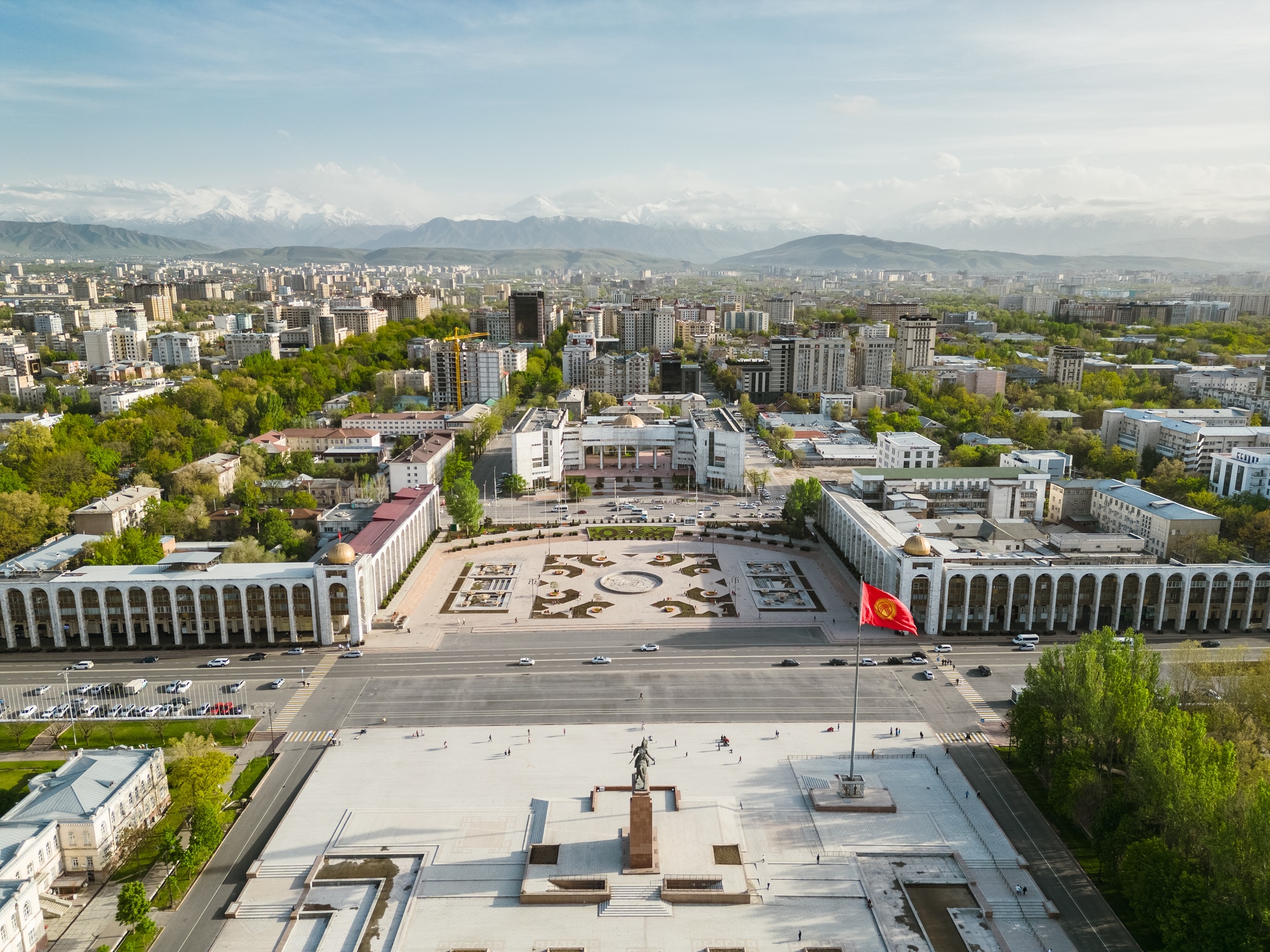
Downtown Bishkek, Kyrgyzstan. Many of Central Asia’s cities were built under the Tsarist or Soviet governments.
Legal Status: Kyrgyz is Kyrgyzstan’s state language, while Russian has been an official language since the 1993 Constitution; both statuses were retained in the 2021 Constitution.
Legislation adopted in 2023, however, has significantly strengthened the position of Kyrgyz. State and municipal employees, elected officials, judges, military personnel, educators, health-care providers, and other public-sector workers are required to know and use Kyrgyz in their official duties. Official documents, including those produced by the state and those in heavily regulated fields like banking, are to be produced in Kyrgyz as the authoritative version and translated only when required or necessary. Further, Official documents in fields ranging from banking, healthcare, and government administration must be produced first in Kyrgyz. The government has begun implementing these requirements through formal proficiency standards: state and municipal employees must reach B1 in Kyrgyz from 2025 and B2 from 2027.
Critics of the reforms argue that Kyrgyz lacks standardized terminology in some legal and medical fields, creating the potential for confusion, and that the changes could limit access to public services for Kyrgyzstan’s sizable non-Kyrgyz-speaking population. Further, Russian is still an “official language” per the Constitution. Meanwhile, the reforms have seen generally weak implementation as funding and staffing requirements have fallen short and the government has not yet found a reliable way to monitor and enforce the law.
Unlike many other Central Asian states, Kyrgyzstan has not adopted a national policy to transition to Latin script. However, in July 2025, legislation was passed allowing Kygyz citizens an expedited path to legally change their names, replacing Russian-style patronymics with Kyrgyz equivalents (ie the Russian endings -ovich or -ovna in favor of traditional Kyrgyz forms such as uulu (“son of”) and kyzy (“daughter of”)).
Ethnic Demographics: At the end of 2024, Kyrgyzstan’s population was approximately 77.8% Kyrgyz, 14.2% Uzbek, and 3.8% Russian. This represents a major demographic shift since 1989, when Kyrgyz comprised 52.4%, Uzbeks 13.0%, and Russians 21.5% of the population. The change has been driven by the emigration of many ethnic Russians to Russia after independence, combined with consistently lower fertility rates among Russians (averaging less than 2) than among Kyrgyz and Uzbeks (averaging just under 3). Russians are now concentrated primarily in Bishkek and the surrounding Chüy Region, where they account for roughly 15–20% of the population overall.
Russia’s Federal Security Service (FSB) noted that more than 167,000 Russian citizens entered the Kyrgyz republic during the third quarter of 2022 alone, driven largely by the military mobilization announcement in September. Investigative journalists at The Bell estimate that only about 12,600 Russians have stayed in the country, however. These Russians are most concentrated in Bishkek, where they may have added approximately 1% to the city’s population.
Language Demographics: According to the 2022 census, approximately 82% of Kyrgyzstan’s population aged seven and older reported confident knowledge of Russian, compared with 91.8% for Kyrgyz. Russian remains particularly prevalent in Bishkek, where more than 97% of residents reported knowing it well or fluently.
Russia remains the principal destination for Kyrgyz migrant workers. Historically, their remittances have amounted to around 30% of GDP. Recent economic shifts following the Ukraine War have altered the share of remittances to roughly 15-17% of GDP, with about 90% of that coming from Russia. Strong Russian skills have allowed a significant number of Kyrgyz citizens to live and work in Russia, making an important contribution to the Kyrgyz economy.
Citizenship: Kyrgyzstan’s 1994 citizenship law granted citizenship to all permanent residents of the Kyrgyz SSR, leaving a relatively small stateless population. Conventional naturalization generally requires five years of continuous residence under permanent-resident status, a legal source of income, and knowledge of Kyrgyz or Russian. While Kyrgyzstan generally prohibits dual citizenship, it maintains a bilateral treaty allowing dual citizenship with Russia.
A 1999 agreement between Kyrgyzstan, Kazakhstan, Russia, and Belarus created a simplified path to Krygyz citizenship for citizens of the four participating states born before 1991. Kyrgyzstan’s permanent residence laws did not require one to actually live in Kyrgyzstan at the time. After 2022, Kyrgyzstan saw a sharp increase in Russian applicants. More than 7,000 Russians received Kyrgyz citizenship in 2024, compared with about 400 in 2021. In February 2025, Kyrgyzstan suspended the expedited procedure for new Russian applicants, with no announced plans to reinstate it. The surge appears to have been driven partly by Russians seeking greater access to international banking and other services after sanctions were imposed on Russia in 2022, although the motivations of individual applicants varied.
Despite any increased migration from Russia since 2022, Kyrgyzstan has continued to experience net emigration to Russia over the longer term.
Education: According to the Kyrgyz Ministry of Education, as of the end of 2025, approximately 58% of schools teach exclusively in Kyrgyz, 12% exclusively in Russian, and 30% offer bilingual or multilingual instruction, most commonly in Kyrgyz and Russian. These mixed-language schools enroll the majority of students: about 56% attend bilingual schools, compared with 36% in Kyrgyz-only schools and 10% in Russian-only schools.
Russia continues to support Russian-language education by funding roughly 200 teachers in 43 Kyrgyz schools, with plans to expand that program and construct nine new schools. Russian also remains the dominant language of higher education, with more than 70-80% of university students studying in Russian. This reflects both the limited availability of academic materials in Kyrgyz and the continued reliance on Russian terminology in many technical disciplines. Russia also co-funds the Kyrgyz-Russian Slavic University in Bishkek, while prestigious Lomonosov Moscow State University operates a branch campus in Osh and is building another in Karakol.
The 2023 Education Law requires the state to provide opportunities to study in the state, official, and at least one foreign language and explicitly permits multilingual education. The updated 2025 educational standards continue to provide curricula for schools operating in Kyrgyz, Russian, Uzbek, and Tajik. Russian remains firmly established across Kyrgyz education, in part because of funding and staffing issues.
The 2023 State Language Law and subsequent Ministry of Education initiatives mandate expanded use of the state language in education, with officials pushing for at least 50% of school instruction to be conducted in Kyrgyz, although no specific legal changes have been made to date. Students must take Kyrgyz-language assessment tests at various grades and before entering college, although these assessments currently are not counted towards grade advancement or competitive admissions.
Media: The 2023 Constitutional Law on the State Language requires television and radio organizations, regardless of ownership, to broadcast at least 60% of their programming in Kyrgyz if using public airwaves. The law also strengthens requirements for the use of Kyrgyz in advertising and public signage.
Although the government has not published detailed procedures for measuring compliance, Kyrgyz-language programming has been expanding. At the same time, Russian television remains widely available. Russian state channels—including Channel One, Russia 24, Kultura, and Zvezda—are widely available via satellite, cable, and streaming.
Kyrgyzstan’s state broadcaster, KTRK, operates in both Kyrgyz and Russian. Major news outlets such as AKIpress and Kaktus.kg also publish extensively in Russian, while broadcasters including MIR and Nomad-TV are jointly operated with Russian participation and broadcast in both languages.
Tajikistan
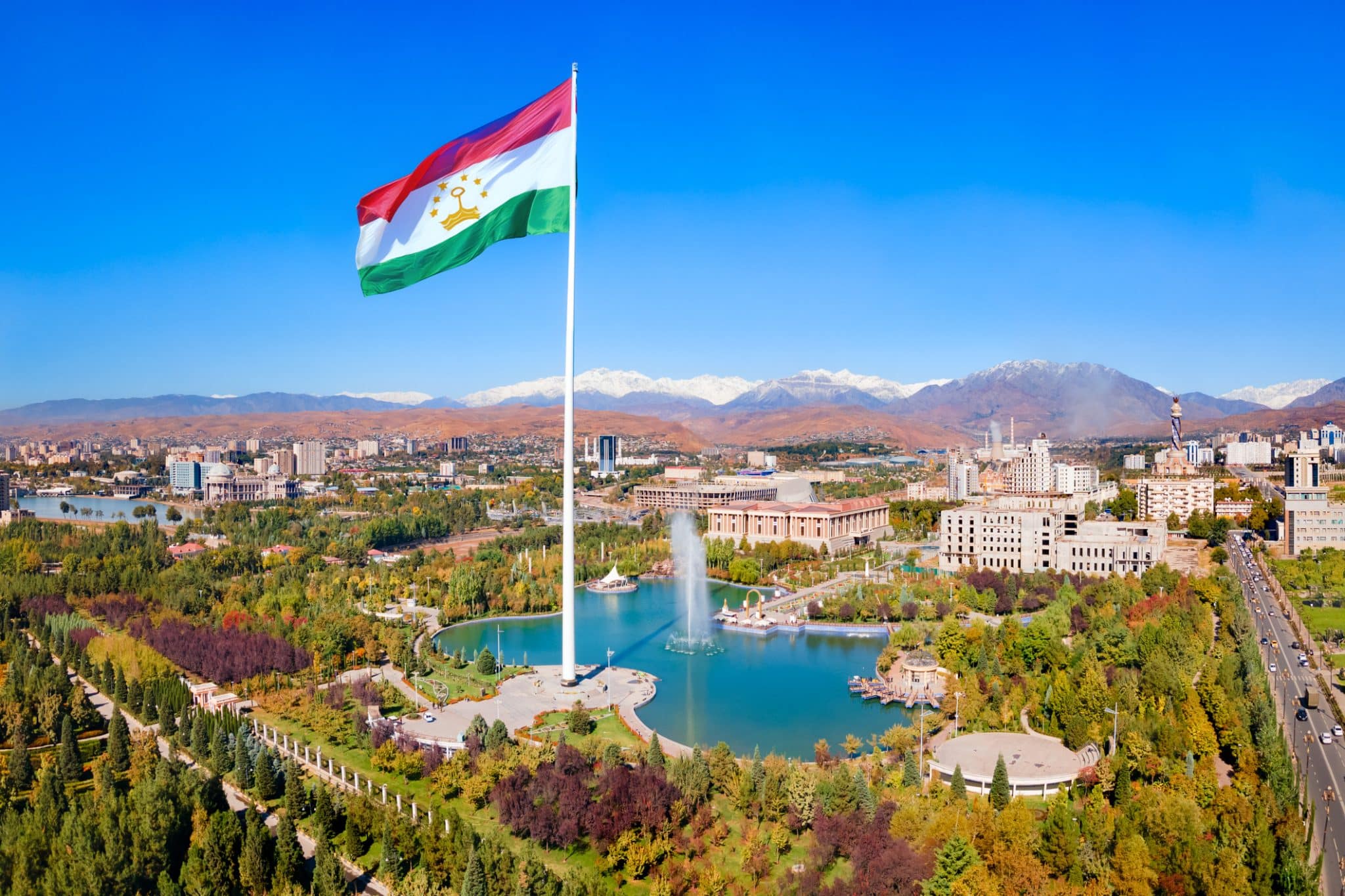
Tajikistan’s Persian-speaking culture sets it apart from the rest of Central Asia. Rugged mountains dominate its landscape.
Legal Status: Article 2 of Tajikistan’s Constitution designates Tajik as the state language and Russian as the language of interethnic communication.
Legislation signed into law in October 2009, mandated that all official government business, documentation, and education be conducted exclusively in the state language, Tajik. In 2011, after considerable lobbying from Moscow, the status of Russian was reinstated. However, the policy that government documents, contracts, and legislation must be in Tajik first, with translations into other languages made after, has persisted. In the event of any discrepancies, the Tajik text serves as the controlling authority.
A 2016 law further promoted Tajik linguistic identity by prohibiting the registration of newborn ethnic Tajiks with Russian-style patronymics (such as -ovich and -ovna) or surnames ending in -ov and -ev. Existing names were unaffected, but new registrations were required to use traditional Tajik suffixes such as -zoda, -zod, -iyon, -far, or -pur.
Tajik continues to be written in the Cyrillic alphabet. Although the government has no plans to adopt a Latin script, a 1998 reform removed four Russian-derived letters (Ц, Щ, Ы, and Ь) that were deemed unnecessary for native Tajik phonology.
Ethnic Demographics: According to the 2020 census, Tajiks comprised 86.1% of Tajikistan’s population, Uzbeks 11.3%, Kyrgyz 0.4%, and Russians just 0.3%. The Russian population is concentrated primarily in Dushanbe.
The country’s Russian population has nevertheless been affected by migration in both directions. Following Russia’s 2022 invasion of Ukraine and September mobilization, approximately 40,000 Russians entered Tajikistan in the first quarter of 2022—nearly five times the number during the same period in 2021—and roughly 30,000 arrived in Dushanbe during September and October alone.
Following mobilization in Russia, Tajikistan saw about 50,000 more people cross into the country from Russia than expected. While a relatively small number compared to other Central Asian countries, it was enough to cause significant price disruptions in the capital, Dushanbe.
Language Demographics: Tajik is the mother tongue of 84.4% of the population, Uzbek at 11.9%, and Kyrgyz and Russian both under 1%.
Russian nevertheless has a much larger reach as a second language: recent estimates suggest that roughly 55% of the population speaks Russian, although only about 30% reports speaking it fluently.
Tajik citizens living and working in Russia are estimated to number 800,000-1.2 million. Many do so without proper documentation and thus many estimates put that figure much higher. Remittances from Tajiks abroad have accounted for an average of roughly 40% of Tajikistan’s GDP over the last decade. Higher wages in Russia are often blamed for shortages of workers in Tajikistan, especially in healthcare and construction. Russian therefore remains important for employment, higher education, and social mobility.
Tajik nationals have consistently formed the largest group receiving new Russian citizens over the past decade. They accounted for roughly half of all naturalized citizens in 2023 and have maintained the leading share amidst overall declining naturalization rates. Over 800,000 Tajiks have acquired Russian citizenship over the last ten years, facilitated by a 1995 Dual Citizenship Agreement.
Citizenship: Tajikistan’s 1991 citizenship law granted citizenship to people living in the country regardless of ethnic origin or length of residence. Tajikistan does not allow dual citizenship except with Russia, with which it signed an agreement in 1995. To gain Tajik citizenship, one needs to live in Tajikistan for five years with residency and show conversational proficiency in Tajik or Russian.
Education: Russian is a compulsory subject throughout general education in Tajikistan. Further, as of 2022, Tajikistan had 39 schools with Russian as the language of instruction, enrolling more than 27,000 students, as well as more than 160 mixed Tajik-Russian schools serving roughly 70,000 students. This represents about 4% of Tajikistan’s public school student population.
At least five additional Russian-medium schools have been opened since the above reporting. They are in Dushanbe, Khujand, Bokhtar, Kulob, and Tursunzoda and were funded with Russian government support. Russia has provided substantial support for Russian-language education in Tajikistan, including funding materials and teacher salaries.
Tajik dominates higher education, but Russian remains significant. In 2022–23, approximately 38,800 of 220,300 university students—about 18%—studied in Russian, compared with about 178,300 in Tajik. Russian is particularly important in institutions and fields with established Russian-language academic materials and terminology. The Russian-Tajik (Slavonic) University in Dushanbe provides higher education in Russian, alongside Russian university branches and other institutions supported through Tajik-Russian educational cooperation.
Media: Tajikistan’s state news agency, Khovar, publishes in Tajik, Russian, English, Persian, and Arabic. State television Tajikistan TV and Jahonnamo TV offer news programs broadcast in Russian. Other channels also broadcast in multiple languages.
Major newspapers offering Russian-language coverage include Narodnaya Gazeta, the official weekly publication and print organ of the Government of the Republic of Tajikistan, Vecherka, a popular local newspaper based in Dushanbe featuring Russian-language content as well as independent news agency Asia-Plus.
Private broadcasters are required to submit all editorial programming produced in foreign languages (which heavily impacts Russian-language content) for prior state approval. However, this has been seen less as an attempt to restrict Russian-language broadcasts and more an attempt to control and impede independent broadcasts in favor of state-run channels.
Turkmenistan
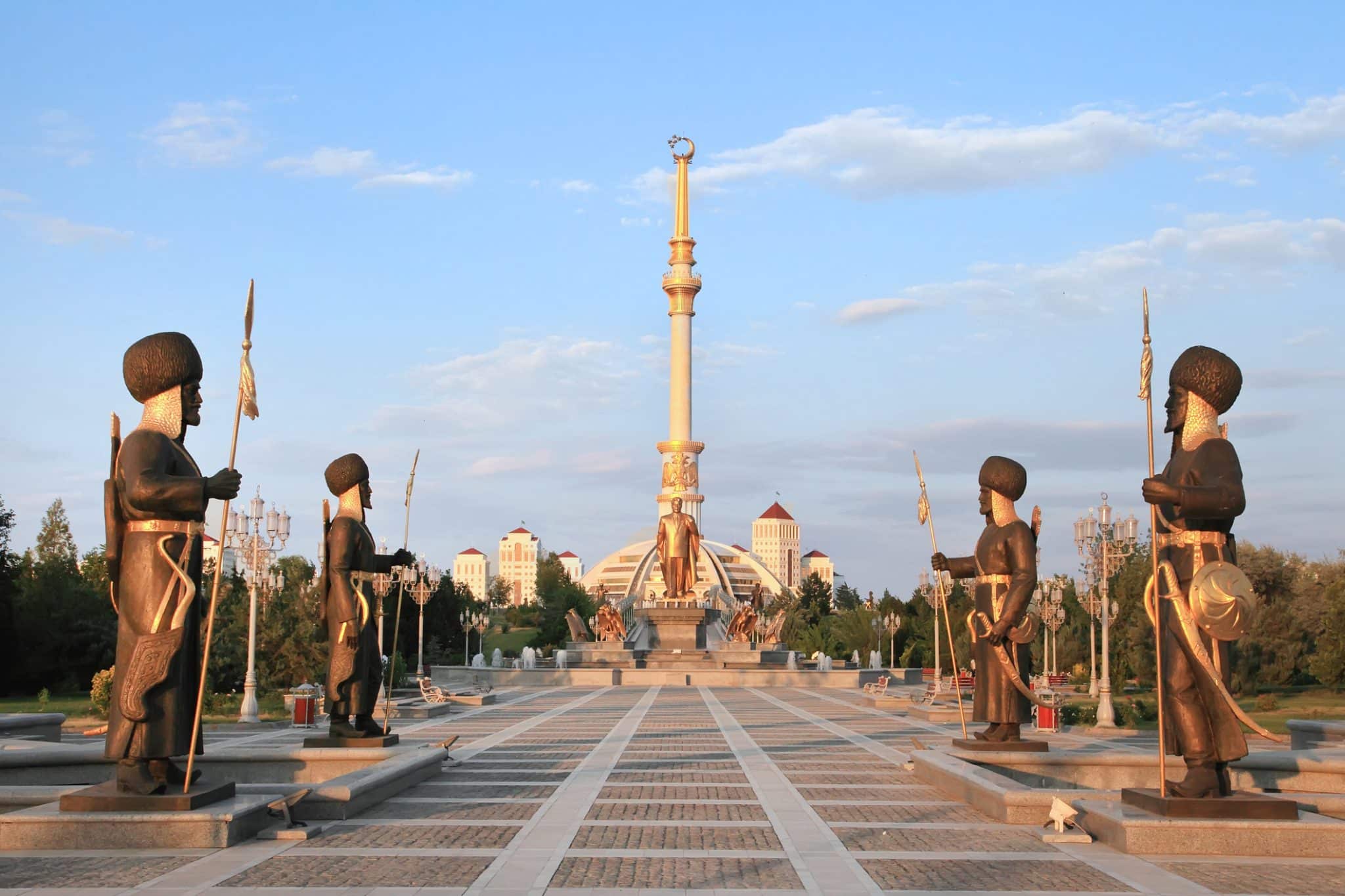
Turkmenistan’s cities are known for their massive white and gold buildings and monuments, such as Independence Arch, pictured here, built with the county’s enormous natural gas wealth.
Legal Status: Turkmenistan’s 1992 Constitution designates Turkmen as the country’s state language and guarantees citizens the right to use their native languages. The 1990 Law on Language had designated both Turkmen and Russian as languages of interethnic communication, but Russian lost this formal status in 1996.
Since independence, the government has pursued policies of Turkmenization, increasingly requiring proficiency in Turkmen for government employment and other regulated professions and shifting official business toward Turkmen. Scores of place names have also been changed. The country began replacing the Cyrillic alphabet with a Latin-based Turkmen alphabet in 1993.
Ethnic Demographics: The 2022 census recorded Turkmen as 86.7% of the population, Uzbeks as 9.1%, and Russians as 1.6%. The vast majority of Russians are concentrated in urban areas, and particularly in the capital of Ashgabat, where they comprised 6.6% of the population.
The Russian population declined sharply following Turkmenistan’s termination of its 1993 dual-citizenship agreement with Russia in 2003. Dual nationals were required to choose between Turkmen and Russian citizenship, prompting substantial emigration of Russian-speaking residents. In June 2022, Turkmenistan resumed issuing Turkmen passports to citizens who had acquired Russian citizenship after 2003, allowing some to restore documentation they had been unable to obtain for nearly two decades.
Language Demographics – The 2022 census found that Turkmen was the mother tongue of approximately 89.2% of the population, followed by Uzbek at 6.8% and Russian at 1.9%. Russian-speaking communities are concentrated particularly in Ashgabat and western cities such as Türkmenbaşy and Balkanabat. Russian speakers outnumber ethnic Russians because the Russian-speaking population also includes Ukrainians, Armenians, and other minorities.
A 2023 estimate by Russia’s Rossotrudnichestvo agency found that approximately 40% of Turkmenistan’s population could speak or understand Russian, the lowest estimated rate among the five Central Asian states. The agency also estimated that up to 12% considered Russian their mother tongue. (The same study found figures for other countries that differ substantially from official sources. For instance, Rossotrudnichestvo found that, in Kyrgyzstan, 44% of the population know Russian. Kyrgyzstan’s census from 2022 reported that number at 82%. Rossotrudnichestvo’s data, however, is the only known data for Turkmenistan.)
Russian has faced increasing competition from Turkish because official Turkmen policy has moved away from supporting Russian language study, Turkish is very similar to Turkmen, Turkish media and schools have spread in Turkmenistan, and many Turkmen citizens have emigrated to Turkey to live and work.
Citizenship – Following independence, Turkmenistan’s 1992 citizenship law recognized as citizens all former Soviet citizens who were permanently resident in the country when the law entered into force, regardless of ethnic background or language, unless they formally declined citizenship.
The 2013 Law on Citizenship established the current naturalization framework. Applicants must generally have lived continuously in Turkmenistan for five years, know the state language sufficiently for communication, and have a legal source of income. The five-year residence requirement may be shortened or waived for several categories, including ethnic Turkmen and certain citizens of former Soviet republics who have a close relative in Turkmenistan, as well as people with particular qualifications or prior claims to Turkmen citizenship.
Education – Turkmenistan’s Education Law establishes Turkmen as the main language of instruction in all educational institutions and requires all general educational institutions to teach it. At least two foreign languages are required for study to complete public education. Foreign languages may serve as the principal language of instruction in certain vocational programs and in foreign or joint educational institutions.
Under President Saparmurat Niyazov, the government sharply reduced Russian- and other minority-language education in 2005 as part of its broader Turkmenization policies. President Gurbanguly Berdimuhamedov subsequently reintroduced a trilingual education model in 2013 emphasizing Turkmen, Russian, and English, but the model was only partially implemented because of shortages of teachers and other resources.
In 2020, several schools again sharply reduced their Russian-language offerings, officially citing COVID-19 measures.
According to the Turkmen government, 72 public schools in the country offered at least some instruction in Russian as of 2023. The joint Turkmen-Russian A.S. Pushkin School in Ashgabat is the country’s most prominent Russian-medium institution, serving some 1500 students. Meanwhile, Russian is one of the most common foreign languages taught in the general education system, which officially emphasizes UN operational languages.
Higher education is similarly centered on Turkmen, while English is gaining importance. The government reported in February 2026 that English had become a mandatory element of the national education system and that four leading universities had transferred their educational processes entirely to English.
All Russian-based educational initiatives tend to be highly specific to specific institutions and jointly funded and run by the Turkmen and Russian governments. Russia unilaterally provides quotas for about 54,000 Turkmen students to study in Russian universities.
Media: Media available in Turkmenistan is overwhelmingly state-owned and published or broadcast in Turkmen. Russian-language programming is available through the state television system, operated by the State Committee for Television, Radio Broadcasting and Cinematography, which runs eight television channels. Its international programming includes news and other content in Russian. The principal Russian-language newspaper is Neutral Turkmenistan (Neytralny Turkmenistan), an official government publication corresponding to the Turkmen language Turkmenistan newspaper; related editions are also published in other languages.
In 2022, Russia’s Rossiya-1 and Zvezda disappeared from some Turkmen television packages as satellite operators removed them in response to international sanctions. Other Russian channels have remained available through some cable and satellite services. The government has also restricted access to alternative information sources by blocking websites and VPNs. In 2015, it ordered privately owned satellite dishes removed from Ashgabat and surrounding areas, officially citing their appearance but also limiting residents’ access to foreign broadcasts.
Uzbekistan
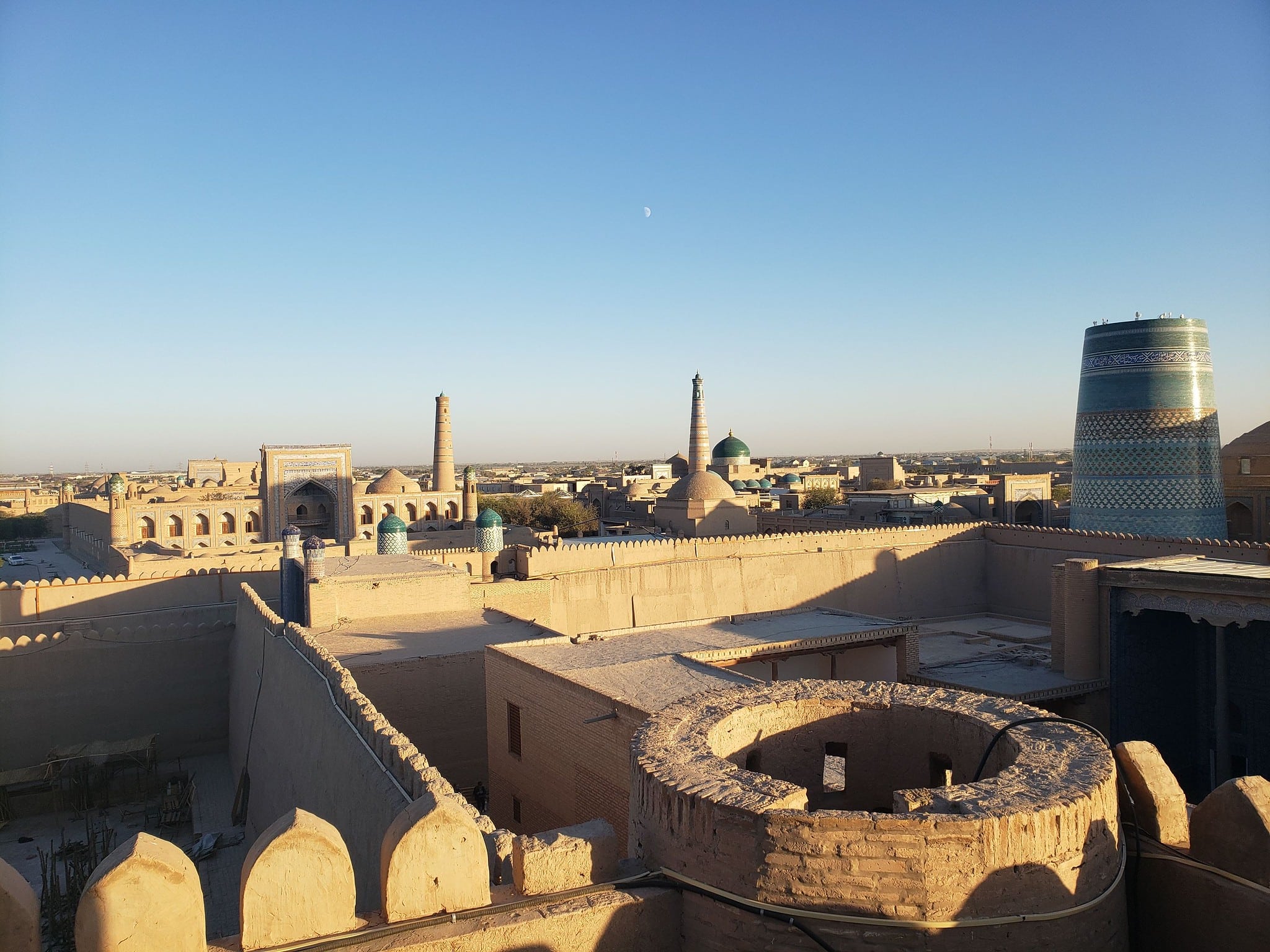
Khiva is a museum city whose centuries-old architecture hearkens back to Uzbekistan’s golden age as one of the world’s wealthiest and most learned cultures.
Legal Status: Uzbek has been Uzbekistan’s state language since the 1989 Law on the State Language, a status reaffirmed by the Constitution after independence and retained in the current Constitution. Article 4 designates Uzbek as the state language while requiring the state to respect and support the languages of other nationalities and ethnic groups.
Although state administration is conducted primarily in Uzbek, Russian and other languages remain permissible in certain administrative and legal contexts with translations and interpretation provided as necessary.
Ethnic Demographics: Preliminary results of Uzbekistan’s 2026 census found that ethnic Uzbeks comprise 89.4% of the population, followed by Tajiks at 3.3%, Karakalpaks at 2.2%, Kazakhs at 1.8%, and Russians at 1.6%. For comparison, ethnic Russians made up 8.3% of Uzbekistan’s population during the 1989 Soviet census. The Russian population is heavily concentrated in urban areas, particularly Tashkent.
Language Demographics – Preliminary 2026 census results found that 91.3% of Uzbekistan’s population reported Uzbek as their native language, 1.9 percentage points more than the share identifying as ethnic Uzbek. Russian was reported as the native language of approximately 2% of the population.
Estimates of Russian proficiency vary substantially based on methodology. In May 2025, a figure presented at Uzbekistan’s government-sponsored IT Park Growth Point Forum indicated that 18.5% of the population knew Russian. Meanwhile, a 2023 estimate by Russia’s Rossotrudnichestvo agency put Russian proficiency at roughly 50% of the population. Russian remains most widely used in Tashkent and other major urban areas and is particularly prevalent among older residents and those that have completed university education.
Citizenship – Uzbekistan’s 1992 citizenship law granted citizenship to people permanently resident in the country on July 28, 1992, provided they were not citizens of another state and expressed a desire to become Uzbek citizens.
Uzbekistan still does not recognize dual citizenship and acquiring a foreign citizenship is considered grounds for revoking Uzbek citizenship. This restriction contributed strongly to the emigration of nearly one million ethnic Russians and others of Slavic identity over the course of the 1990s. Further, in 1992, approximately 97,000 people were left stateless and restrictive naturalization policies meant that, between 1992 and 2007, only 482 stateless people reportedly acquired Uzbek citizenship, while many others emigrated.
Ordinary naturalization generally requires five years of continuous permanent residence, a legal source of income, and knowledge of the state language. The 2020 Law on Citizenship now contains provisions waiving the language requirement for those over 60, those who had held residency since 1995 or before, and for certain other groups. However, Uzbekistan still has an estimated 20,000 known stateless people, which is the largest stateless population in Central Asia.
Education – Uzbekistan permits schools with foreign-language curricula, with Russian remaining the most widely used language of instruction after Uzbek. Approximately 10% of schoolchildren received instruction in Russian in 2021. Under the Soviet system, education was largely dual-track, with schools teaching in Uzbek or Russian. Most Russian-medium schools survived independence, their number declining from more than 1,100 in 1992 to 862 in 2019—a decrease of about 22%, compared with a decline of roughly 80% in the ethnic Russian population. Uzbek public schools generally require students to study two foreign languages to graduate. Uzbek, Russian, and English are most common (with Uzbek a required subject and counting if the language of instruction is not Uzbek). Turkish is also gaining popularity. Russia provides substantial support for Russian-language education in Uzbekistan, including providing teaching resources and teacher training.
Russian also remains an important language of higher education. Numerous major Uzbek universities offer Russian-medium degree programs and Uzbekistan also hosts branches of Russian universities, including Moscow State University, Plekhanov Russian University of Economics, Moscow State Institute of International Relations and others. Bilateral agreements with Russia provide these institutions with favorable administrative arrangements, including tax and registration provisions.
Media: Major Russian channels including Perviy Kanal, Rossiya 1, Rossiya 24, NTV, Zvezda, Mir, and others are widely available via streaming and cable packages. UzReport TV is a major domestic private news and information channel broadcasting around the clock in Uzbek, Russian, and English; its hourly UzReport News provides domestic and international news in Russian as well as Uzbek. Other Uzbek television channels also incorporate Russian-language programming, including rebroadcasting material produced in Russia. While the overall television environment is increasingly Uzbek-language, Uzbekistan has no quotas limiting the amount of foreign language broadcasts in Uzbekistan.
Major print media includes Narodnoye Slovo, which publishes a Russian-language edition alongside the Uzbek-language Xalq So’zi. Both remain active in 2026. Major independent or semi-independent digital outlets also publish extensively in Russian, including Podrobno.uz, Kun.uz, and Gazeta.uz. Kun.uz maintains a full Russian-language edition, while Podrobno.uz operates as a Russian-language news agency covering politics, economics, society, culture, and other subjects.
Radio is similarly multilingual rather than exclusively Uzbek. Russian-language commercial stations, affiliates of Russia-based stations, and mixed Uzbek-Russian language stations operate legally, including stations such as Avtoradio, Oriat, Grand FM, and others.
Credits
SRAS Online Research Interns, including Alexandra Cuello and Gilda-Mei Kahealani Pesqueira, have contributed to this page.

