


Russia’s media landscape has changed considerably in recent years. The following resource is meant to document those changes and give a detailed view of how news is produced and consumed in Russia. We hope that this will be of use as a case study to classrooms teaching media literacy. Major themes covered below include consolidation of the industry, regulations implemented in the name of national security, and changing patterns of consumption and trust.

Boost your resume and your knowledge of the Baltics with this unique certificate program.
Media production and consumption in Russia, where most Russian speakers are located and most Russian media is produced, is the main focus. However, Russian media also crosses borders. There are large minorities of Russian speakers in countries outside of Russia and some media founded in Russia have since moved outside of Russia. Thus, regulations on Russian media in the EU, where many Russian speakers live, where several Russian-language media outlets have relocated, and where many Russian media outlets are banned and/or sanctioned, is also touched upon.
Introduction: Concepts and Reforms

Interns like you help create resources like this. Find out how you can apply here.
Russian law uses a number of specific terms that one must be familiar with to understand Russia’s current media landscape. Below is a brief list of such terms, ordered approximately by when their relevant laws first came into force.
“Unitary Enterprise” (унитарное предприятие) is a status formalized in Russia’s 1994 Civil Code. The form originated as a way to keep some state-owned producers under state control after the fall of the USSR. Such enterprises are formed by the state or by a municipality as a way for the government to supply needed services as required by law. They receive all property and founding capital from the government and the government retains ownership of that property although the enterprise has usage rights. Although the management of a unitary enterprise is ostensibly independent, the government often has the right to appoint the top managers and often supplies these enterprises with funding or subsidies. In 2025, for instance, the Russian Ministry of Finance authorized 139.6 billion rubles (~$1.4 billion) in funding for state media, with most of it going to organizations classed as unitary enterprises. Other organizations operating in Russia as unitary enterprises include many that make police equipment, educational materials for schools, medical supplies, etc.
“Budgetary Institution” (бюджетное учреждение) is a status that describes a handful of Russian media organizations. Budgetary institutions are non-profit organizations established by the state or a municipality to perform work and provide services to ensure the implementation of executive powers in the areas of science, education, healthcare, culture, social protection, employment, physical education and sports, and other areas. They operate as integral parts of the government.
Mandatory Public Television Channels (обязательные общедоступные телеканалы) were created by presidential decree in 2009. These must be carried by all cable and terrestrial networks in the country. All smart TVs sold in Russia must have these channels pre-programmed. The list includes 20 channels including news and news-carrying channels Channel One, Russia-1, Russia-24, NTV, Mir, Pyatyi Kanal, Ren TV, Zvezda, OTR, and TV Tsentr. They also include entertainment channels like STS, Domashny, TV-3, Pyatnitsa!, TNT, Match TV, and Muz-TV. Lastly, educational and specialty channels Russia-K (culture), Karusel (children’s programming), and SPAS (a Russian Orthodox channel) are included. Certain regions also have regionally mandated channels.
“Foreign Agent” (иностранный агент) is a legal status introduced in Russia in 2012. The status has counterparts in many countries, including the US, and is used to restrict the activities of someone or some organization deemed to be acting in the interests of a foreign government or actor. In Russia, the status is determined by the Russian Ministry of Justice, which, in practice, has applied it to any person or organization which has received any amount of financing from outside Russia and acted outside of what the Ministry of Justice perceives to be the Russian government’s interests. The “foreign agent” legal status in Russia carries heavy administrative, financial, and reputational burdens. Introduced first for NGOs and later expanded to media outlets and private individuals, foreign agents must register with the Ministry of Justice, submit frequent and detailed financial and activity reports, and mark all published content – whether articles, videos, or social media posts – with a prominent disclaimer stating their status. Anyone mentioning them in Russian media must include the status with their name. Failure to comply can result in large fines, criminal charges, or imprisonment. For journalists and media organizations, the label restricts advertising and partnerships, can discourage sources from speaking to them, and often makes journalistic work economically and/or legally unsustainable, leading many to shut down or relocate abroad.
Foreign Ownership Caps (oграничения на долю иностранной собственности) for Russian media are set at 20% following a 2014 federal law. Passage of this caused many foreign holdings and partnerships to leave Russia or reorganize (such as Independent Media, which once owned the Moscow Times) and has caused some conglomerates with publicly listed shares (such as Rambler&Co) to seek complex ownership structures for media outlets to comply with the law. In 2017, the law was extended to cover streaming services as well.
“Undesirable Organization” (нежелательная организация) is a legal status introduced in Russia in 2015. It means that the organization is treated much like a terrorist group. It bans organizations from Russia and allows the Prosecutor General’s Office, in coordination with other authorities, to prohibit an organization’s activities outright, block its websites, freeze assets, and criminalize cooperation with it. Anyone or any organization who works with, distributes content from, donates to, or publicly promotes an “undesirable” organization can face heavy fines or prison sentences.
Fake News (фейковые новости) was made punishable by fines in Russia in 2019. At the time it was defined only as “unreliable information” (недостоверная информация). A separate law provided similar punishment for “blatant disrespect” (вопиющее неуважение) for the government or towards “public morality” (общественную мораль). Laws were amended during COVID to specifically include fake news about the pandemic. Additional amendments were passed in March 2022 to include “false information” about Russia’s armed forces, which effectively made it illegal to publish anything pertaining to the war in Ukraine that did not come from or conform with government sources. In response, some media sources pledged to simply not cover the events. Others exited Russia or closed.
Confidentialty of Shareholder Information (kонфиденциальность информации для акционеров) was greatly expanded in 2019 for companies under sanctions. Although major shareholding was once public information for the sake of transparency, confidentiality became the norm for all publicly held and “economically significant” companies by 2023. Tracking ownership of conglomerates is now particularly difficult, as many are now owned by more recently founded companies for which there is often no information at all.
Major Russian Television Channels
According to the Levada Center, as of August, 2025, 60% of Russians get their news primarily from television channels, with female, older, less educated, more rural, and less affluent respondents more likely to report this. In March, 2022, this number was about 70%. In addition, 44% of respondents in 2025 trust television more than other sources. This number is also in long-term decline but has not changed much since 2022.
Below are Russia’s major news-carrying television channels. Many popular channels, such TNT, do not offer news programming and are not listed here. The vast majority of the below channels are currently under US sanctions and are banned in the EU for charges concerning their reporting on the war in Ukraine. They may not be accessible from all locations.
Major Multi-Genre TV Channels with News Programing back to top
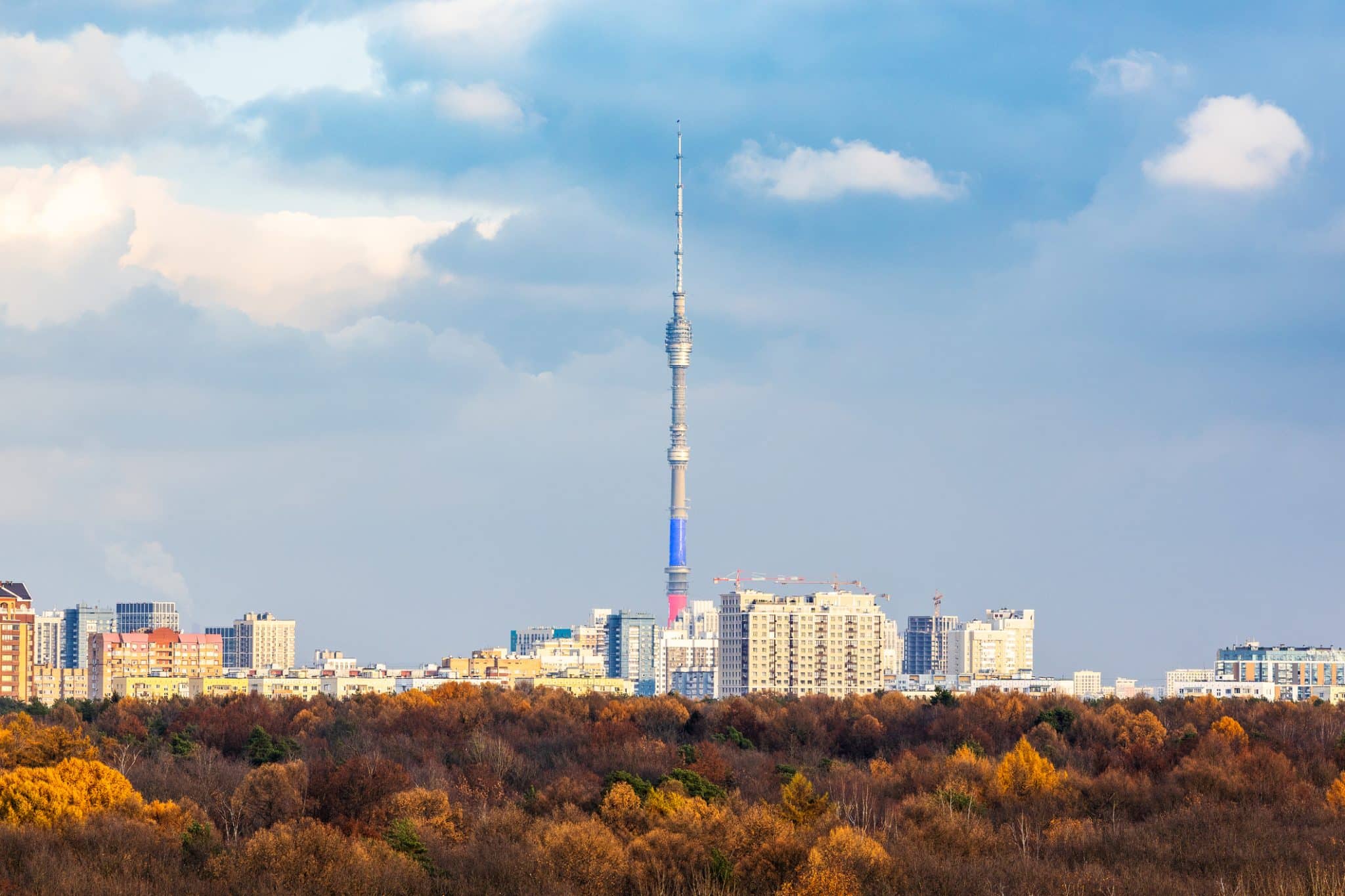
The Ostankino TV Tower dominates the skyline in northern Moscow. When it was built in 1967, it was the tallest TV tower in the world and could reach 10,000,000 viewers. It is still operational today.
Rossiya 1 is Russia’s most popular channel, its market share growing to 14.3% as of 2025. The vast majority of its programming (around 75-80% on average) is given to news and information programming. Its regular news program, Vesti (News), airs a few times a day with its main broadcast, Vesti 20:00, airing nightly. Localized versions are shown daily by market, such as Mestnoe Vremya and Vesti. Sankt-Peterburg. Meanwhile, 60 Minutes (no relation to the US production) and Vecher c Vladimirom Solovyovym combines news and interviews or group discussions about the news. Utro Rossii and Zhizn i Sudba are daily general interest programs with news content while O Samom Glavnom covers health issues and Malakhov focuses on crime, scandal, and celebrities. All of these shows air daily or every weekday. On Sundays, the station airs Moskva. Kreml. Putin., which specifically covers the activities of Vladimir Putin and Russia’s federal government, as well as Vesti Nedeli covering major news of the week plus analysis by conservative host Dmitri Kiselev, who is also the Deputy General Director of VGTRK and General Director of the Rossiya Segodnya conglomerate. Rossiya-1 was founded in 1991, replacing Program Two under the USSR’s Central Television. Rossiya-1 is wholly owned by the federal government via its conglomerate, VGTRK and broadcasts online via Smotrim, a VGTRK-run service.
NTV is Russia’s second most popular channel, with a market share of 9.3% as of 2025. Its programming day is about 50-60% devoted to news and information. Its main news program, Segodnya, is shown six times a day in various formats including local editions. ChP (short for “Чрезвычайное происшествие” or “emergency situation”) shows crime news while Za Granyu focuses on crime and scandal. Mesto Vstrechi offers group discussions of current events while Pozdnyakov gives long-form interviews. Utro. Samoe Luchshee is a general interest morning show with some news content. Tsentralnoe Televedeniye (Central Television; the name is the same as the Soviet-era state television broadcasting) and Itogi Nedeli are weekly news programs that cover world news. The channel also offers weekly special interest shows on science, education, celebrity news, and history. Ch.T.D, for instance, is a series of documentaries hosted by Margarita Simonyan, the editor in chief for media conglomerate Rossiya Segodnya. NTV itself started broadcasting in 1993, replacing the Fourth Channel Ostankino. Of its traded shares, media conglomerate Gazprom Media controls 86.5%.
Pervyi Kanal is broadcast free to over 99% of the population and over 90% of Russia’s federal territory. Its falling market share stands at 6.5% as of 2025. About 80% of its broadcasting time is devoted to news and information. Pervyi Kanal’s main news program is “Vremya” (Time) which shows at 9pm and runs a full hour. News is also shown at five other times daily as “Novosti.” On Sundays, the channel offers Voskresnoe Vremya, which covers major news for the week and adds conservative analysis. Bolshaya Igra and Vremya Pokazhet feature group discussions on contemporary issues in Russian and global news. Pust Govoryat and Muzhkoe Zhenskoe both look at scandals, Modnyi Prigavor at fashion, and Zhit Zdorovo at health. Dobroe Utro is a general interest program with news content. PODKAST.LAB looks at specific subjects with invited guest hosts. Pervyi Kanal was founded in 1995, replacing the USSR’s First Program. The government once directly held as much 51% of the channel’s traded shares, but as of 2022, the state, through RosImushestvo, controls 34.2% plus a “golden share” that allows it to veto “any important decision” concerning the channel. Other shareholders include National Media Group at 19%, VTB Bank at 33% (VTB is 50% plus one share owned by the federal government), and the SOGAZ insurance company, at 13% (in which government-controlled entities are also invested). Due to the golden share, sales of the channel’s stock are regulated through the Russian Prime Minister’s office.
Pyatyi Kanal claims a falling market share of 6.9% as of 2025. It began broadcasting in 1938 as Leningrad’s local station. As of 2022, it relocated its headquarters to Moscow and maintains a federal focus. Pyatyi mostly focuses on entertainment, often airing episodes of shows in marathon formats of 3-4 hours at a time. Its only news show, Izvestia, is shown five times daily on weekdays, once on Saturdays, and not at all on Sundays. It is produced by the news team from the paper of the same name, as both are majority owned by National Media Group (73.4% as of 2023). Minority shares, as of 2023, were held by Sergei Rudnov (owner of Baltic Media Group), the Saint Petersburg City Agency for TV and Radio broadcasting, and the SOGAZ insurance company.
Ren TV claims about 6.7% market share as of 2025 and is known for sensationalism. About 80% of its content is news or informational. RenTV’s thirty-minute daily news program, Novosti 24 (News 24), airs between four and five times a day. Itogovaya Programma airs Sundays with news and analysis while Voennaya Taina and Sovbez, which air Saturdays, focus heavily on Ukraine, NATO, the US, and other “enemies.” Other news programs include Samye Shokiruiushchie Gipotezy (The Most Shocking Hypothesis), which specializes in making the most extreme predictions and analysis of current events, and Ekstrennyi Vyzov 112, which covers scandals, often involving local governments or city services. Other general interest informational programming like S Bodrym Utrom and Tainy Chapman (the latter hosted by Anna Chapman, who was expelled from the US on charges of espionage), often present pseudoscience and conspiracy theories. The channel is majority owned by National Media Group (82% as of 2023).
TV Tsentr is 81.3% owned by the City of Moscow, Department of Property. About 20% of the channel’s programming is given to news and information. The channel’s major news program, Sobitiya, maintains a federal and international focus and airs two to four times daily. A special episode, Sobitiye 25-y Chas airs each weekday at midnight with news and analysis. Sobitiya has also provided weekly half-hour special reports on topics from geopolitics to local agriculture. Meanwhile, Gorod Novostei, which airs once every weekday, focuses on Moscow city news, especially infrastructure, sport, and culture. Gorodskoe Sobranie, airs once on Mondays and looks at official activities of the city government. Petrovka 38, produced in partnership with Russia’s Ministry of Internal Affairs, broadcasts crime news once or twice daily. Weekend analysis programs include V tsentre sobiti, Postscriptum, and Moskovskaya Nedelya, the latter only partly focused on Moscow-specific news and all three covering global and federal news. The channel focuses mainly on documentaries and producing romance and detective serials. It claims 3.4% of the market share. Minority shares are held by the Central Fuel Company and Aktiv Telekom System.
Telekanal Zvezda is 100% owned by Russia’s Ministry of Defense. It is unique in that while a relatively low two thirds of its airtime is given to news, it airs by far the greatest number of individual programs. Novosti Dnya (no page on site), airs three to four times daily with Novsoti Nedeli (no page on site) additionally shown on Sundays. On weekdays, Otkrytyi Efir offers group discussions, Mezhdu Tem long form interviews, and Po Goryachim Sledom hot, quick takes on major issues. Voennye Novosti (no page on site) looks specifically at the army and Segodnya Utrom mixes chatty daytime hosts with serious issues like world politics, economics, and health. Weekly shows like Kod Dostupa, Glavnoe, Vtoroe Mnenie, and others cover various news subjects in various formats. Zvezda also produces documentaries as well as informational shows about military life and equipment. Outside of news and information, it offers a steady feed of military-themed movies and serials. Zvezda was first conceived in 1998 as a way for the army to improve its image after multiple corruption and abuse scandals. Although it was scheduled to go on air in 2001, it missed its deadline, but continued to receive financial support from Russia’s Ministry of Communications during a “period of correction” that lasted until 2005. Only then did broadcasts begin.
Telekanal Sankt Peterburg is a multi-genre station 100% owned by the St. Petersburg City Administration. It was launched in 2009 as part of Pyatyi Kanal’s (see above) reform into a fully federal station. It airs a number of news and information programs in both surprisingly short formats and unusually long formats. Its main news program, Novosti, airs four to seven times each day in slots of 5-15 minutes, with a half-hour Novosti Itogi Dnya program shown Monday-Thursday at eight. Specialized short slots are devoted to sports, business, and crime. Even some weekly analytical shows like Sol Sobytiy and interview shows like Pryamaya Rech are also short. Meanwhile, other programs like the weekly news show Itogi Nedeli and the cultural interview show Teatralnaya Gostinaya air in formats that take 1-2 hours. Most of its programming is focused on St. Petersburg city news, history, culture, politics, and lifestyle, but it also airs older serials and films.
24-Hour News and Information Channels back to top
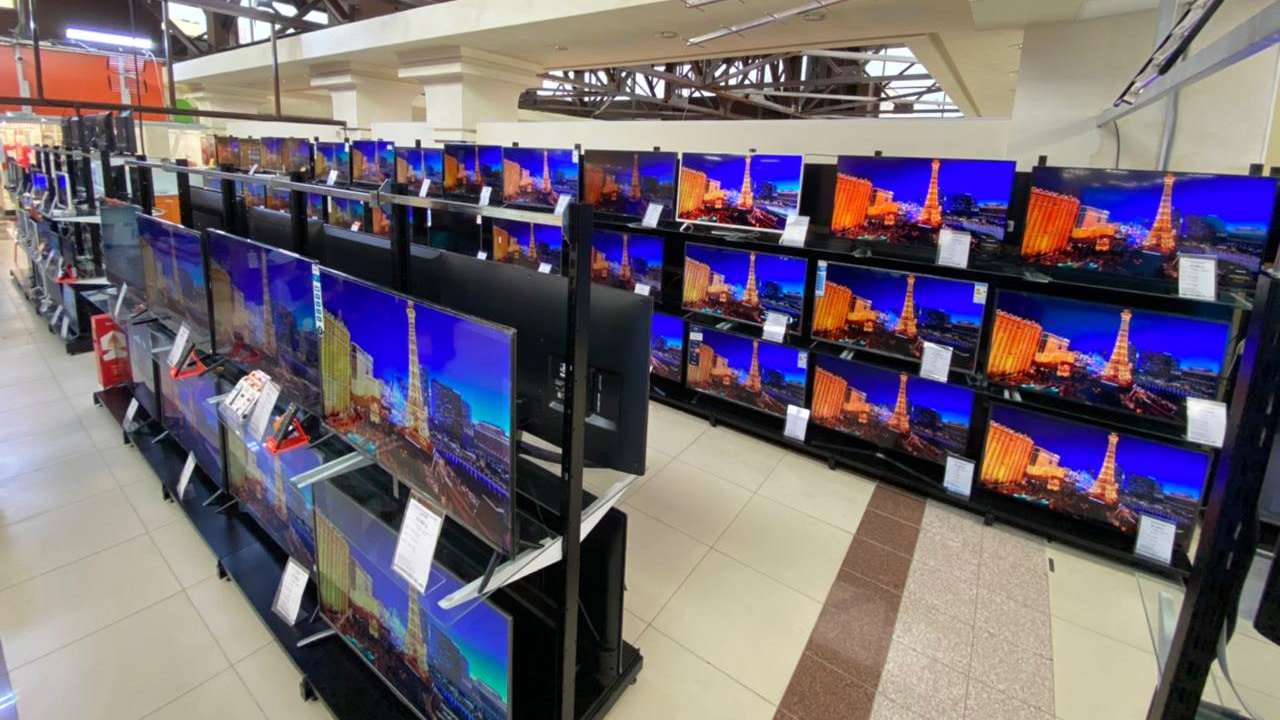
TVs for sale at an electronics shop in Berezniki, a city of about 130,000 people in western Russia.
Rossiya 24 is wholly owned by the federal government via its conglomerate, VGTRK. It began broadcasting in 2006 under the name “Vesti” but rebranded in 2010 as Rossiya 24. It shares a news room and several programs like Moskva. Kreml. Putin. with its sister channel, Rossiya 1 (see above). Rossiya 24 offers news as Novosti in the morning and Vesti in the evening (no online material for either program). Specialized segments are regularly aired for crime, weather, and the Duma. Economics is reported in segments devoted to specific sectors. Coverage has changed considerably in recent years, with sports being taken out of regular rotation and weekends no longer focusing on documentaries and economics. The channel now offers more programs such as Fakti (focusing on statistics and quotes), Za Lentoi (war coverage; no online material), and programs focused on news from and about specific countries and regions like America, Great Britain, and Central Asia. The channel also airs interview programs like 5-ya Studiya and Tucker Carlson dubbed into Russian.
Moskva 24 is a 24-hour news and information channel operated by the Moscow City Government. It carries national news with a heavy skew towards Moscow-specific coverage. Regular reporting slots are given to weather, crime, culture, and economy. A weekly Itogi program is aired on Saturdays and rerun on Sundays. The channel does not focus on interviews, group discussions, or analysis, and instead gives more cultural information and “light” programming. Moskva 24 replaced the Moscow cable channel TV Stolitsa in 2011 under a reorganization initiated by Moscow Mayor Sergei Sobyanin. It is owned by the Moscow-city controlled conglomerate Moscow Media.
RBK is a 24-hour news channel devoted to business, finance, and investment, with some coverage of art and culture. Politics is sometimes covered, most often in terms of how it might affect investments. Since 2022, the channel has focused on Russian economic issues rather than extensively looking outward at global markets. Regular updates are aired on Russian stocks, bonds, and specific shows on various Russian industries. There are also analytical and interview programs like Tamantsev, Insite, and Chto Eto Znachit? Regions are occasionally specifically covered, particularly St. Petersburg and the station also recently ran a series of regional profiles focused on culture and economics. RBK is 100% owned by the RBK Information Systems conglomerate.
Euronews was available in Russia in Russian via satellite packages as well as on broadcast TV, sharing airtime with Russia’s Telekanal Kultura, which is usually devoted to arts broadcasting, and which is 100% owned by media conglomerate VGTRK. It was taken off the air in March 2022 and has since been declared undesirable. Euronews is 97.6% controlled by Alpac Capital, a private investment group based in Portugal.
Major Social Networks in Russia
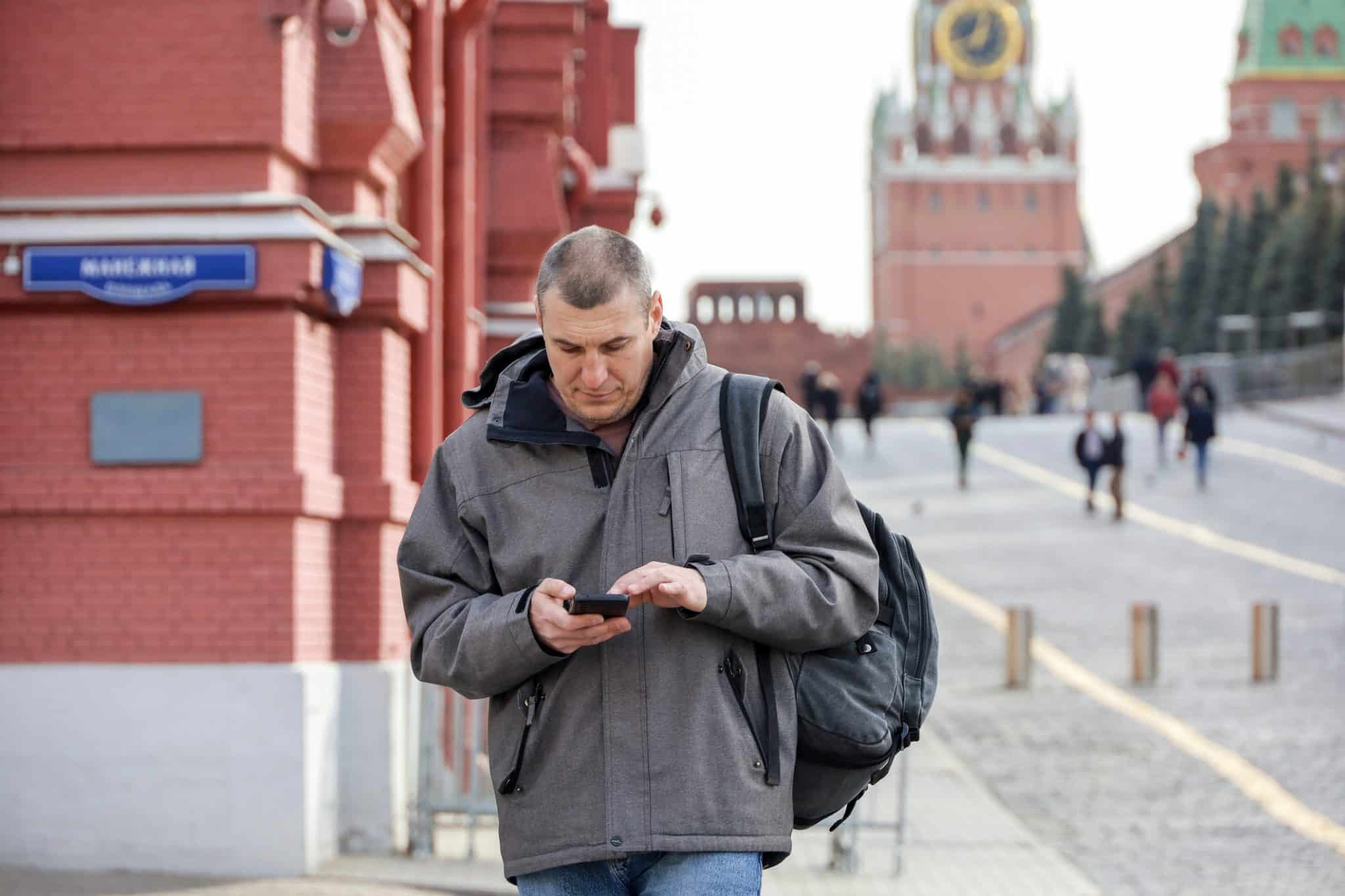
A man exiting Red Square, browsing information on his phone. Russians increasingly get their news from online sources.
According to the Levada Center, as of August, 2025, 36% of Russians get their news primarily from social media. This audience tends to be younger, more educated, and more urban than those primarily watching television. Trust in news from social media has hovered around 17% overall since 2022, although 34% of respondents under 24 years of age say they trust this medium. Below are Russia’s major social media networks.
Russia has always had a unique internet environment, in part because global companies were slow to launch Russian-language versions of their sites and services and because Russian-language morphology required specially-coded search functions. Below is information on the current status (as of February, 2026) of major social networks in Russia.
VK (originally VKontakte) was founded in 2006 by Pavel Durov and his brother Nikolai in Saint Petersburg as a Russian equivalent to Facebook. It allows users to message, join groups, and share text, images, audio, and video media. It long faced some controversy as the ability to post large files led to numerous instances of piracy and copyright infringement. Durov was forced out of the company in 2014 for not releasing user information on protesters to Russian state security forces and refusing to delete opposition groups from the site. VK was then 100% absorbed into Mail.ru Group, then controlled by billionaire Alisher Usmanov through his investment vehicle, USM Holdings. Ownership of VK has changed often since, most recently in 2024. Current shareholders include Vladislav Brylkov (former CEO of Gazprom’s Gaz-Service subsidiary) with 25%, Professionalnyi Stroitel (an infrastructure firm working for the city of Moscow) with 25%, financier and fund manager Pavel Prass (who also helped “reshore” Yandex back to Russia in 2024), with 19%. The rest is owned by the Nezavisimaya Alians investment fund, about which little is known. Although VK is Russia’s largest social network, with hundreds of millions of accounts and estimates suggesting billions of page views per day, the company is unstable and posted a financial loss in 2024 of more than $1 billion.
Telegram is the social media Russians cite as using specifically as a news source. It was founded in 2013 by Pavel and Nikolai Durov as they realized that weaknesses in their site, VKontakte, left it open to privacy concerns. Telegram is cloud based and billed as one of the world’s most secure social media platforms. It allows users to send messages, make calls, and share files and media, and create public “channels” and groups that function like news and community feeds. These feeds are now the second most trusted source of news in Russia, especially among those under 40. Although the authorities have pressured the Durovs for the keys to monitor Telegram, they have been unsuccessful. The servers, company, and the Durovs themselves are now based in Dubai, Saudi Arabia. Pavel Durov is the app’s sole owner. Previous attempts to block or censor the app have been made, but its cloud hosting, popularity with Russians, and integration to media companies, whose monetized feeds are often a major part of their business, and to government entities, who use channels for public outreach, previously made this difficult. However, in February, 2026, the Russian government announced that it would begin throttling Telegram traffic using methods that have proven effective for severely disrupting WhatsApp and YouTube services. Telegram has surpassed one billion monthly active users, making it one of the world’s largest social platforms.
Meta has been declared an extremist organization in Russia. Facebook, Instagram, and WhatsApp, which are owned by Meta, are all officially blocked within the country. Enforcement of VPN rules and ISP requirement has gotten increasingly more effective, meaning that for most Russians using these platforms has gotten increasingly difficult if not impossible.
TikTok, in response to further tightening of Russia’s “fake news” laws in 2022, restricted content for Russian users made before the law was passed and blocked new content from being loaded inside Russia. Thus, the app is still available, but officially restricted to older, local content. That said, an article recently posted on mail.ru (owned by Rambler&CO) details how Russians can skirt restrictions on TikTok inside Russia. It appears the Russian government has not taken additional measures specifically to restrict the service.
RuTube is a Russian video-sharing platform founded in 2006 by Oleg Volobuev and Mikhail Paulkin, a pair of businessmen from Oryol, Russia. It was created specifically as a domestic alternative to YouTube. However, although it copied most of YouTube’s functionality, it offered little to draw users away from the already extensively-populated Google-owned giant. In 2008, Gazprom Media acquired the service and today still owns 100% of it. RuTube has continued to grow steadily and, as of 2025, its monthly audience reached around 70–80 million users with total video views in the billions. Most popular fan-created content is duplicated on other platforms such as YouTube. The service is also populated with content created by Gazprom Media’s television stations.
YouTube has been very popular in Russia and has produced a number of major Russian-language vloggers such as Yury Dud and Irina Shikhman, who produce long-form interviews, Daniil Orain, with man-on-the-street interviews, and Illia Varlamov, with indepth reporting on various issues. YouTube has not been expressly banned in Russia, but has been notified of many infractions of Russia’s media law and has not always abided by “take down orders” made by the Russian government. YouTube’s traffic has been slowly throttled in Russia through ISP filters, making it an increasingly inconvenient platform there. As of 2025, YouTube usuage in Russia has fallen to around 10% of its former highs.
Odnoklassniki was launched in 2006 by programmer and businessman Albert Popkov. Odnoklassniki is especially popular among older users and in regional communities. The platform is owned by the conglomerate VK, which acquired full control in the late 2000s. Although Odnoklassniki generates hundreds of millions of monthly visits, it is still far behind other social media platforms in terms of use.
For more information (in Russian), this December 2025 article from RBK provides an excellent overview of the status of other networks and services in Russia.
News Agencies
Boost your resume and your knowledge of the Baltics with this unique certificate program.
News agencies are organizations that gather, verify, and distribute news to other media outlets rather than primarily publishing directly to the general public, although many do maintain websites with their stories and sometimes are part of conglomerates that also own newspapers, broadcasters, websites, or magazines that might use these stories as is or in adapted form. News agencies typically maintain networks of correspondents and bureaus across regions or countries, allowing them to cover events efficiently and at scale. They operate on subscription, membership, or contractual models and may be privately owned, state-owned, or publicly funded. Major news agencies in the west include Reuters, a publicly listed company majority-owned (67.8%) by the Thomson family, and the AP, a non-profit organization owned by its members, which include newspapers and broadcasters.
Of the news agencies below, the vast majority are now either owned by the state or have close managerial ties with the state. Most are now sanctioned and/or banned in the EU for charges relating to their coverage of the war in Ukraine.
TASS was originally founded in 1904 and was controlled by the tsarist government. Today, it is one of the largest global news agencies and is wholly owned by the Russian government as a unitary enterprise. Its Director General is Andrey Kondrashov, a former television journalist who served as a press secretary for Vladimir Putin’s election headquarters in 2018.
RIA Novosti was originally launched in 1941 by the Soviet government. It has been reorganized many times and currently operates under the Rossiya Segodnya conglomerate.
Sputnik operates under Rossiya Segodnya as the media conglomerate’s main international arm. It was spun off from RIA Novosti after its integration into Rossiya Segodnya. Sputnik has bureaus in Washington, D.C., Cairo, Beijing, Paris, Berlin, Madrid, Montevideo, and Rio de Janeiro and offers news in 31 languages.
Interfax is a privately held company originally founded by employees of the Voice of Russia radio station shortly before the fall of the Soviet Union. In the past, it worked closely with some government entities (such as the Federal Financial Markets Service) as well as western entities such as Reuters news agency and Moody’s ratings service to provide both news and legal compliance services. Paid news feeds are available in English; only the Russian language side contains substantial free news.
Rosbalt was founded in 2000 as an independent news agency covering Russian regions and Russia’s near abroad. In 2021, it was labeled a foreign agent and lost much of its advertising revenue. It was then bought by PremierMediaInvest, which already held several smaller and regional publications. PremierMediaInvest itself was shortly thereafter purchased by Maer Group, one of Russia’s largest advertising firms.
Regnum was founded in 2002 to focus on reporting from the post-Soviet space. It also operates regional branches throughout Russia. Regnum publishes upwards of 700 articles a day from its various sources. The agency is owned by Sergei Rudnov, who is currently sanctioned by Canada, Ukraine, and the United Kingdom for supporting Russia in its war in Ukraine. The agency’s CEO is Yulia Krizhanskaya, a former deputy chairwoman of the United Russia party.
Ura.ru is focused on news from the Urals Federal District. A majority stake in the agency (75%) was purchased by Readovka, a company that consists of news sites and monetized social media pages on Telegram and VKontakte. Readovka was recently taken over by Andrey Tkachenko, an elections manager that has worked closely with President Putin’s campaigns in the Urals region. He immediately fired most of the top staff, including editorial board head Mikhail Vyugin (who still owns the other 25%) and editor-in-chief Diana Kozlova. The new appointed editor is Ekaterina Kuraeva, a journalist who previously headed the Kurgan Regional Management Center. These centers were set up by the presidential administration to monitor and answer residents’ local complaints.
Sibnovosti.ru is another example of a regional news agency. MKR-Media combined the news site Sibnovosti with the Radio Siberia network into a single holding to create a new news agency in 2025.
Online Aggregators and Publications
Online media is cited by 29% of Russians as the primary way that they stay informed about events. About 15% of Russians say they trust internet publications the most. Both statistics were determined by a Levada Center poll from August, 2025. The majority of major print publications in Russia also run online editions.
News Aggregators back to top
News aggregators compile news feeds from other sources, often favoring what is trending and/or curating feeds based on past user behavior and/or stated preferences. Many readers will check them regularly as one once browsed a newspaper.
Rambler was once a major search engine and now most popular in Russia as an aggregator. It is owned by Rambler & Co.
Mail.ru is an email service in Russia which also supplies a popular news aggregator. It is owned by Rambler & Co.
Dzen was once owned by Yandex, Russia’s top search engine. In 2022, to avoid new laws surrounding fake news, Yandex sold Dzen, a blogging platform, and Yandex.Novosti, Yandex’s news aggregation platform, to VK, a Russian conglomerate which also owns Russia’s largest social networking site. VK combined the two functionalities into Dzen, which also still offers Yandex-powered search functions.
Online News Publications back to top
The following are some of the major internet-only journalistic enterprises in Russia.
Lenta.ru and Gazeta.ru were both launched in 1999 as projects of the Foundation for Effective Politics, which specialized in organizing political campaigns. They worked mostly with liberal candidates including the Union of Right Forces and, at the time, Vladimir Putin’s first 2000 election campaign. Both sites were later sold to Uzbek businessman Alisher Usmanov in 2006 and then to Alexander Mamut in 2013. Mamut immediately fired the editors of both independent sites and replaced them with journalists who had worked in state-owned media companies. Mamut also joined both sites to his media conglomerate Rambler&Co, which was later sold to Sberbank. Lenta is still Russia’s #2 news site. Gazeta is ranked #3. Each site gets 30-40 million page views per month.
INOsmi.ru is a site entirely devoted to translating foreign journalism into Russian. It receives about 13 million visitors per month as of April 2025. Launched in 2004 as part of the news agency RIA Novosti, it is now owned by the Rossiya Segodnya state media group.
The Russian Legal Information Agency focuses on news from Russia’s legislatures and courts. It was launched in 2009 as a project of the news agency RIA Novosti, the Russian Supreme Court, and the Russian Constitutional Court. It is now owned by the Rossiya Segodnya state media group.
Fontanka.ru is a St. Petersburg-based Internet news site founded in 2000 by the Agency for Journalistic Investigations. The agency itself was founded in 1996 by a journalist collective the would soon make a name for itelf by solving major crimes in ways that actually resulted in convictions. A controlling stake in the site is now owned by Shkulev Holding, which runs it as a “city portal,” focused on culture, entertainment, and local infrastructure projects. It receives about 200,000 visitors per day.
Life.ru started as an Internet tabloid known for paying generously for scoops on celebrities and politicians. It published some of the first pictures of Edward Snowden in Moscow and once had an army of “citizen journalists” follow Alexei Navalny as he vacationed in France. While the organization still holds true to its roots, it more or less functions today as a Russian equivalent to Buzzfeed. It once also had a TV and radio station, although those services have since been taken off the air and brought entirely online. It is owned by News Media Holding.
Vzglyad covers domestic and international economic, political, and cultural news. It is known for its decidedly conservative, pro-Kremlin viewpoints. It is owned by the Expert Institute for Social Research, a political think tank with close ties to Russian nationalists and the Kremlin. It receives about 250,000 visitors per day.
Republic (formerly Slon.ru) is a digital magazine devoted mostly to political and business news. Owned by Moscow Digital Media, it receives about 180,000 visitors per month. In 2021, Moscow Digital Media was added to the Russian government’s list of “foreign agents” and its editor left Russia. The “foreign agent” label was removed after the editor resigned in 2024.
Compromat.ru was a well-known site that specialized in publishing information that makes people look bad. Owned by private investor Andrei Rotburg, it stopped publication in 2024 and has since gone offline.
Print Publications

A newsstand in Moscow in 1961 near Pushkin Square.
In 2013, nearly a quarter of Russians got their news primarily from print media, making it second only to television in terms of its dominance of the media sphere. Today, just 6% of Russians rely primarily on print media, putting the category in last place. Further, print sources are trusted by only 5% of the population, ranking them only marginally above YouTube channels. Russia’s Union of Printing Industry Enterprises states that from 2004-2024, the number of newspaper kiosks, once prolific in the country, decreased by 75%.
All of the publications below also run online editions which would also place them in the Online News Publications category above.
Newspapers back to top
Argumenti i Fakti is a weekly publication and one of the world’s largest newspapers by circulation, with print runs of over 1.5 million, similar to The Sun (UK), to which it is also similar in style. Published since 1978, it comes in various regional, international, and topical editions. Once held by the publicly traded Media 3, it was sold in 2014 to the conglomerate Moscow Media, which is owned by the Moscow City Government, and which paid nothing for the paper, except assuming $55 million of the paper’s debts.
Rossiyskaya Gazeta (RG) is directly owned by the Russian government as a budgetary institution and serves as Russia’s “paper of record.” This means that the Russian government is legally required to publish new laws in the mass media and Rossiyskaya Gazeta is the paper in which it does so. RG was founded in late 1990 by a decision of Soviet Russia’s Supreme Court, which stated that the Russian RSFSR needed its own paper of record as glastnost encouraged more autonomy from the various constituent republics. The Baltics had already declared independence at the time and the USSR would cease to exist about a year later. Russia retained the paper of record after independence. In addition to publishing legislation, RG also covers politics, business, and culture in weekday print runs of just over 100,000 as of January 2024. RG-Nedelya, its Saturday edition, runs at 3.2 million copies.
Komsomolskaya Pravda is the former mouthpiece of the Komsomol, the official USSR-wide communist youth group. Originally launched in 1925, it is now one of Russia’s largest tabloid-format newspapers, printing about 165,000 daily copies and about 1.2 million weekly “fat editions” across Russia (and nearly one million more outside of Russia as an international edition in places like Israel and Kazakhstan). It is majority owned by LDV Press, a company 75.1% owned by Sergey Rudnov, whose father is the founder of Baltic Media Group. The rest is held by Media Partner, a company controlled by Vitaly Krivenko and Sergey Orlov, businessmen with ties to the Russian state-owned railway company RZD.
Izvestia was founded in 1917, originally as the organ of the Petrograd Soviet of Workers’ and Soldiers’ Deputies, and later became the paper of record for the USSR. The paper became independent and internationally respected after 1991, even partnering with the famed British Financial Times, but was unprofitable. It changed hands several times before being purchased by National Media Group in 2008. The paper was greatly downsized and became more oriented towards specifically business and culture. It now has print runs of about 83,000. They have recently launched what appears to be an AI-translated English version of their site. In addition to its own print and electronic versions, Izvestia also runs the news services of the TV stations REN TV (see below), Pyatyi Kanal (see below), Telekanal 78, and the publication Delovoi Peterburg.
Vechernaya Moskva was founded in 1923 and has the largest weekly circulation of any newspaper in Moscow. It is currently organized as a joint-stock company wholly owned by the Moscow City Government. It focuses mostly on current business, social, cultural, and demographic issues, especially those affected by the policies of the city government. Over 2.5 million copies are published each week across three formats: a daily, a weekly, and an evening edition which is available for free in the Moscow subway system.
Metro started as a free Swedish tabloid. It grew into a Europe-wide company based in Luxembourg that published in localized editions in major cities, drawing all revenue from advertising and using public transport stops as main distribution points. The main parent company has since folded, as readers have turned more to cell phones and stopped reading the free papers. Its Russian editions in Moscow (print run 270,000) and St. Petersburg (print run 150,000) continue, however, having been purchased by their respective city governments. Both appear to still be joint-stock companies and wholly owned by each city, and are possibly now integrated in the organizational structure of the busy subway systems in each city where they continue to be distributed for free. Once published in smaller Russian cities, such as Kazan and Nizhniy Novgorod, editions were planned for far more cities such as Barnul and Ufa. However, no other edition besides those in Moscow and St. Petersburg has been published since late 2021. Some past digitized print editions can be found online.
Peterburgskiy Dnevnik is the official newspaper of and wholly owned as a joint-stock company by the St. Petersburg municipal government. It focuses on “modern life” in the city and “city projects being implemented by the authorities.” It is produced each weekday in print runs of 150,000.
Kommersant focuses on business and politics. Originally founded under glastnost in 1989, it was owned by liberal-leaning investors until 2006. In that year, it was purchased by Uzbek businessman Alisher Usmanov. There have been some editorial clashes between Usmanov and the paper, although it does retain a reputation of being relatively independent. As of 2023, it has daily print runs of about 63,000.
RBK Daily has been known for business coverage since its founding in 2006. RBK and its parent company, media conglomerate RosBusinessKonsulting (RBK), were once highly associated with their founder, business tycoon and one-time presidential hopeful Mikhail Prokhorov. Shortly after RBK Daily broke a sensitive story about the business dealings of Putin’s close associates, its sale was arranged to Russian businessman Grigory Beryozkin’s ESN Group in 2017. RBK Daily is published in daily print runs of 80,000.
Vedomosti is a daily financial newspaper with an audience of about 200,000. Founded in 1999, it marketed itself as a “Western newspaper” in Russia, with significant percentages of its shares owned by the Wall Street Journal, the Financial Times, and Sanoma Independent Media until 2015, when the Russian government passed restrictions on foreign ownership of Russian media. It has since changed hands several times. While owned by businessman Ivan Yeremin, in June of 2020, much of the senior staff left Vedomosti to found the now defunct online publication known as “VTimes,” accusing Yeremin’s new editor-in-chief of censorship to suit pro-government narratives. Since then, Vedomosti has been sold to Russian businessman and politician Oleg Leonov, who is also a State Duma legislator with the New People party.
Moskovskii Komsomolets, founded in the USSR in 1919, was the official paper of Moscow’s municipal communist youth group. It is still published every day except Sunday, while weekly regional editions are released on Wednesdays. It is one of the most affordable papers on the market (with issues priced around 60 cents USD). It is privately held by journalist and businessman Pavel Gusev, who chairs the Moscow Union of Journalists (see “Professional Organizations,” below) and who is on several government boards concerning human rights and civil society. Daily distribution is around 400,000, except for the Wednesday daily, which includes a TV program and of which 700,000 copies are printed.
Trud was founded in 1921 as a flagship for Communist ideology. By 2007, it was fully owned by Media 3. Advertising revenues declined as the owners tried to rebrand one of Russia’s oldest newspapers for a younger audience. It was eventually sold to The Society of Free Journalism, an organization controlled by Sergei Tsoi, a former press secretary for former Moscow Mayor Yuri Luzhkov. Tsoi also once managed many of the extensive media holdings of the Moscow City Government. As of 2026, Trud was published weekly with print runs of 65,000 and offers a weekly edition, Trud 7, in runs of 1.3 million.
Nezavisimaya Gazeta was originally founded by the Moscow Soviet under perestroika in 1990. It was modeled on the British paper The Independent. After the 1993 constitutional crisis and the dissolution of the Soviet, it was privatized and sold to its editorial board who then sold it on to The Berezovsky Media Group. Since 2007, it has been owned and edited by Konstantin Remchukov, a journalist and businessman who once also served as a Duma Deputy with Boris Nemtsov‘s Union of Right Forces Party. The paper is known for its moderate opposition political and social reporting. It is published weekly with print runs of 40,000.
Novaya Gazeta was opened in 1993 by Mikhail Gorbachev using money from his 1990 Nobel Peace Prize. Today, the paper is majority owned by its staff, although liberal oligarch Alexander Lebedev also holds shares in the paper. A long-time oppositionist publication, the paper is known for the number of its journalists that have been assassinated (including Anna Politkovskaya and Stanislav Markelov). In 2021, its general editor Dmitrii Muratov was awarded a Nobel Peace Prize for his efforts towards the preservation of freedom of thought. In 2022, the paper refused to follow labeling requirements after being named a foreign agent. Their license to publish was revoked the same year. Muratov and the paper’s journalists (both those who had fled Russia and those who stayed) launched several online publications, most notably Novaya Gazeta Europe, which is banned in Russia. The original site Novaya Gazeta website is now operational again as a “constructor,” offering crowdsourced stories and personalized news feeds built without editorial oversight. Presumably, this allows it to be classed as a social network rather than a news site.
Literaturnaya Gazeta was first founded in 1830 by a literary group led by Alexander Pushkin. It became a staple of Soviet life and by 1989, it ran in print runs of 6.5 million, one of the largest of any newspaper ever. Today, without the massive Soviet subsidies, the paper prints weekly runs of 113,800. Its logo is still a sketch of Pushkin with Maxim Gorky, the most celebrated Soviet author. The paper is known for a conservative focus on literature (with some actual stories and poems published) and also some political and social commentary. It is owned and operated by a non-profit group of the same name that is specifically devoted to publishing the paper.
Magazines back to top
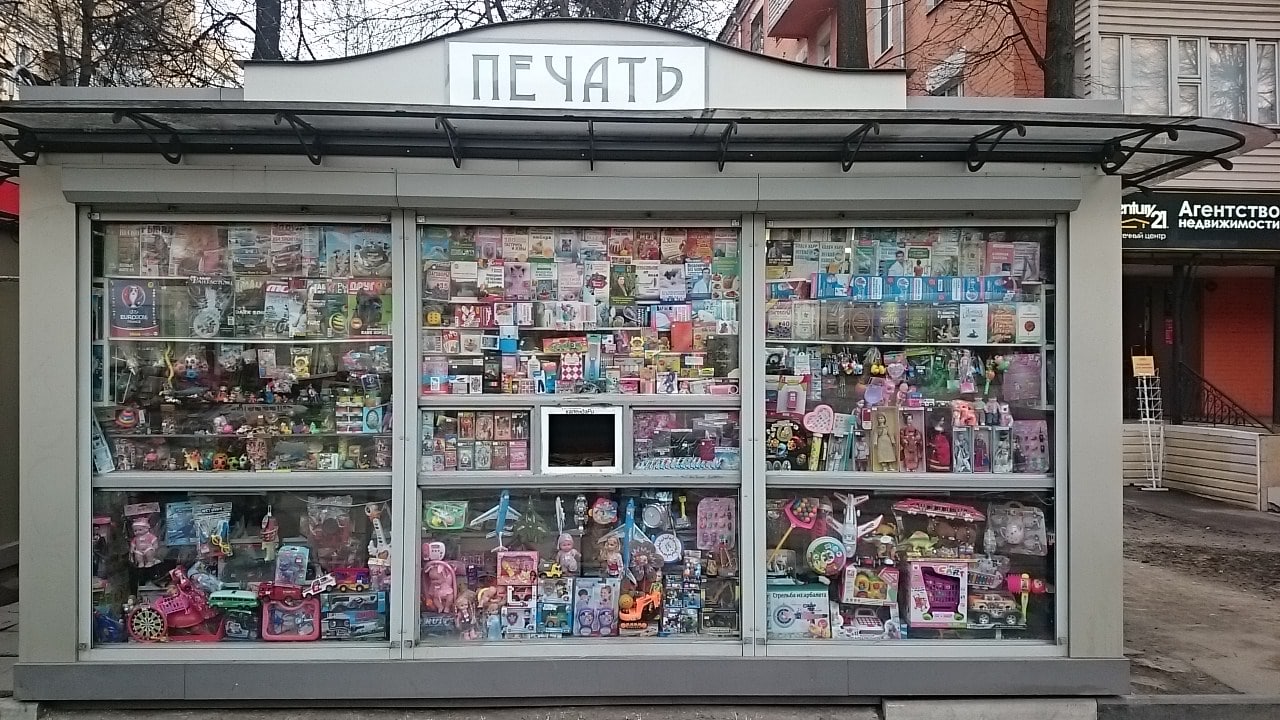
An example of a modern press kiosk – which often now do not display newspapers as their first offerings.
The magazines listed below are those which give some coverage to political and social issues as well as those which did so until recently.
Expert is a monthly business magazine that frequently addresses political issues. Most recent issues are published in print runs of 70,000. However, some special report issues may be printed in runs of up to 100,000. There are also various regional publications under the brand (including Siberia and the Far East, North-East, South, and Ural regions). The magazine was once owned together with Russian ratings agency Expert RA (now known as RAEX) and Expert TV, a former cable TV news channel. Although the holding should have had obvious synergies, the ratings agency alleged the media arms were taking payment for positive coverage of businesses and pushing for the agency to improve the scores for these paying businesses. Expert RA broke ties with the media arms which then soon went bankrupt. In 2023, the magazine was re-launched under new management and without ties to the ratings agency. A significant stake in the company was and is owned by VEB Bank, which is in turn fully owned by the Russian Government.
RBC (RosBuisinessConsulting) is a business-focused magazine published five times a year. Topics include society and politics as well as various deep dives into economic sectors. RBK often publishes stories that purport to view stories from multiple angles, using quotes from opposing forces. The magazine is owned by the conglomerate RussianBusinessConsulting and is published in print runs of 145,000.
Pravila Zhizny (Rules of Life), formerly a licensed a partly localized version of Esquire, once gave heavy focus to the Russian political opposition. In March 2022, American-owned Hearst Media, which holds the rights to Esquire, terminated its agreements in Russia, posting a statement about the “escalation of the humanitarian crisis.” Today, the renamed Russian magazine focuses on lifestyle, pop culture, fashion, and entertainment. It is printed in runs of 30,000 and is owned by Independent Media.
Snob is a monthly lifestyle magazine that covers everything from literature and consumer goods to popular science and culture. It was once heavily associated with its former owner, 2012 liberal presidential candidate Mikhail Prokhorov, who has since sold his stake to current CEO, Marina Gevorkian. Under Prokhorov, the magazine was associated with liberal politics and philosophies. It has now discontinued political coverage and avoids sensitive social issues. It is published in print runs of 90,000.
Russkii Reporter was a weekly, later bi-weekly magazine printing 160,000 copies per issue. It was primarily marketed to men and middle-class individuals, focusing on politics and social issues. It was particularly known for its photo journalism and billed itself as a rough equivalent to Time or Der Spiegel. It was owned by Expert Media Holding (see “Media Conglomerates,” below). Russkii Reporter was WikiLeaks’ main partner in Russia. From 2016 to 2017, the journal ceased to be published, citing financial issues and a lack of interest from investors. The journal resumed publication in February 2017 but suspended its operations in April 2020, again citing financial troubles.
Ogonyok (The Flame) was a long-standing weekly magazine that covered social and political issues, discontinued in 2020. It began in 1899 as a weekly illustrated magazine devoted to literature and the arts. Ogonyok became increasingly devoted to political issues during the Soviet period, particularly after it was acquired by the Pravda publishing house. After the fall of the USSR, it was taken over by a collective of its journalists but eventually sold, changing hands several times over the course of the 1990s. In 2009, Kommersant Publishing House (see “Major Newspapers,” above) bought the paper, which is owned by Alisher Usmanov, known as a Kremlin-friendly oligarch who was sanctioned by the US, EU, and UK following the outbreak of the war in Ukraine. In December 2020 Kommersant announced the discontinuation of Ogonyok, citing financial issues and stating that the Ogonyok team could not find a place within Kommersant.
Major Media Conglomerates
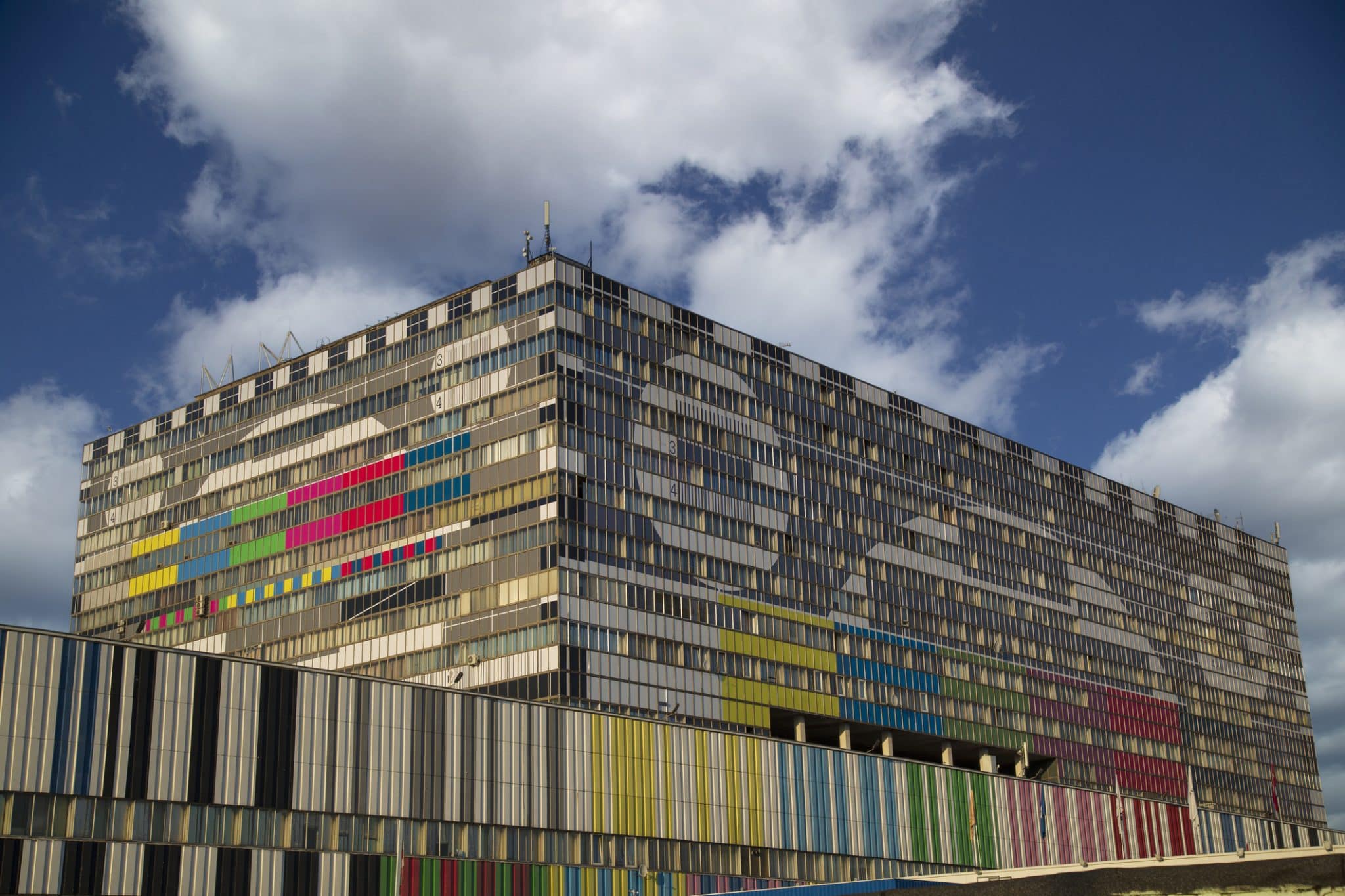
Ostankino Television Center houses the VGTRK stations in northern Moscow.
VGTRK controls most of Russia’s oldest and most recognizable TV stations. It operates as a unitary enterprise under the Russian Federal Government. VGTRK controls 100% of the Russia Channel franchises, which includes Russia-1 (Russia’s most popular channel), Russia-24 (a 24-hour news channel), Russia Kultura (devoted to cultural broadcasts), Russia RTR (a satellite multi-genre channel), while Karusel, a popular children’s channel, is controlled 50% by VGTRK and 50% by Pervyi Kanal. VGTRK also controls radio stations including Radio Mayak (mainly devoted to news and talk shows) and several that are essentially radio versions of the TV Station it controls such as VestiFM (Russia 24) and Radio Kultura. The conglomerate also runs the internet streaming services Smotrim (multi-genre) and Vesti (dedicated to news).
Gazprom Media is Russia’s largest media holding. In television, they own the multi-genre, news-carrying stations NTV (currently Russia’s second most popular) and TV3 (somewhat similar to SciFi network) as well as a range of some of Russia’s most popular entertainment channels such as TNT (a channel specializing in comedies and reality TV), Pyatnitsa (formerly MTV Russia before it rebranded), Subbota (like Pyatnitsa but for slightly older females), sports channel Match TV, 2×2 (formerly affiliated with Cartoon Network) as well as several sub-branded channels. They own several production and distribution networks including Central Partnership, which produces its own films and distributes dubbed films from other countries, Comedy Club Productions, Belye Nochi film studios, and the famed Oktyabr cinema in central Moscow, which is used for film premiers. Gazprom Media’s streaming platform Premier and the social media site RuTube, which it also controls, both feature content from its studios. Gazprom media holds a number of radio stations including the news-carrying AvtoRadio and several entertainment stations focused on youth, women, and comedy. Ekho Moskvy was once part of the portfolio as well, and was long known for offering criticism of the government and liberal points of view until its forced liquidation by Roskomnadzor in March 2022 as a result of its coverage of the war. In print, the company controlled Itogi (a monthly magazine covering everything from culture to politics), which is no longer publishing and still controls other entertainment and lifestysle holding such as Karavan and Sem’ Dnei, both known for celebrity news. Gazprom Media is also now active in blogging platforms with SRSLY as well as Insight, which is essentially a Russia-wide news agency uniting bloggers. Gazprom Media is wholly owned by Gazprombank, which is majority controlled by Gazprom (partially through other companies and organizations controlled by Gazprom). Gazprom is a publicly traded company. As of December 2024, the Russian state holds a controling share in the company through shares held by RosImushestvo and via holdings held by companies owned by Gazprom in a circular ownership scheme.
Rossiya Segodnya is a unitary enterprise under the Russian Federal Government that controls three major news agencies: RIA Novosti, Sputnik, and PRIME (the latter devoted to economic news). Rossiya Segodnya also operates three regional news projects: Ukraina.ru, Baltnews, and Arctic.ru which all carry Russia’s narratives as well as Russia-centric news about these areas. Particularly Ukraina.ru and Baltnews have drawn criticism from the governments of the countries they cover. InoSMI specializes in translating foreign news to Russian. Social Navigator is a series of special projects that produce news articles and internet resources that focus on, for instance, increasing adoption rates and college enrollment rates in Russia, but also on increasing awareness of ancient Russian heroes and Russia’s narrative of liberating Eastern Europe in WWII. The roles of many Russian heroes are contested by Ukraine (which claims some of them and denounces others) while many Eastern European nations teach their experience of WWII as beginning with Nazi invasion and ending in Soviet occupation. Lastly, Rossiya Segodnya runs the TOK and KOT service, which specializes in creating short social media videos, with a specialization in cat videos. Rossiya Segodnya is managed by Dmitry Kiselyov and Margarita Simonyan is the agency’s chief editor. Kiselyov is also known as a conservative pro-government news presenter in Russia, and has also worked on the USSR Central Television. Simonyan is also the chief editor of RT and was personally sanctioned by the EU in 2022 and 2023 as a “central figure of Russian government propaganda.”
Rambler&Co was formed in 2013 after a merger of Afisha-Rambler (controlled by Vladimir Pontanin) and SUP, controlled by Alexander Mamut. The company rebranded to Rambler&Co, after its main holding, the Rambler search engine (which was Russia’s first, but now very rarely used, search engine). The company also controls Lenta.ru and Gazeta.ru, Russia’s #2 and #3 news sites, respectively, Live Journal, one of Russia’s most popular blogging platforms, and other internet holdings. The Rambler Group was purchased by Sberbank in 2020 to aquire Okko, a popular streaming service recently merged into Rambler. Sberbank spun off all assets from Rambler&Co that were, at the time, not affected by Russia’s legislation that forbids more than 20% of news companies being owned by foreign entities (~40% of Sberbank is held by foreign investers). 80% of Rambler&Co was then sold to Medianna, a company owned by Sergey Shishkin, who got the money to buy that majority share in Rambler&Co by taking a loan from Rambler&Co and pledging 100% of his shares in Medianna to Rambler&Co as collatoral. Thus, Sberbank, which is 50% plus one share owned by the Russian government, remains in control of the holding via a circular ownership arrangement.
National Media Group (NMG) was formed in 2008 when billionaire Alexei Mordashov (best known for ownership of Severstal, a mining and steel production company) and the Russian companies Sogaz, Surgutneftegas, and Bank Rossiya combined their media assets into a single holding. All four investors were already largely interconnected through mutual investment and Gazprom concerns are also invested in most of the member companies. NMG owns 19% of Pervyi Kanal and majority shares in the news-carrying Pyati Kanal and 78 (both St. Petersburg-based multi-genre channels), and Ren-TV (a national multi-genre station known for sensationalism). Its news content is all produced by the news room of Izvestia, a newspaper the company bought from Gazprom Media in 2008. The company also controls numberous enterainment TV channels such as STS (focused on comedy) and Domashny (homemaking and lifestyle). NMG also owns several production companies such as KinoProkat and NMG Studios. NMG was once licenced to run Netflix in Russia, but after Netflix left in 2022, NMG purchased 30% of the Wink streaming service from state-controlled RosTelecom, securing a streaming home for its content. In print, the company also runs Delovoi Peterburg (a news publication that also shares the Izvestia newsroom) and the popular Sport Express. The current ownership of National Media Group is not known although it was recently reported that Mordashov had sold his ~27% of the company and exited media to focus on metals.
Moscow Media is a holding company owned by the Moscow City Government. It was founded in 2011 under the reforms of Mayor Sobyanin to unite the city’s various media projects under a single editorial policy. The company’s major holdings include the television stations Moskva 24 (24-hour news) and Moskva Doverie (a mutli-genre news-carrying station). It also controls the Russian-language radio stations Radio Moskvy and Moskva FM, and the English-language Capital FM, as well as its own news agency. The Moscow City Government also owns over 80% of TV Tsentr and controls the major newspapers Vechernaya Moskva and Argumenti i Fakti.
Independent Media is a company created by private entrepreneur Derk Sauer in the 1990s. It began with English-language publications aimed at foreigners such as The Moscow Times and distribution of The International Herald Tribune. They also launched the Russian-language business paper Vedomosti and expanded to bring western publications in translation to Russia such as Esquire (now Pravila Zhizny), Cosmopolitan (now Golos), National Geographic, Harper’s Bazaar (now The Symbol), Harvard Business Review (now Bolshye Idei), among others. These magazines were rebranded in 2022, when foreign media companies, most notably the Hearst Corporation, revoked licenses for Russian editions of their magazines. The Moscow Times was sold and relocated to the Netherlands. Independent Media remains one of the top magazine publishers in Russia.
ESN Group (no website) is a Russian private investment holding founded in 2017 by businessman Grigory Berezkin, with a strong focus on media, energy, and infrastructure assets. ESN is best known as the controlling owner of RBC Media Group (RBK), which it acquired in 2017–2018 from its founder, business tycoon and one-time presidential hopeful Mikhail Prokhorov. The purchase included the RBK news agency, television channel, website, and print publications. The company also owns HH.ru, one of Russia’s main job search portals, as well as several other sites. ESN also once held a significant stake in the publishing house of Kommersant, one of Russia’s most influential business and political newspapers. ESN-owned media are generally positioned as business-oriented, analytical, and relatively professional, catering to urban and elite audiences. ESN Group remains privately owned and controlled by Grigory Berezkin.
News Media Holding is controlled by businessman and sensationalist journalist Aram Gabrelyanov, who refers to President Putin “the father of the nation.” The holding’s flagship is Life.ru, which specializes in publishing news about celebrities and politicians. The conglomerate also owns other, similar publications, a regional news agncy, publicity services, digital resource development services, and a series of monetized Telegram channels. National Media Group, another conglomerate (see above), owns part of the holding through an $80 million investment.
Shkulev Holding was formerly known as Hearst Shkulev Media until the US-based Hearst Media pulled out of the partnership in 2022. Most American-based magazines licenced in Russia changed their names in 2022, but Shkulev still publishes Marie Claire, Psychologies, and Maxim under the same branding, although content is no longer shared and the latter publication is now entirely online. The holding also purchased Vokrug Sveta in 2019. That magazine, often compared to National Geographic, was first published in St. Petersburg in 1861, was beloved under the USSR, and spawned a successful TV show in the 2000s before falling on hard times. Shkulev Holding is named for and owned by Viktor Shkulev, who got his start in media as the legal counsel for Komsomolskaya Pravda and went on to found a small empire of print and online media. Another of the holding’s publications, Star Hit, which has also spawned a chain of coffee shops in Russia, is backed by Andrey Malakhov, a TV personality for VGTRK. He initially tentatively supported Ukraine’s Euromaidan in 2014, but has made no comment concerning the war since its beginning. He is married to Natalia Shkuleva, Editorial Director for Shkulev Holding and the daughter of Viktor Shkulev.
Unions, Watchdogs, Government Agencies
Unions and Professional Organizations back to top
The Russian Union of Journalists is the dominant journalists’ union in Russia. The Union’s earliest predecessor was founded in 1918 as the Russian Union of Soviet Journalists. It is officially a not-for-profit, non-political, public institution (equivalent to an NGO) that is fully or partially financially supported by the federal budget of the government. The union’s objectives include protecting journalists’ rights, promoting pluralism and professionalism in media, and advocating for freedom in the media. Many of the tasks include surveying the level of journalistic freedom and rights, and lobbying for legislation that protects journalists. Other pursuits include professional development opportunities for journalists, organizing media festivals, and supporting the families of deceased journalists. In February 2023, the Russian Union of Journalists was expelled from the International Federation of Journalists, citing its poor conduct following the Russian invasion of Ukraine, and the establishment of branches in occupied territory.
Center for the Protection of Media Rights was founded in 1996 to protect the rights of media editors and provide legal assistance to journalists, bloggers, and photographers on matters related to their professional activities. The center was named a “foreign agent” in 2015, but continues to operate.
MediaKratia was a national association encouraging journalists and civil society to speak out on social and national issues. The organization was dissolved in 2017. The website remains active and posts recent news, although there are no authors attributed and information about the site and who now controls it is scarce.
Moscow Union of Journalists unites journalists, retired journalists, publishers, TV and news agencies, and faculty members from university journalism programs in Moscow. The union works broadly for “members’ interests,” which includes everything from advocating against violence towards journalists to obtaining housing and newspaper subscriptions. Similar organizations can be found in many Russian regions and major Russian cities.
The Association of Communications Agencies in Russia unites over 260 advertising and communications firms in an organization that seeks to “implement measures to prevent and suppress violations of advertising legislation, antimonopoly legislation in the media markets, and acts of unfair competition.”
Regional and city organizations for journalists are common. See, for instance, Saint Petersburg, The Moscow Region, Krasnodar, and Primorsky Krai.
Thematic organizations were once also quite common. These unite journalists operating in niche markets and often provide professional support and legal services while working towards an ideological goal. See, for instance: The Guild of Automotive Journalists; The Association of Ecology Journalists; and The Guild of Inter-ethnic Journalists. Former organizations, now liquidated, included: The Association of Agriculture Journalists; The Guild of Legal Reporters; The Guild of Journalists of Religion.
Government Agencies back to top
The Ministry of Digital Development, Communications and Mass Media is the official governing body for the press in Russia, with the power to close or re-appropriate newspapers, television stations, etc.
Presidential Council for Civil Society and Human Rights is a consultative body to the Russian president concerned with a range of issues, including press freedom. The Council was led for many years by well-known liberal activist Ella Pamfilova. It is now led by journalist Valery Fadeyev.
Organizations Formerly in Russia back to top
PEN International is an international NGO which sponsors literary events and also lobbies for government support for and the protection of literary and journalism organizations and professionals. In 2016, famed author Lyudmila Ulitskaya became vice president of the Russian branch, significantly enlarged its membership, and began actively campaigning for writers considered to be oppressed politically. President Andrey Bitov criticized her activities as politicizing the organization and usurping his powers. The membership also polarized, leading to scandals, the expulsion or suspension of some memberships, and then a mass resignation by other members. The St. Petersburg branch also cut off relations with the main Moscow office. Eventually, many of those that resigned from the organization reformed as PEN-Moscow, recognized by PEN International as the new official branch. The original Russian PEN Center was liquidated by court order but then its remaining members reformed with new Russian Ministry of Justice registration under the original name, which PEN international has condemned.
Zhivoe Slovo is a government-sponsored organization providing training, master classes, and professional resources for journalists and writers (though their content has shifted considerably towards other trades, such as masonry). The organization doesn’t appear to be particularly active, with their last article published in 2023.
Glasnost Defense Foundation was an NGO founded to defend the principles of Glasnost. They ran several studies concerning media freedom and provided legal help to journalists in conflict situations, supported the families of dead journalists, and recorded violations of journalists’ press freedoms. The GDF had connections with international organizations and was declared a foreign agent in 2015, a decision condemned by the OSCE. In March 2025, the organization was liquidated by court order.
The Center for the Development of Democracy and Human Rights is an NGO supporting civil society, including journalism. Its branches in Russia were shut down by court order in 2017.
Kantar (formerly known as Taylor Nelson Sofres) is a global company based in the UK that provides statistics on television viewership, newspaper sales, Internet usage, and retail sales. The company was long considered the standard measurement in Russia upon which advertising was priced and media infrastructure was built. However, the agency ceased doing business with Russia in 2022, citing the war in Ukraine.
Russian Language News Sources Outside Russia
Russian-language media outside of Russia has been changed considerably in recent years. With tightening state control and regulation inside of Russia, which started before the war in Ukraine and accelerated afterwards, many publications now operate in exile. At the same time, regulations and suspicions in Europe have also squeezed Russian-language media there as the Russian language itself is shunned and distrusted and local languages are increasingly supported. Lastly, there are some state efforts to directly broadcast in Russian in an attempt to control or counter narratives and propaganda.
Dozhd (Rain) is an entirely online television channel now based in the Netherlands. It was founded in Moscow in 2010 by Natalya Sindeeva as a 24-hour news and information channel with a liberal reporting perspective. It is still 100% privately owned. Made internationally known for its reporting on Russia’s 2010-2011 election fraud protests, Dozhd was investigated soon after for compliance with Russian media law. Charges were never filed. In 2014, Dozhd polled viewers, asking if Leningrad should have been surrendered to save lives in the Second World War. The channel was dropped by advertisers and cable companies soon after. Soon dependent on funding from abroad, Dozhd was declared a foreign agent in 2021. It last broadcast in Russia on March 3, 2022, when its journalists condemned the war and walked out. The channel moved first to Latvia, but soon had their broadcasting license revoked for a map depicting Crimea as Russian, referring to Russian forces as “our army,” its lack of Latvian language subtitles, and other related reasons. Dozhd has broadcast from the Netherlands since March 2023. Dozhd continues to focus its news on Russian domestic and international news and its journalists speak as though speaking to Russians inside Russia. Dozhd was declared undesirable in July, 2023. It has also been banned in Ukraine since 2017 (for maps showing Crimea as part of Russia), making it unique in being banned on both sides of the conflict. The channel was once part of a holding that also published the liberal-leaning Slon Magazine (now Republic Magazine) and the newspaper Bolshoi Gorod. Both have since been sold to investors inside Russia. Most programming on Dozhd is broadcast live, including regular news, analysis, and lifestyle programming.
Nastoyashcheye Vremya (Current Time) is a Russian-language 24-hour news network broadcasting since 2017. Created by Radio Free Europe/Radio Liberty (RFE/RL) and Voice of America, it is headquartered in Prague and funded through RFE/RL by the U.S. Agency for Global Media. The agency is directly funded by the U.S. federal government. Its budget for 2025 was set to be nearly one billion dollars, but President Trump, by executive order, mandated that it be eliminated “to the maximum extent consistent with applicable law.” Nastoyashcheye Vremya continues to operate as does its entertainment arm, VotVot. Nastoyashcheye Vremya’s YouTube channel has roughly 3.9 million subscribers and over 2.3 billion total views, reflecting significant digital reach among Russian-language audiences. It has been declared undesireable in Russia.
Novoe Vremya (The New Times) began in 1943 as a Soviet-produced international journal called War and the Working Class. It was published in multiple languages and distributed internationally to make known the official position of the USSR on domestic and foreign issues and policy. It was reorganized as Novoe Vremya during Perestroika and saw its popularity increase as it published more dissenting views, although decreasing sales meant that its publication runs were shortened considerably. The magazine is now known both as The New Times and Novoe Vremya, with some articles now provided in bilingual format. As of 2017, the journal has only been published digitally, but previously, its monthly print run was 50,000 copies in each language. Beginning in February 2022, the New Times website has been blocked in Russia following the Russian invasion of Ukraine, due to its noncompliance with Russia’s regulations on “fake news.” Its editor, Evgeniya Albats, who has been named a “foreign agent” in Russia, relocated to New York in 2022 and continues to publish the site from there.
Regional news sources include Kavkaz-uzel.eu.
English Language News Sources Outside Russia
Interns like you help create resources like this. Find out how you can apply here.
Below are some sources that focus in part or entirely on news from Russia in English. Most are based in the US or EU.
Johnson’s Russia List compiles English-language articles about Russia and emails them as a newsletter. It is funded by reader contributions and subscriptions and sponsored by the Institute for European, Russian and Eurasian Studies (IERES) at The George Washington University’s Elliott School of International Affairs.
BNE Intellinews, headquartered in Berlin, focuses on topics of business, economy, and politics.
Bear Market Brief monitors mostly economic and political issues inside Russia and Ukraine. It is funded by an American-based think tank, the Foreign Policy Research Institute. In 2020, it launched a podcast.
The Moscow Times is the best-known English-language newspaper devoted to Russia-related topics. Originally launched in 1992, it once enjoyed large print runs and a sister publication in St. Petersburg. It has been an Internet-only publication since 2017, and is now majority-owned (51%) by businessman Vladimir Dzhao. In 2022, its headquarters were moved to Amsterdam in response to new restrictions on media passed in the wake of the war in Ukraine. The next year, the paper was declared a “foreign agent” by the Russian government.
GeoHistory offers historical analyses and other resources about Russia and other Eurasian countries. GeoHistory is run by SRAS.org, an independent study abroad organization based in the US. Most articles are written by students as part of internships or journal submissions.
Meduza is a Latvia-based website with English-language coverage that focuses mostly on opposition politics and police activities in Russia. It was founded by journalists who left Lenta.ru (see “News Portals,” below) after Lenta was bought by businessman Alexander Mamut. On April 23, 2021, Meduza was officially designated a “foreign agent.”
Novaya Gazeta Europe was founded in Latvia in April 2022, after most of Novaya Gazeta’s editors and journalists left Russia. Many participated in founding the new entity. The publication offers news about Russia, Ukraine, and Belarus in both Russian and English.
Harriman Magazine is run by Harriman Institute at Columbia University and focuses on Eurasia and Eastern Europe. The magazine also has an affiliated podcast, Beyond the Scoop.
TASS is Russia’s official state news agency covering a range of topics and runs an English-language side to their site. Originally founded in 1904, TASS is one of the largest global news outlets. It is wholly owned by the Russian government as a unitary enterprise.
RT is a TV station focused on Russian and international news owned by the Rossiya Segodnya conglomerate. Formerly known as “Russia Today,” it changed its name to just “RT” in 2013 when it was folded into the larger conglomerate, whose name translates to “Russia Today” from Russian. Broadcast globally in multiple languages, RT has been registered as a foreign agent in the US since 2017 and banned in the EU since 2022.
Gateway to Russia concentrates mainly on travel and culture articles. It is the successor site to Russia Beyond, which once also covered some business and politics, and was originally known as Russia Beyond the Headlines and was owned by Rossiyskaya Gazeta, a major Russian newspaper owned by the state. Gateway to Russia and Russia Beyond are/were both operated by the Rossiya Segodnya conglomerate. Gateway to Russia is also available in Russian, billing itself as “Window on Russia” (Окно в Россию).
Carnegie Moscow Center produces many articles in English and Russian on geopolitics, political economy, military issues, and more. It has been based in Germany since 2022, was labeled a foreign agent in Russia in 2023, and as “undesirable” in 2024.
PONARS Eurasia offers mostly academic pieces on politics and security in the Eurasian space. It is run out of The George Washington University in the US.
Wikipedia offers lists of publications popular during Soviet times and modern times.
JHistory is a listserv of journalism historians. They also offer links and a book review project covering the history of journalism everywhere – including Russia.
RIMA is a U.S-based project between PEN America, Bard College, and co-founder Ana Nemzer (from Dozhd). The archive preserves the historical record of independent Russian news from since about 2000.
Screening Socialism was a research project carried out between 2013 and 2016 devoted to researching the history of popular television in socialist Eastern Europe, and its legacy on popular memories of the socialist period. Its articles remain accessible on the website, and in 2017, a book based on the project, called “From Media Systems to Media Cultures: Understanding Socialist Television” was published.
Russian Chronicles was a project of the Washington Post. Two American Journalists traveled from Vladivostok to St. Petersburg in 2005 recording impressions, interviews and pictures. The same project was also carried out in 1995, providing a very interesting comparison.
You can also set news.google.com to English or Russian and it will build a new aggregate for you based on your interests and preferences.
–Many Russian papers once had English-language versions of their websites. Most of these efforts were shut down after the 2009 financial crisis.
Credits
A number of SRAS Interns have contributed to this page, supplying new information and updates over the years. These interns include Jacob Babb, Gregory Tracey, Tanya Tanyarattinan, Sophie Boelk, Katharina Hass, and Alexandra Cuello.
Also From This Site

An Introduction to Russian Archives
Russian archives are an essential resource for anyone seriously studying Russia. Unfortunately, today, travel to Russia is not advisable. The US embassy is largely closed…

Recycling and Waste Recovery in Russia: Policy and Infrastructure Challenges
“Municipal solid waste,” or “MSW,” is the technical term given to “garbage consisting of everyday items used by the public.” Managing MSW is increasingly a…

Four Reformers in Russia’s Shock Therapy
In the wake of the 1990’s, the future of nascent post-Soviet Russia was in the hands of four groups of reformers, who were entrusted with…

The Effects of the Mongol Empire on Russia
The history of Russia has always been a relatively sad and tumultuous one wrought with wars, power struggles, and abrupt changes. These changes have often…

Russian for Wonks: Demographics and Childbirth
Russian demographics have been a major policy issue for the Russian state since its formation in 1991. As the population continues to age and fertility…

A Guide to Russia’s Resources
Natural resources remain a crucial part of Russia’s economy and play a role in its projection of power abroad. Domestically, resource rents (profits) accounted for…

The Dacha in Modern Russian History and Legislation
The Russian word “дача” is often translated into English as “summer residence” or “cottage,” but the best translation is simply a transliteration to English: “dacha.”…

Russian Archive Diaries: A Blog
The following are observations by SRAS employees and clients while exploring Russian archives as part of SRAS’ Research Support Services. SRAS specializes in remote research…
