


SRAS offers a wide range of programming in Georgia. Click here to find out more.
The Republic of Georgia, a small state in the South Caucasus, occupies territory contested by multiple empires over the past three millennia. Its rugged geography has played a decisive role in shaping both its strong cultural identity and spirit of independence. That same landscape has fostered remarkable linguistic and cultural diversity, encouraging vibrant exchange while also complicating internal cohesion. In early history, these tensions appeared mainly in rivalry between monarchy and nobility and later centered increasingly on Tbilisi’s relations with ethnic minorities.
Today, Georgia is a sovereign state and has recently been granted EU candidate status, though full membership remains distant. Political polarization, uneven economic development, demographic pressures, and unresolved regional security issues continue to pose serious challenges.
Georgians take pride in their deeply rooted traditions of hospitality, cuisine, and viticulture, as well as in the preservation of their language and Christian heritage despite centuries of foreign domination. Cultural expression remains highly visible in dance, polyphonic song, and visual arts.
Georgia’s Extreme Geography
Although comparable in size to West Virginia, Georgia contains extraordinary ecological, cultural, and linguistic diversity.
Georgia lies between two major mountain systems. The Greater Caucasus form the northern frontier with Russia, bordering volatile regions such as Chechnya, Ingushetia, and Dagestan. The Lesser Caucasus run along the borders with Armenia and Turkey – two countries that have been in loggerheads for most of the modern period. Meanwhile, the Likhi Range divides Georgia into eastern and western halves.
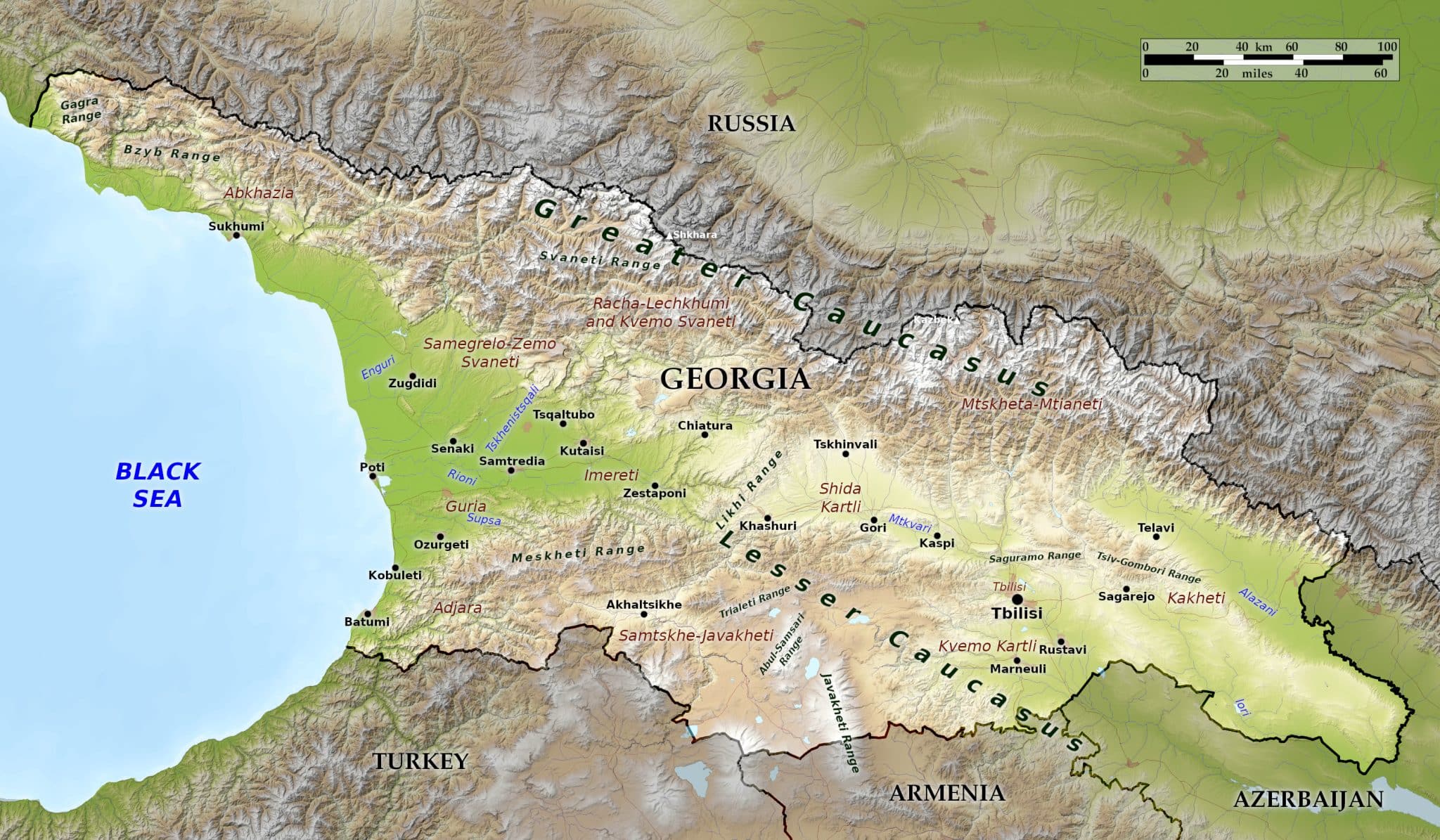
A detailed map of Georgia’s striking geography. Click for high-resolution. Map provided by Blue Green Atlas.
Between these ranges lie Georgia’s contrasting agricultural heartlands. In the west, the Colchian Lowland stretches along the Black Sea. Heavy rainfall, mild winters, and mineral-rich rivers support maize, citrus, tea, beans, and nut trees. Abundant water and rich forests shaped a cuisine rich in herbs and walnuts, while maritime trade encouraged liberal use of spices. Ancient Colchis emerged here as an early center of wealth and power.
Eastern Georgia, by contrast, is dominated by the river valleys of the Mtkvari River and Alazani River, where a drier continental climate favors wheat, barley, pastoralism, and viticulture. This region became the core of Georgian wine culture and its early state formation.
Georgia also sits astride a major trans-Caucasian trade route linking the Caspian and Black Seas. The Mtkvari was navigable to Tbilisi until the 20th century, reinforcing that city’s political importance. Goods then moved west across the Likhi Range toward the Rioni River, connecting near Kutaisi, a city long regarded as a second capital.
The mountains themselves are central to Georgian identity. Rising to over 3.5 miles high just 100 miles from the sea, they create microclimates from sharp elevation changes, varied sun exposure, and wind patterns. Within short distances, one finds alpine pastures, forested slopes, and sheltered valleys capable of supporting grapes, fruit trees, barley, rye, beans, potatoes, and herbs.
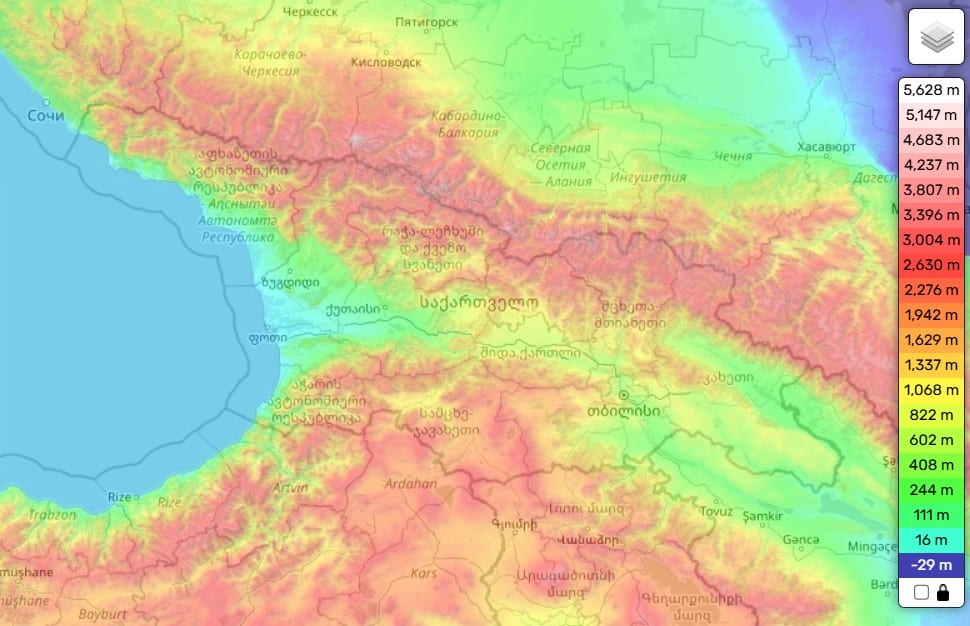
-

- Map showing Georgia’s extremes in elevation. The country is approximately the size of the US state of West Virginia.
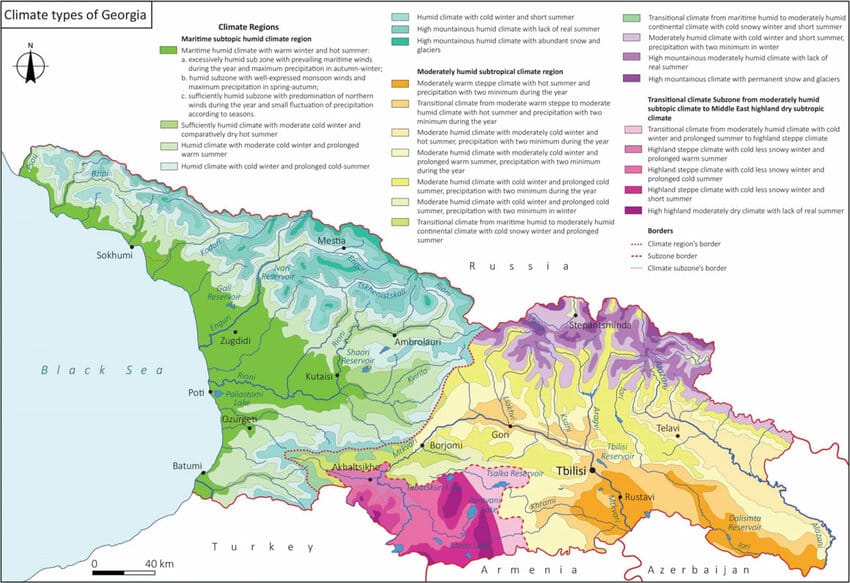
-

- Map showing Georgia’s climate types. They range from subtropical to semi-desert to alpine glacial. Map from Research Gate.
Highland communities practiced seasonal pastoralism and cultivated hardy crops such as barley, rye, potatoes, and beans. The region’s rich deposits of iron, copper, gold, and silver supported early metallurgy by the second millennium BCE, with areas such as Svaneti and Racha gaining reputations for both skilled metalwork and fierce martial culture.
Geographic isolation protected mountain societies from imperial control but also limited economic development. Narrow gorges and heavy snows encouraged autonomy and preserved distinct dialects, architecture, social structures, and musical styles. For Georgians, these highlands came to symbolize both cultural preservation and resistance to foreign rule.
Georgia’s geography, in both its beauty and severity, has shaped much of the country’s history and remains an integral part of Georgian identity and culture.
The Origins of Sakartvelo and Georgia
According to Georgian mythology, the Georgian people descend from a heroic ancestor named Kartlos (ქართლოსი). As described in the medieval Georgian Chronicles (ქართლის ცხოვრება), compiled between the 6th and 13th centuries, Kartlos was a son of Targamos, the patriarch from whom the peoples of the Caucasus were believed to descend. Georgian regional peoples were likewise traced to the sons of Kartlos.
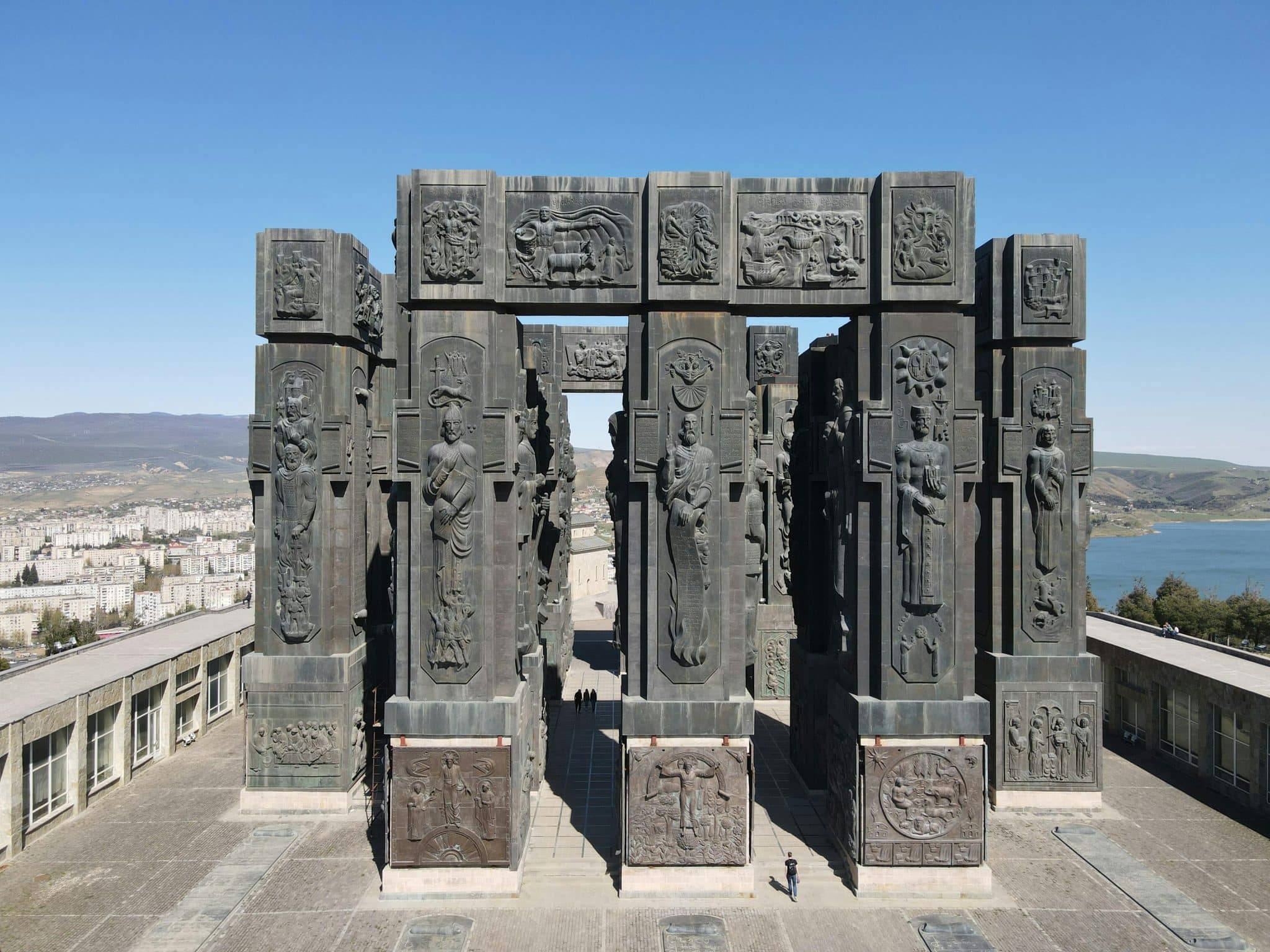
While Kartlos is generally accepted as mythological, the story of the Georgian Chronicles is deeply embedded in Georgian identity. This massive statue complex depicts its personages near Tbilisi. (Note the person standing at the base.)
Georgians call themselves Kartvelebi (ქართველები), and their country Sakartvelo (საქართველო); both terms share a root with Kartlos’s name. Some linguists caution against seeing this as a direct relationship, however, pointing out the same root may have referred, in ancient Georgian, to a fortress or “enclosed land,” a plausible origin given the mountainous environment in which early Georgian societies developed.
The exonym “Georgia,” which Georgians generally accept, likely entered European languages through Persian, where gorg means “wolf.” Georgia was known then as Gorgān or Gorgia, meaning “Land of the Wolves.” The English name probably emerged as a Greek or Latin corruption of the Persian. Its persistence may have been reinforced by resemblance to the Greek root geo (“earth”). Other theories propose an independent Greco-Roman origin, linking the Latin georgi (“agriculturalists”) to Roman perceptions of Georgians as settled farmers, or it may have been a portmanteau of “geo” and “argo,” in an allusion to the story of the Argonauts and the search for the Golden Fleece in the ancient Kingdom of Colchis, what is now modern-day Georgia.
The “wolf” association is likely the strongest, however, and was known in ancient Georgia at the time. For instance, the founder of Tbilisi was Vakhtang Gorgasali (literally, Victor Wolfheaded), whose epithet likely invoked both fierceness and intelligence.
The very existence of these etymological hypotheses speaks for the myriad strands of cultural influence that have left their imprint on Georgia and highlights Georgia’s location in a crossroads of Eurasian civilizations.
Christianization and the Path to Unity

The ancient kingdoms of Colchis and Iberia.
The territory of modern Georgia has been inhabited since the Paleolithic era. Archaeological evidence shows that its early populations adopted agriculture, animal husbandry, social stratification, and metallurgy at an early stage. By the late second millennium BCE, these societies were integrated into long-distance trade networks linking the Black Sea, Anatolia, Mesopotamia, and the Iranian plateau. As economic and social complexity increased, two political precursors to the Georgian state emerged: Colchis in the west and Kartli in the east, initially as loose tribal confederations united by language and shared culture.
Although separated by natural barriers, growing pressure from Greek, Roman, and Persian imperial expansion increasingly pushed the confederations toward cooperation. While Colchis was generally wealthier, Kartli developed stronger centralized authority first under Pharnavaz I. He unified most Georgian tribes in the 3rd century BCE and is traditionally credited with laying the foundations of state administration and the expanded literacy needed to support it.
Much of what is known about this period comes from texts compiled later during the medieval era which blend historical memory with myth. Archaeology confirms some elements, but the texts trace a somewhat questionable royal lineage that idealizes many rulers and endows them with supernatural powers. Further, they connect all of Georgia’s major rulers to the legendary Kartos in an attempt to show continuity and legitimacy. This is despite the fact that the region suffered from frequent invasion and fragmentation that would have likely disrupted the lineage.
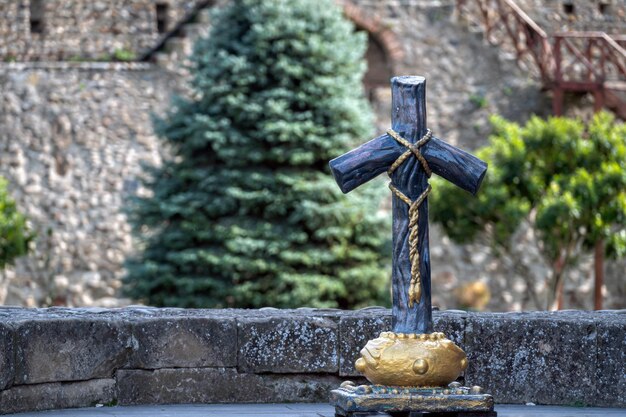
St. Nino is said to have carried a cross made from grapevine pieces bound with her own hair. Georgia’s national cross is a distinctive reflection of this legend.
Georgia converted to Christianity in the early 4th century CE under Mirian III. Legend says that Saint Nino, a young female missionary, was able to cure Mirian’s wife, Queen Nana, of an illness and Nana soon converted. Mirian, staunchly pagan, refused to convert until, while on a hunting trip, found himself suddenly “blinded” and had his sight restored only after praying to “Nino’s God.” Astronomers calculate that a solar eclipse happened in Georgia on May 6, 319 CE, which may give a precise date for Georgia’s official conversion. Tribes in Colchis also initially converted under Mirian’s influence.
The adoption of Christianity would be one of the most pivotal historical events for Georgia. Already united by language and culture, Christianity gave the tribes a shared worldview transcending regional divisions and provided an even stronger cultural shield against influence from the Turkic and Persian empires that would later dominate the area. It also gave them strong diplomatic and cultural ties to Rome, Byzantium, and, later, Europe.
In the 5th century, Vakhtang I Gorgasali consolidated royal authority again, reformed the military, and secured key trade and invasion routes, including the “Gates of Iberia,” considered the main pass through the Greater Caucasus. He resisted Persian efforts to impose Zoroastrianism and, with Byzantine backing, secured autocephaly for the Georgian Church, elevating the bishop of Mtskheta to a Catholicos. Vakhtang also founded or greatly expanded Tbilisi, establishing it as a future capital.
-

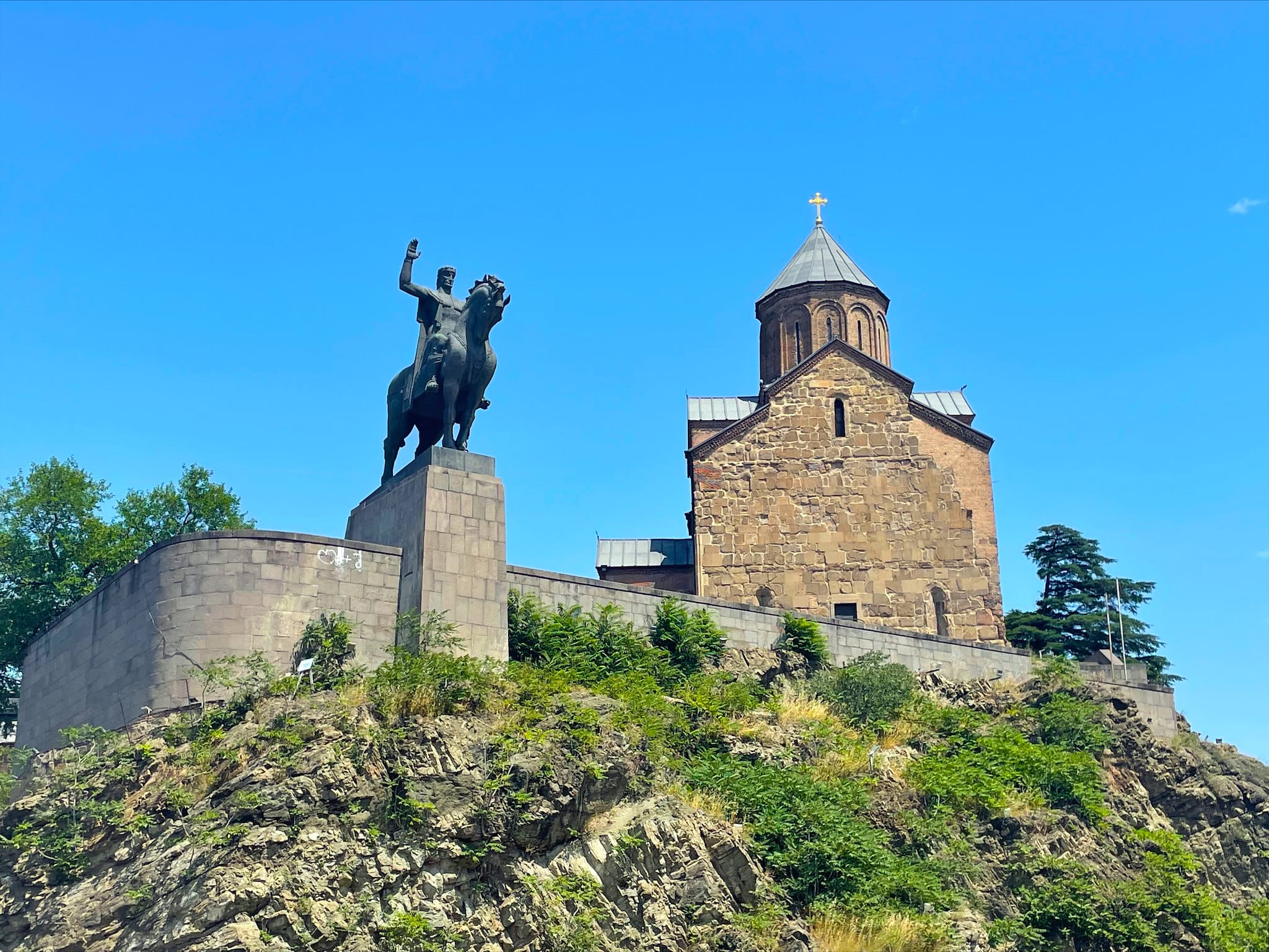
- A statue of King Vakhtang I Gorgasali overlooks Tbilisi from the grounds of the Metekhi Church, an early example of Georgian Christian architecture, and which he is said to have personally overseen the construction of. Photo by SRAS student Brendan Thompson.
-
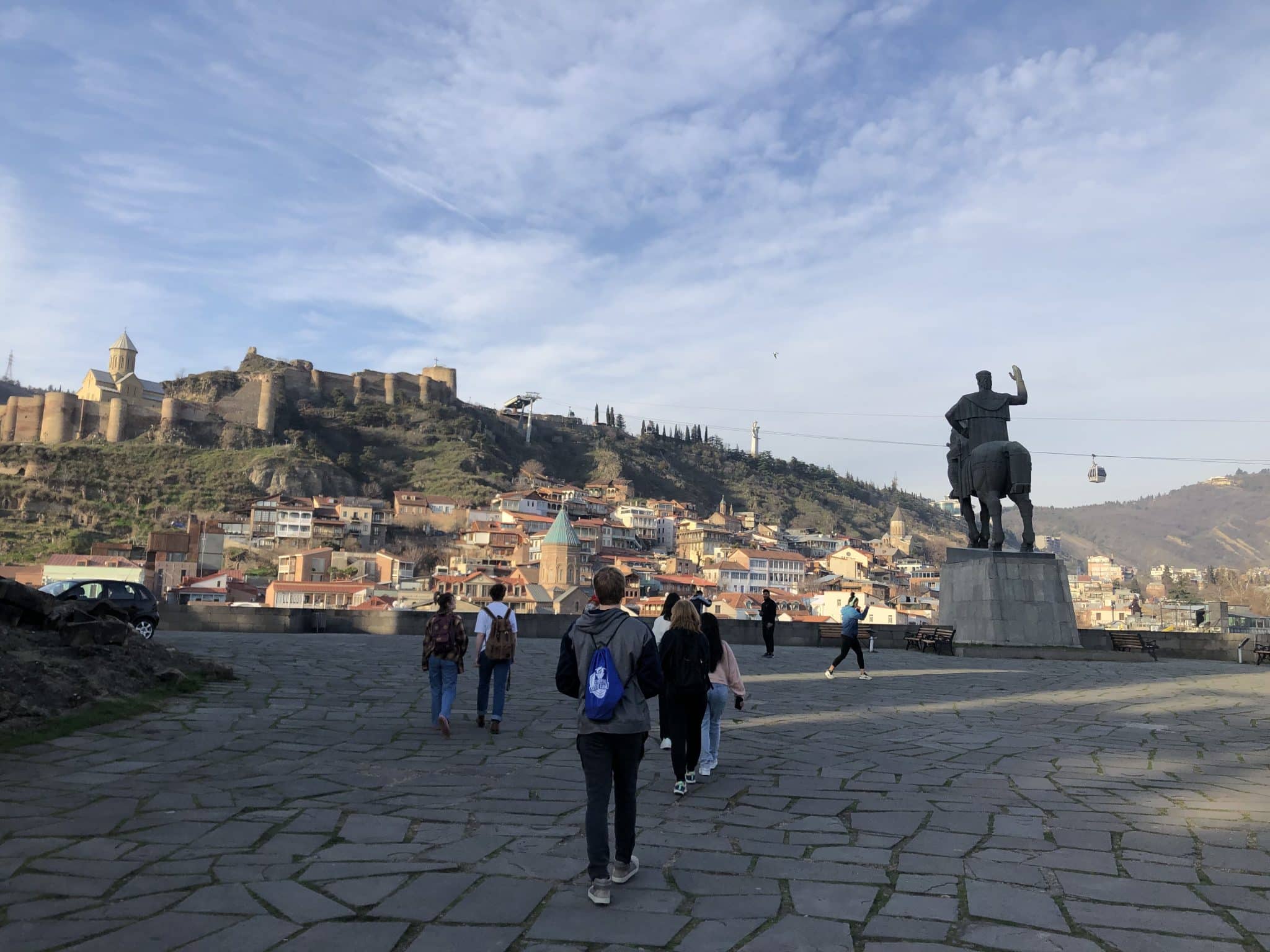
- SRAS students approach the statue from behind, revealing the Narikala Fortress and Tbilisi Old Town. Vakhtang built the original Narikala Fortress as well. The St. Nicholas Church inside was first built in the 13th century and rebuilt in the 20th in the same style.
During this early time, Georgia was rarely fully sovereign. Pharnavaz ruled in close alliance with the Greek Seleucid Empire. Mirian initially ruled as a Persian appointee before shifting allegiance to Rome, while Vakhtang himself began as a Persian vassal and was ultimately exiled for rebellion.
Each of these rulers is upheld as a Georgian national hero, however. Each fought for Georgian rights and cultural autonomy, often in the face of a more powerful foreign force. Each also helped build a unified identity and institutions that would set the stage for Georgia’s eventual golden age.
The Rise of Bagrationis
Throughout Georgia’s early medieval history, larger powers—including the Diadochi, Roman Empire, Armenian kingdoms, Byzantine Empire, and successive Persian states—repeatedly sought influence over the Georgian heartlands. Following the fall of Vakhtang I Gorgasali, Georgia was again politically fragmented and increasingly vulnerable. In the 7th century, the first Arab invaders arrived and, in the 8th century, the Emirate of Tbilisi was established.
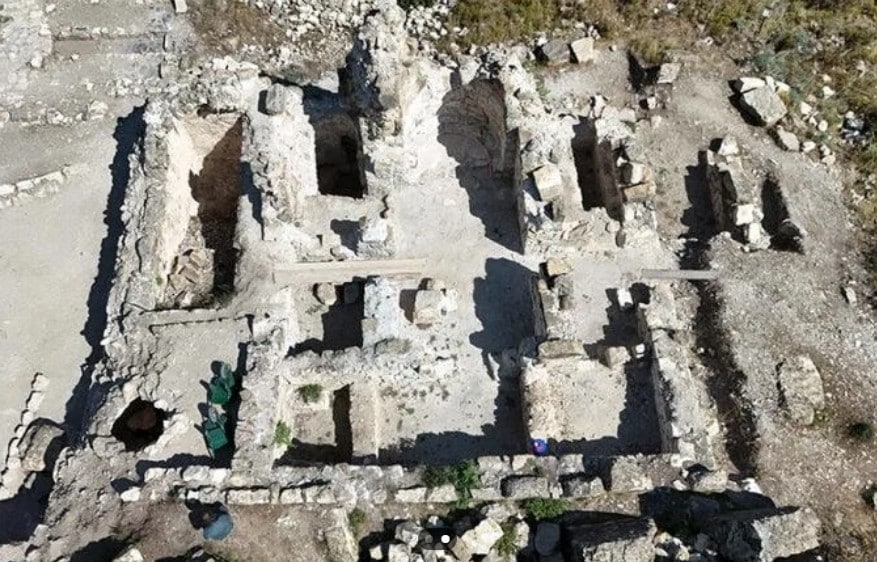
The tomb of Ashot I, once thought lost to history, was rediscovered in 2025 by archeologists working in the Peter and Paul Church, part of the Georgian-built fortress of Artanuji that is now located in Turkey. The fortress was likely built by Ashot.
In the early 9th century, Ashot I exploited internal divisions within the caliphate to challenge foreign rule. Inheriting the princedom in Klarjeti in southwest Georgia, he initially tried to wrest control of Tbilisi. Failing that, he fell back to his mountainous homeland and fortified his positions. There, he fortified strongholds and secured recognition from Byzantium, receiving the court title kouropalates and declaring his domain an independent Christian state under Byzantine protection. Ashot strengthened local support by patronizing monasteries and encouraging Georgian resettlement in his lands.
Ashot belonged to the Bagrationi dynasty, a noble family of Armenian origin whose Georgian branch became fully assimilated over time. During the 9th and 10th centuries, Bagrationi rulers gradually expanded their authority by absorbing neighboring territories, building fortresses for defense, and founding monasteries that promoted literacy, culture, and religious unity.
Despite this expansion, the dynasty remained divided. Competing branches ruled Kartli, Tao, Klarjeti, and later Abkhazia, while navigating pressure from the Abbasid Caliphate, Byzantium, and Armenian neighbors. This fragmentation ended in the late 10th century when Bagrat III united eastern Georgian lands with the Kingdom of Abkhazia, creating the first unified Georgian monarchy—though aristocratic rivalry and foreign pressure remained persistent challenges.
David IV, the Builder of Georgia’s Golden Age
David IV ascended the throne in 1089 at the age of sixteen. He would earn the epithet “the Builder” for reconsolidating Georgian lands and launching ambitious construction projects. His father left the throne after years of humiliation. The Seljuks demanded tribute despite raiding regularly and settling in Georgian villages, forcing locals into fortified citadels. Combined with aristocratic infighting, both the economy and military morale had collapsed.
-

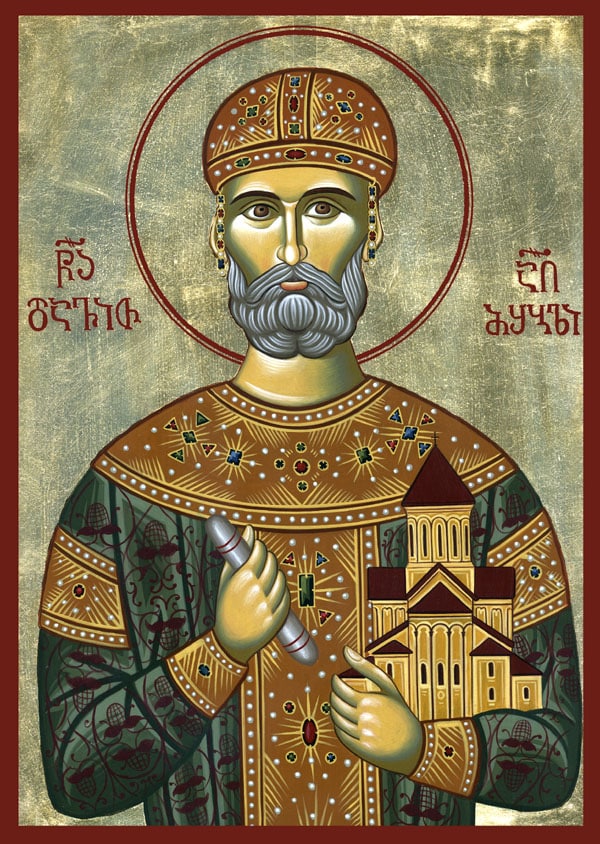
- Most icons of David, who was cannonized a Saint, show him holding a model church and a scroll as he was also known for construction projects and his devotion to his faith as well as to learning and law.
-

- Map of the expansion of Georgia under David IV.
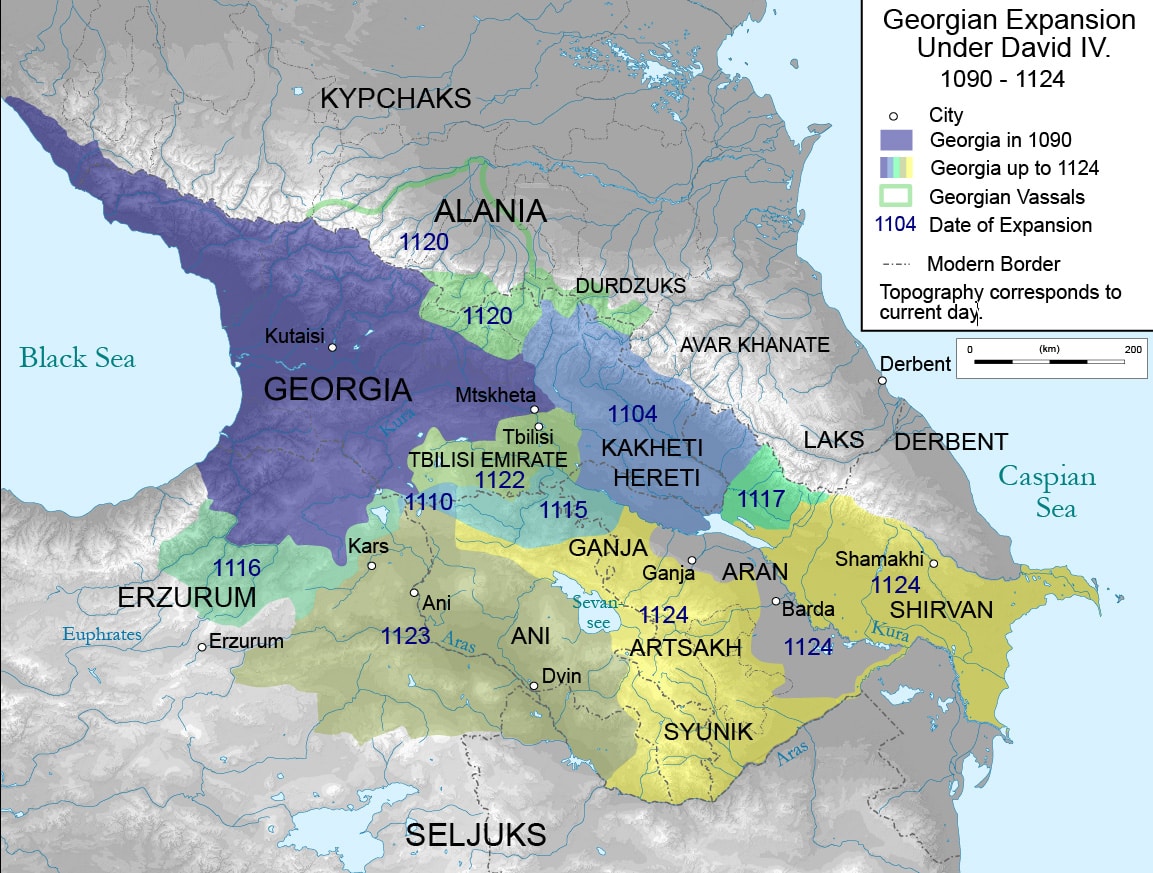
David introduced sweeping reforms. He first formed new military units drawn from minor nobles he could trust and peasants from his own lands. He then led them in surprise attacks on the Seljuks, who were soon forced from Georgian lands. As villages were resettled, the economy revived. David imprisoned or exiled disloyal nobles, claimed their lands, and restructured the government, church, and army to curb corruption and centralize authority.
When he retook eastern Georgia in 1104, David was aided by the local king’s conversion to Islam, an attempt to draw Seljuk support. However, the Seljuk empire was then distracted by the Crusades and, by converting, the king lost the support of his nobles who captured him and delivered him to David.
In 1104, David regained eastern Georgia. The local ruler had converted to Islam in hopes of securing Seljuk backing, but this alienated his own nobility, who captured him and delivered him to David. With the Seljuks increasingly distracted by the Crusades, David invited the Kipchuks, renowned mounted warriors, to settle in Georgia in exchange for military service. Around 200,000 Kipchuks arrived, providing roughly 40,000 soldiers loyal directly to the crown.
-

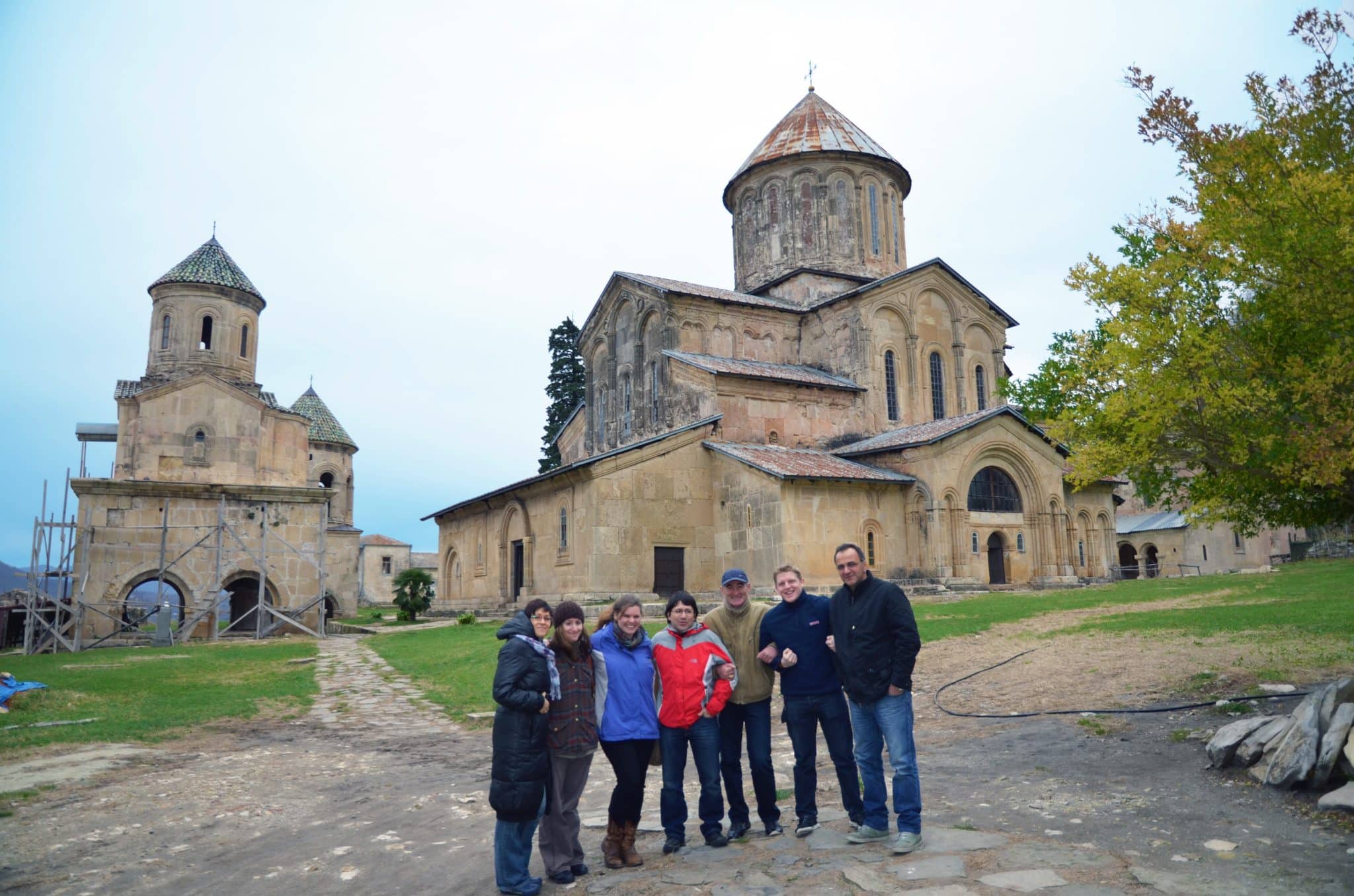
- SRAS students at the Gelati Monastery, one of David the Builder’s greatest construction projects.
-

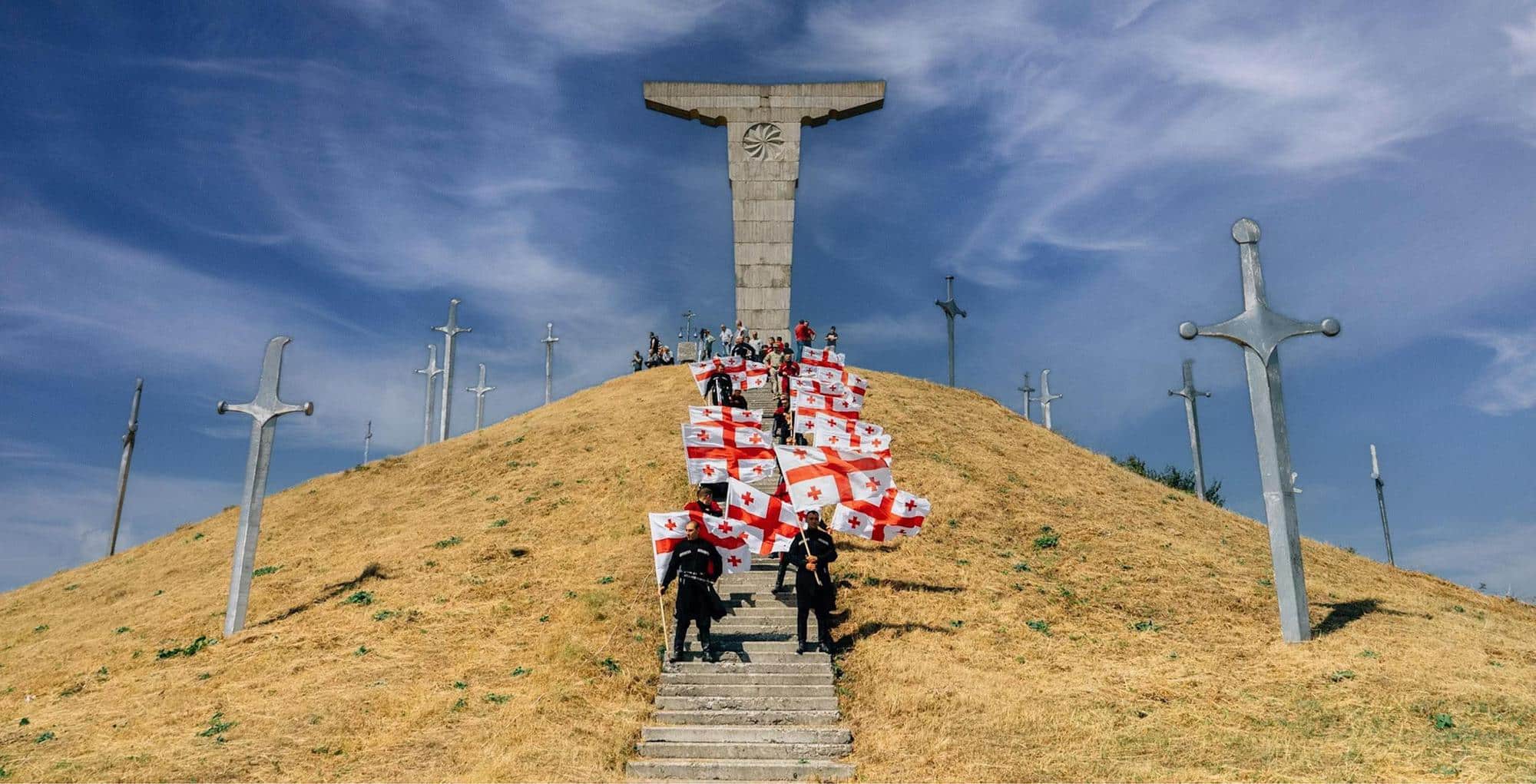
- The Didgori battlefield is now adorned with an elaborate monument complex. The crossess seen scattered on the hill are medieval swords planted in the ground.
-

- An enromous statue of King David calling his troops to battle – part of the Didgori battlefield monument complex.
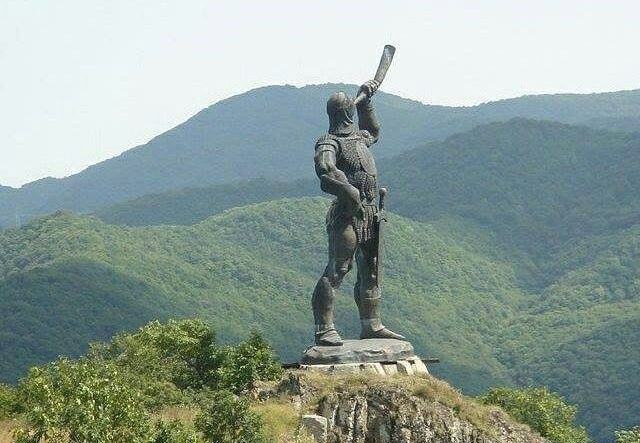
Although still outnumbered, David exploited Georgia’s terrain and used sophisticated flanking tactics and surprise attacks to distract, scatter, and ultimately defeat larger armies. This strategy culminated in the Battle of Didgori in 1121, where allied Georgians, Kipchuks, Alans, and Crusaders from Jerusalem destroyed a Seljuk army several times their size. In 1122, David retook Tbilisi, ending the emirate there and effectively eliminating Muslim political power in Georgia. His final years were spent securing the wider South Caucasus against renewed invasion.
By his death, Georgia dominated much of the Caucasus. David invested heavily in infrastructure, building roads, bridges, hospitals, and fortresses, and expanding Kutaisi and Tbilisi. Widely read, he also penned Hymns of Repentance, which is widely read and still considered a sacred text in the Georgian church. His most enduring legacy was the Gelati Monastery, which became a major center of learning and spirituality. David was buried at Gelati, where his grave remains today.
Tamar and the Apex of the Golden Age
David IV’s immediate successors focused primarily on holding David’s gains. Although noble resistance and renewed Seljuk and regional pressures periodically destabilized the monarchy, royal authority largely held, supported by the administrative, military, and ecclesiastical institutions David had created. Georgia continued to project power beyond its borders, intervening in Armenia and the eastern Black Sea region and maintaining ties with the Crusader states and Christian Europe.
-

- Tamar as pictured on Georgia’s 50 Lari note.

-

- Map of Georgia as well as its dependencies and vassals under Tamar.
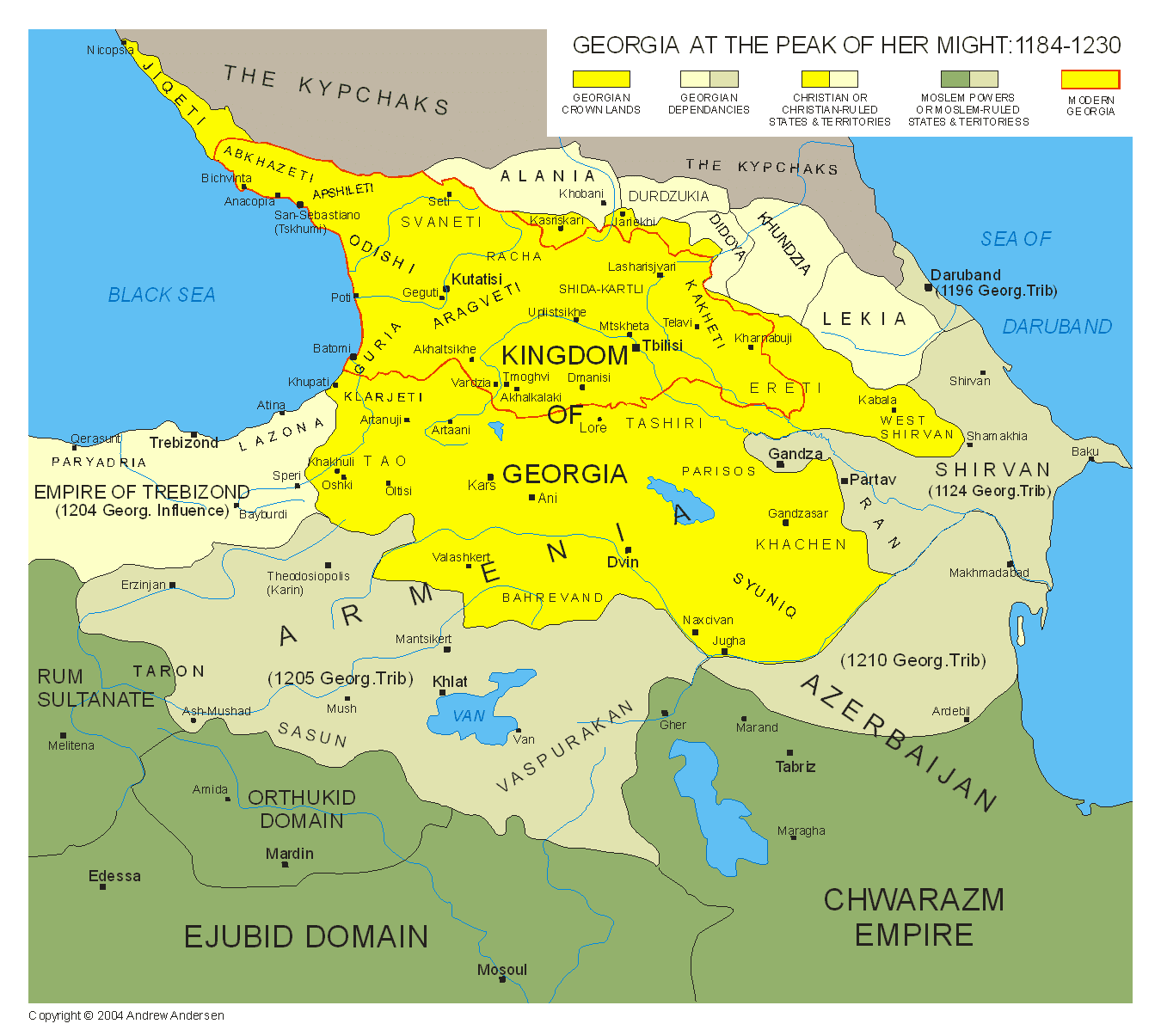
Georgia’s golden age reached its height under Tamar. Anticipating resistance to a female ruler, her father George III took the extraordinary step of crowning Tamar as co-ruler in 1178. When she assumed full authority in 1184, Tamar pursued a careful strategy of legitimacy-building by confirming certain noble privileges, replacing unpopular officials, and seeking ecclesiastical re-consecration. Meanwhile, she decisively suppressed challenges to her authority through exile or imprisonment.
Under aristocratic pressure, Tamar married Yuri Bogolyubsky, an exiled prince from Novgorod with strong trade connections and military experience. The marriage quickly failed, with Tamar accusing him of political, personal, and moral failings. With church support, she divorced Yuri and later defeated him after he attempted to overthrow her. Her second marriage, to David Soslan, was a calculated success. A brilliant commander from Georgia’s important allies, the Alans, David energetically helped Tamar expand and defend Georgia’s lands, but never sought political authority himself.
Tamar and David often traveled with the army together. While he commanded them in battle, she sustained morale and participated in strategic decisions. Under their joint leadership, Georgian territory doubled through conquest, vassalage, and tribute, extending in all directions, and particularly deep in Armenian lands as the Georgians sought to drive Muslim rule from the land of their Christian brethren. Georgia came to control key trade routes and economic centers, filling its treasury with tribute and war booty.
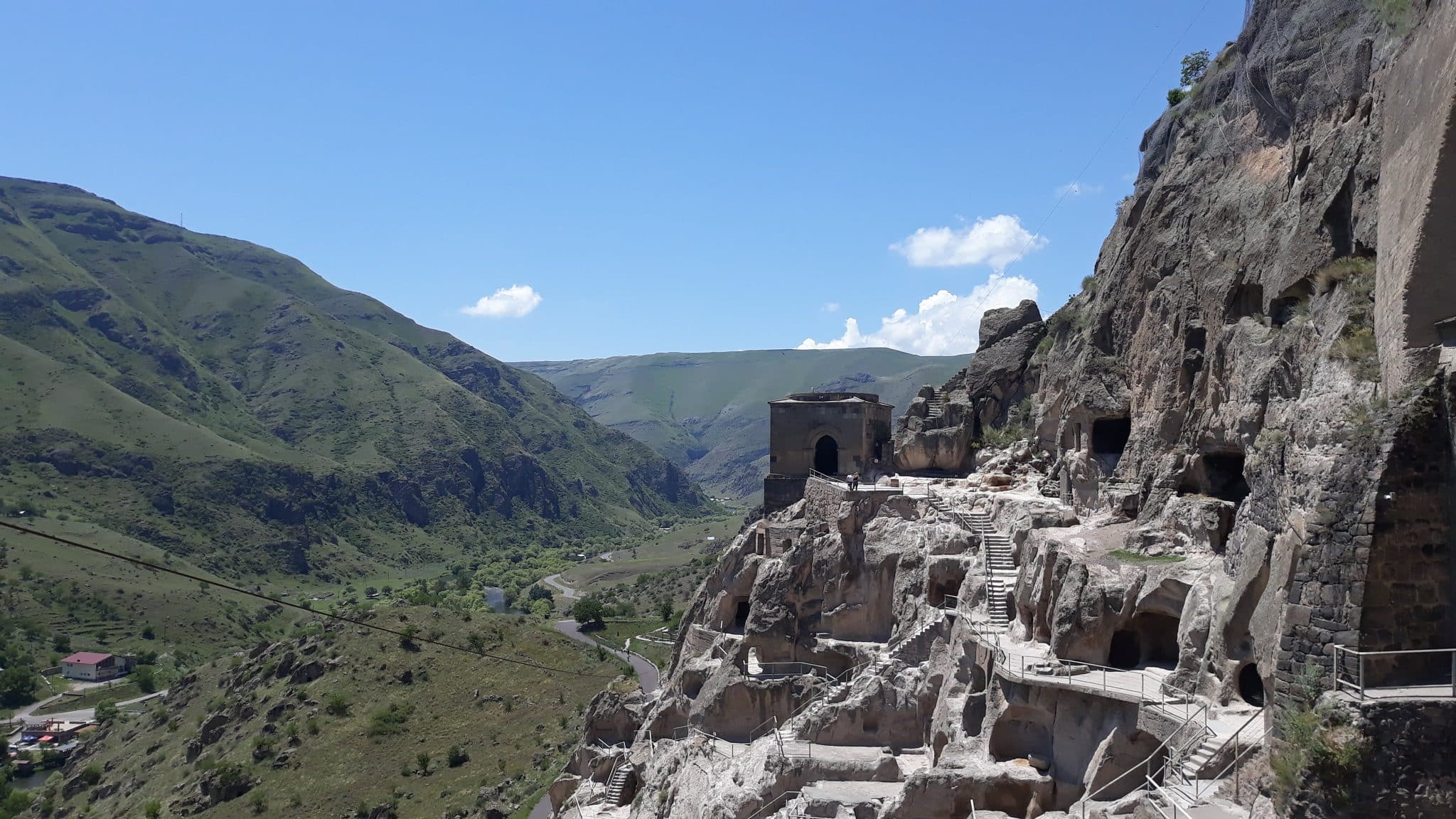
Vardzia is a massive monastery carved out of a cliff face. Photo by SRAS student Jill Neuendorf
Tamar invested this wealth heavily in religion and culture. She expanded the cave monastery of Vardzia and founded Georgian monasteries in Jerusalem, Mount Athos, Cyprus, Bulgaria, and Constantinople, strengthening ties with the wider Christian world. Monasteries became centers of education and manuscript production. The Georgian language itself was raised to an art form in literature such as The Knight in Panther’s Skin by Shota Rustaveli, now considered Georgia’s national epic poem.
Tamar also pursued notable social reforms, allocating roughly 10% of the treasury to public welfare and banning punishments such as blinding and the death penalty, urging judges toward rehabilitative sentences.
Many sources refer to Tamar as “king.” In Georgian, the word “mepe” (მეფე) denotes a sovereign ruler and is, like the rest of the Georgian language, genderless. Thus, English often renders her as “King Tamar” because the same word is used for her predominately male counterparts.
Tamar died in 1213, five years after David Soslan. Both Tamar and her grandfather David IV were canonized by the Georgian Orthodox Church and remain revered today.
Georgia’s Fall and the Arrival of Russia
Georgia’s golden age ended soon after Tamar’s death. The kingdom, awash in wealth, slid into inflation and corruption, provoking resistance to tax and tribute. Rising church fees led peasants to boycott religious services. Military discipline fell as feudal rule became more arbitrary. Waves of Turkic, Persian, and Mongol invaders began in 1226. The Black Death reached Georgia in the 14th century and would not fully abide until the 18th, deepening demographic decline.
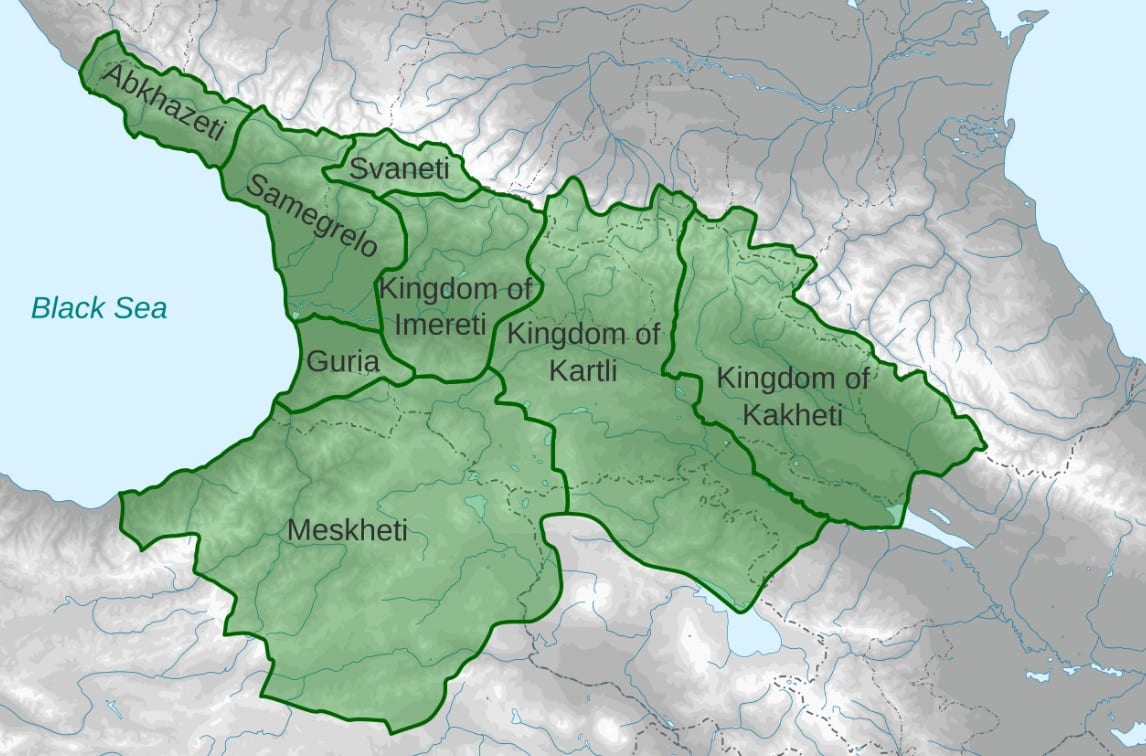
Georgia fractured into several rival kingdoms after its civil war that lasted from 1463–1490.
In 1453, the Ottoman Empire captured Constantinople, eliminating a key Georgian ally and restricting Black Sea trade. As external pressure mounted and the economy deteriorated, conflict between crown and nobility escalated into civil war. By the late fifteenth century, Georgia again fragmented into rival kingdoms and principalities. From the 16th to 18th centuries, Georgian lands became a battleground between the Sunni Ottomans and the Shia Safavid Empire, with intermittent Georgian rebellions punctuating imperial warfare.
In the mid-18th century, following the death of the Shah, the eastern Georgian kingdoms of Kartli and Kakheti united and, following the same strategy as Ashot I, sought the protection of the greatest nearby Christian power. At the time, that was Russia, then under Catherine the Great. Under the 1783 Treaty of Georgievsk, Russia pledged guardianship over Kartli-Kakheti, but, when Persia moved to retake the kingdom, Russia was at war with the Ottomans and declined to help. When the next shah’s death provided another window of opportunity, Russia returned to find Kartli-Kakheti itself in dynastic turbulence. Tsar Paul I then annexed both in 1800.
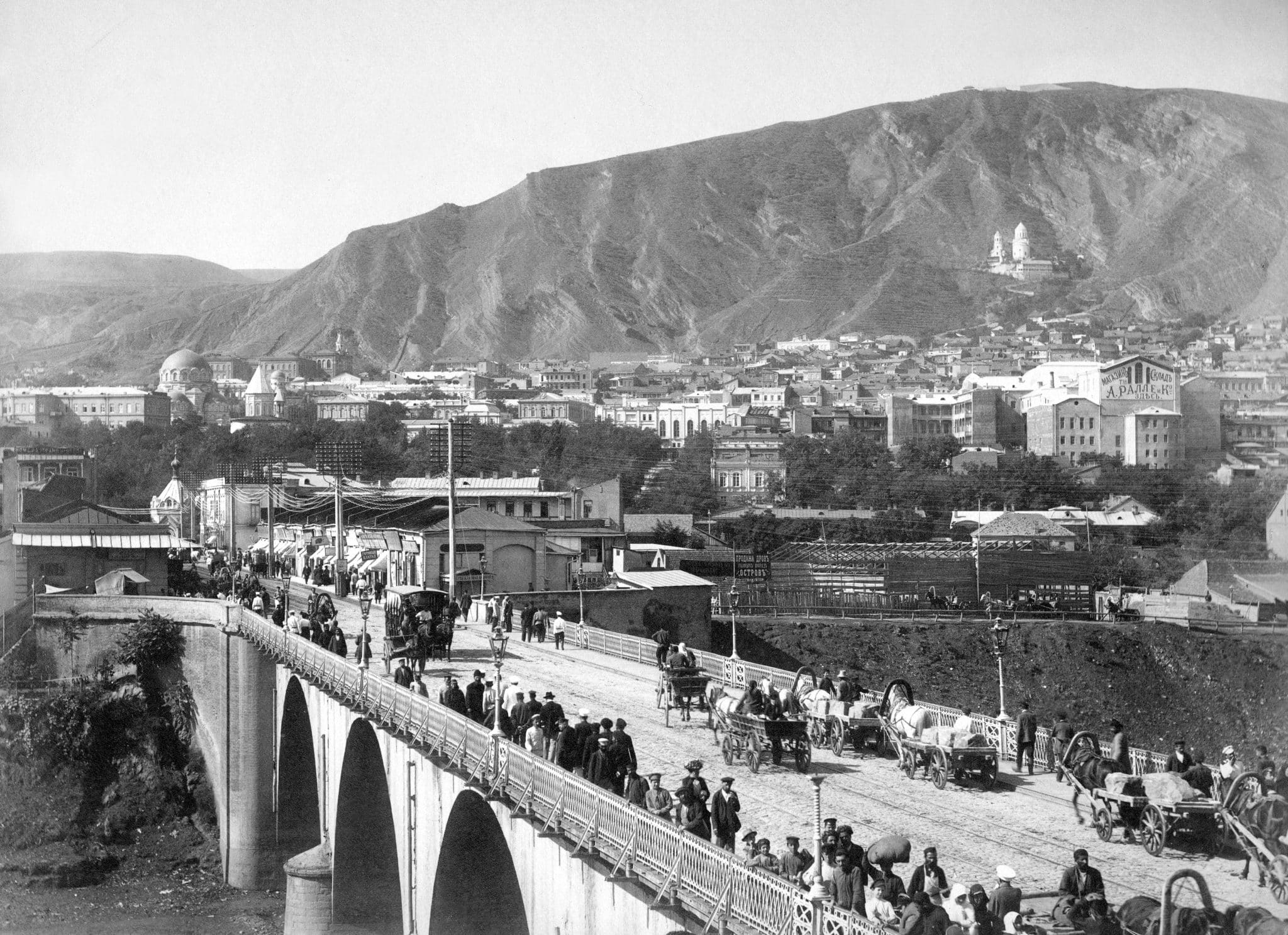
Tbilisi at the cusp of the 20th century. Pictured is Vorontsov Bridge, named for Mikhail Vorontsov, who served as Russia’s Viceroy of the Caucasus from 1844–1854.
Georgia became a base for Russia to conquer the Caucasus. The Persians were pushed back and Russia annexed the Ottoman-dominated Kingdom of Imereti in Western Georgia before reuniting much of the old Kingdom of Georgia within the Russian Empire.
Tsarist authorities invested heavily in infrastructure to secure the Caucasus and transform Tbilisi into a regional administrative center. The Georgian Military Highway was built to link Georgia to Russia, while imperial planners reshaped Tbilisi with boulevards, theaters, barracks, and neoclassical architecture. After oil was discovered in Baku in 1845, railways spread across the Caucasus, and a pipeline connecting Baku to refineries and ports in Batumi was completed in 1907 along the ancient trans-Caucasian trade corridor.
Wine production expanded, tea and citrus cultivation developed, and manganese mining became significant to global steelmaking. Industrialization spurred urbanization and the growth of a Georgian working class, though profits largely flowed to Russian and foreign capital. Discontent grew as Russification policies curtailed Georgian language and culture even while Georgia emerged as a Caucasian intellectual center. By the late 19th century, modernization, education, and repression together fueled nationalist and socialist movements.
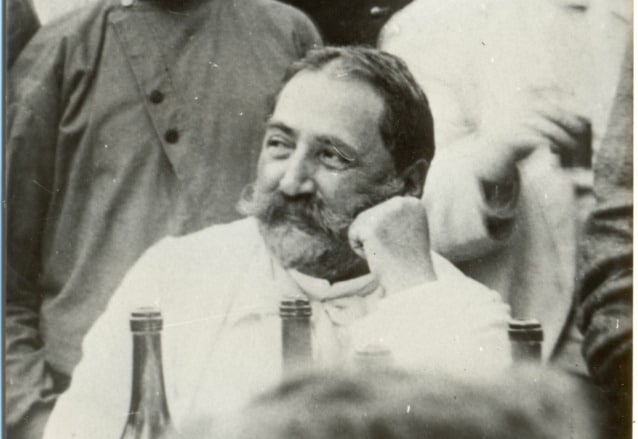
Ilia Chavchavadze never saw the formation of the independent Georgian Republic, but he laid out the philosophy and ideals that it would be based on.
Ilia Chavchavadze emerged as a central figure to Georgia’s national revival. Born into the nobility and educated in St. Petersburg, he returned to Georgia committed to resisting cultural assimilation and modernizing Georgian society. He funded Georgian-language publishing, schools, libraries, cooperatives, and banks that helped Georgians purchase land. Chavchavdze taught that Georgian identity was rooted in “language, faith, and motherland,” a simple formula that still holds today for many Georgians. He advocated moral renewal, legal equality, and gradual reform over revolution. His assassination in 1907 shocked the nation and cemented his status as a national martyr and, like David IV and Tamar, he was later canonized by the Georgian Orthodox Church and is today regarded as the father of the Georgian Republic.
The Georgian Republic to Soviet Georgia
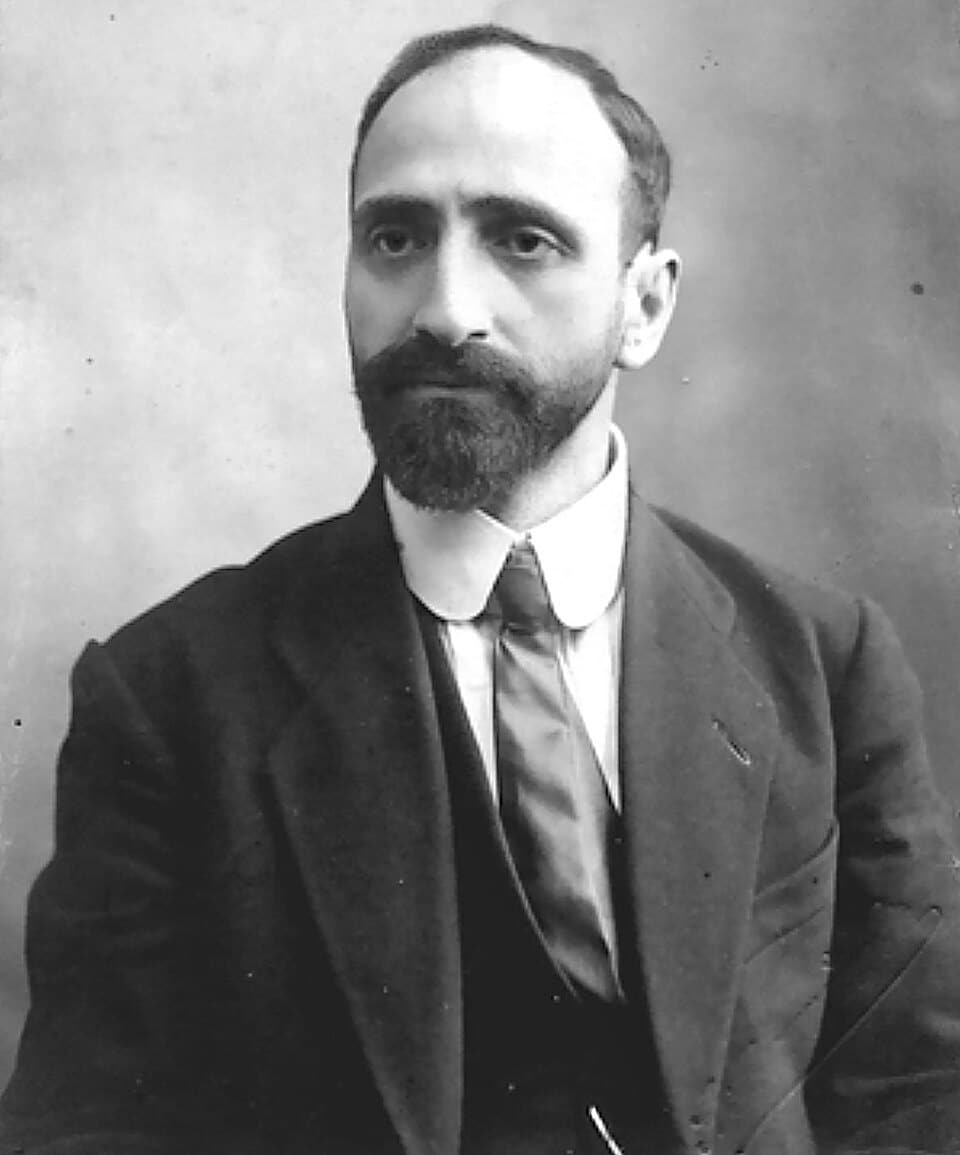
Noe Besarioni was the first president of the Georgian Republic.
The 1905 revolution saw violence and multiple deaths stemming from agrarian unrest and the government’s later crushing of the rebellion. However, the 1917 Russian Revolution was relatively quiet in Georgia and consisted mostly of the Social Democrats assuming power as the region’s main alternative power as the Tsarist system collapsed.
The Democratic Republic of Georgia was declared in 1918 only after the Bolsheviks seized control in Petrograd and dissolved the Constituent Assembly, in which the Caucasus peoples had been represented. Georgian leaders had initially hoped to remain within a democratic, parliamentary Russia, but disagreements with the increasingly radical Bolsheviks made independence unavoidable.
The new republic faced severe challenges. War had left the economy fragile and dependent on former imperial markets. Borders with neighboring Caucasian states were disputed—leading to armed conflict with Armenia—and Georgia was geopolitically exposed to both a resurgent Turkey and a hostile Bolshevik Russia. Despite this, the republic sought to build a European-style democracy, introducing universal suffrage (including for women), land reform, civil liberties, and an independent judiciary, while pursuing international recognition through diplomacy.
Lacking strong military forces or reliable foreign guarantees, the state proved vulnerable. In 1921, the Red Army invaded, forcibly incorporating Georgia into the Soviet Union. The republican government fled to France, operating in exile until 1954 when it voluntarily dissolved. Modern Georgia views the Soviet period as an occupation and its current statehood as a continuation of the republic founded in 1918.
In 1924, a major rebellion was staged involving several political figures of the government in exile and, according to most sources, “tens of thousands” of civilians. The rebellion was put down and a major purge saw thousands killed or displaced.

A map of Georgia showing surrounding countries and the breakaway states of South Ossetia and Abkhazia.
One of the most consequential legacies of Russian and Soviet rule was its reshaping of Georgia’s relations with the Abkhaz and Ossetian populations.
The Abkhaz, despite speaking a distinct language, had long been integrated into Georgian political and cultural life. Under tsarist rule, Abkhazia was administered separately, and Christianization and Russification policies prompted many Muslim Abkhaz to flee to the Ottoman Empire. Their lands were repopulated with Georgian and Russian settlers, planting the seeds of ethnic tension. Within the Democratic Republic of Georgia, Abkhazia rejoined the state with limited autonomy. Under Soviet rule, however, it was first treated as a separate entity again and later incorporated into the Georgian SSR as an autonomous republic via treaty that gave it outsized representation in Georgia’s legislature and the right to keep many of its own administrative bodies. This, with the ability to appeal any disagreement directly to Moscow, accelerated its estrangement from Tbilisi.
South Ossetia, meanwhile, had never previously existed as a distinct administrative unit. Ossetians had migrated south into Georgia between the 17th and 19th centuries. They were integrated into Georgian feudal and religious society and, while tensions occasionally arose over land use, grazing rights, and taxation, these tended to be economic rather than fully ethnic tensions. During Georgia’s independence, Bolsheviks successfully mobilized support among poorer Ossetians, leading to attacks on Republican forces between 1918 and 1920. In 1922, the Soviet government created the South Ossetian Autonomous Oblast within Georgia, granting it formal political status and an ethnic majority. However, it was given few real guarantees of actual autonomy. This arrangement fostered long-term frustration and mistrust.

A statue of Stalin outside the Stalin Museum in Gori, Georgia. Picture by SRAS student Paula Hunter.
This strategy for “Sovietizing” Georgia was engineered by Joseph Stalin under his tenure as the Commissar of Nationalities. A native of Georgia, he was knowledgeable on how best to ensure that his homeland remained politically dysfunctional and unable to oppose Moscow.
Stalin’s legacy in Georgia remains complex. His fracturing of society was continued in his collectivization campaigns and the Great Purge of the 1930s that saw thousands executed, arrested, or deported as Stalin sought to drive the firmly planted Menshevism from Georgia. At the same time, Stalin oversaw the construction of hydroelectric projects, railways, and entire new industrial cities such as Rustavi, Chiatura, Tkibuli, and Tkvarcheli. Education and science boomed with new public schools, universities, and, most prestigiously, the new Georgian Academy of Sciences in 1946.
During WWII, no battles were fought in Georgia, but the state did contribute half a million soldiers and most of the production of its textile and munitions factories. Stalin boosted local support by restoring the autocephaly to the Georgian Orthodox Church which the Tsar had revoked when he placed it under the Russian Orthodox Church in the nineteenth century. The move was widely popular and long remembered among Georgians who see the Church as a core part of their identity.
Although Georgia remained relatively underdeveloped by Soviet standards, it achieved comparatively high living standards through a large informal economy, its prestigious resorts, and near-monopolies on subtropical crops such as tea, citrus, and tobacco. For some Georgians, Stalin’s rise to global power as a Georgian remains a source of pride in itself. Nikita Khrushchev’s 1956 denunciation of Stalin sparked mass protests in Tbilisi that quickly turned anti-Soviet and were violently suppressed. The Stalin Museum in Gori still presents him as a heroic figure, and polls have shown that positive views of him declined below 50% only within the last decade.
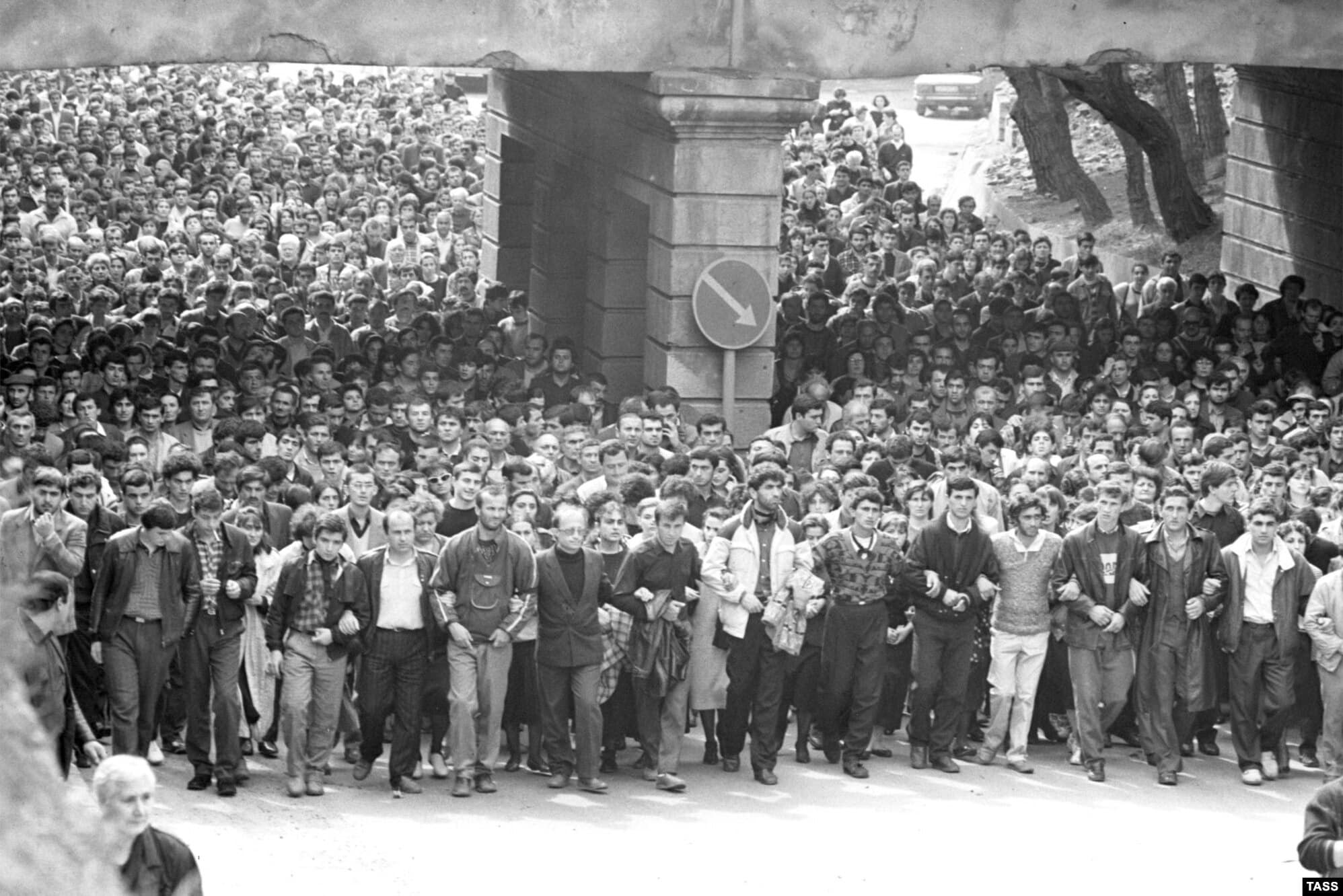
Georgian protestors on April 9, 1989.
Another turning point came in 1978, when mass demonstrations forced Moscow to retain Georgian as the republic’s official language. This period saw the rise of dissident figures such as Zviad Gamsakhurdia and Merab Kostava, who linked cultural preservation to human rights and national self-determination.
In the 1980s, protest movements intensified, increasingly focused on sovereignty and territorial integrity as Abkhazia and South Ossetia pressed Moscow for greater autonomy or even secession from Georgia.
This tension culminated in Tbilisi on April 9, 1989 when thousands peacefully demanded territorial integrity, political autonomy, and independence and were met with lethal violence from Soviet troops. Twenty-one people died, mostly young women, and hundreds were injured. April 9 became a foundational trauma and rallying point for Georgians and its Declaration of Independence from the USSR would be signed, meaningfully, exactly two years later. April 9th is now celebrated as “National Unity Day” in Georgia, emphasizing the values and causes that the protestors died for that day.
Post-Soviet Georgia: Ethnic Conflict and Russian Influence
In 1990, opposition leader Zviad Gamsakhurdia was elected Chairman of Georgia’s Supreme Council in what were the only genuinely open elections ever held in the Soviet Union. He oversaw Georgia’s declaration of independence and was subsequently elected its first president.

Zviad Gamsakhurdia, Georgia’s first president.
Gamsakhurdia was a prominent intellectual and author. He was a capable and inspiring opposition leader, but his populist and unyielding anti-establishment rhetoric alienated him from the security forces and often corrupt commercial networks that emerged as the main centers of power. Further, his insistence on ruling all of Georgia directly from Tbilisi was popular with Georgians but made negotiating with the ethnic enclaves difficult. Although he tried to maintain an image of relative moderation, elements within his political movement, Round Table – Free Georgia, promoted slogans like “Georgia for Georgians,” and referred to ethnic minorities as “guests.”
Fearing marginalization, South Ossetia moved toward declaring a Moscow-aligned republic shortly before independence. Gamsakhurdia’s government responded by revoking its autonomy and rejecting the declaration, triggering an armed conflict in January 1991 between Georgian forces, local militias, and volunteers from Russia.
Independence also brought economic collapse, as Georgia’s Soviet-integrated economy disintegrated. As unrest grew and his grip on power weakened, Gamsakhurdia shut down newspapers and arrested opposition figures. In late 1991, an alliance of corrupt military commanders and organized crime networks overthrew him in a violent coup. After weeks of barricade building, street fighting, and shelling confined largely to Tbilisi’s parliament district, Gamsakhurdia fled abroad. A military council took power and invited former Soviet foreign minister Eduard Shevardnadze, also a former long-time Georgian Communist Party head, to lead the state.
Shevardnadze signed a 1992 ceasefire with South Ossetia, but violence continued as Gamsakhurdia’s supporters launched an armed resistance and Abkhazia seized the moment to pursue its own war of independence. Both conflicts raged until 1993. Gamsakhurdia returned to lead his supporters but was assassinated, while Shevardnadze — backed in part by Russian assistance — suppressed the resistance. In Abkhazia, an initially successful Georgian campaign collapsed after the Confederation of Mountain Peoples of the Caucasus, an armed group based in Russia, intervened with surprisingly advanced military hardware. They marked all ethnic Georgians in Abkhazia as “hostages” and drove Georgian forces out. More than 200,000 Georgians were displaced in the ethnic cleansing that accompanied the conflict.
At the same time, Adjara, a region in Western Georgia populated by another ethnic minority, demanded extensive autonomy, a crisis ultimately resolved through negotiation in 2006.
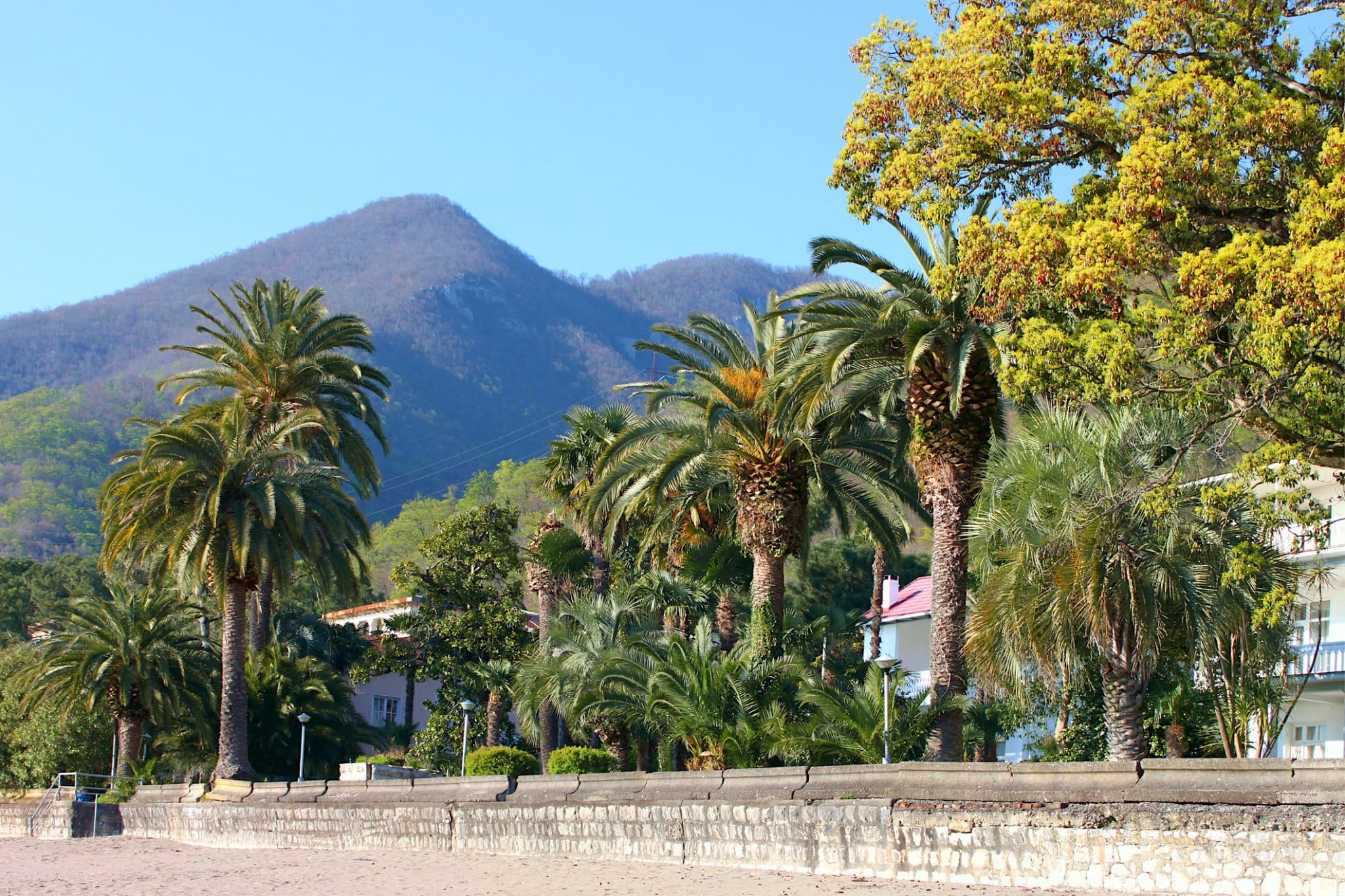
Palm trees along a beachfront resort in Abkhazia.
Abkhazia and South Ossetia remain “frozen conflicts,” ended by Russian-mediated ceasefires but never fully resolved. Georgians still consider the territories’ reintegration to be the most pressing political need within their country, even beyond improving Georgia’s still-troubled economy. For most Georgians, the conflict is one seen as entirely of Moscow’s making and its continuation is only made possible due to the breakaway regions’ continued Russian support. Should Russia be convinced to withdraw, the narrative goes, Georgia could then regain the territories.
Shevardnadze managed to rebuild a centralized security apparatus and stabilized the economy through currency reform and international assistance. He built diplomatic ties with the West and Russia. By the mid-1990s, electricity, transport, and state administration functioned again. However, Shevardnadze did all this by tolerating or coopting organized crime and entrenched corruption. Rule of law remained weak. Abkhazia and South Ossetia remained frozen conflicts and families remained separated across borders. Eventually, stagnation, electoral fraud, and public frustration lead to his largely peaceful removal in 2003.
From Rose Revolution to Constitutional Crisis
When President Eduard Shevardnadze claimed a surprisingly large victory in the 2003 parliamentary elections despite the public discontent against him, mass protests erupted. Demonstrators stormed the parliament in what became known as the Rose Revolution, prompting Shevardnadze’s resignation. He remained in Tbilisi until his death a decade later.
New elections in 2004 brought Mikheil Saakashvili to power on a broadly anti-corruption platform. A Columbia Law School graduate fluent in English, Saakashvili rapidly reformed the police, imposed severe penalties for corruption, and cultivated close ties with the West. Georgia joined the World Trade Organization, and discussions with the North Atlantic Treaty Organization began, though membership stalled in part because of the security risks of Georgia’s breakaway regions and exposure to Russia.
While corruption fell sharply, concerns grew over the harshness of the new police and the uneven distribution of quality-of-life improvements, which largely benefited Tbilisi. Discontent, especially in rural areas, fueled mass protests in 2007 that were dispersed using increasingly heavy-handed tactics. Saakashvili called early elections in 2008 to reaffirm his mandate and won 53 percent, though opponents accused him of restricting media and allowing them little time to organize.
Saakashvili reasserted central control over Adjara, but his presidency was defined internationally by the disastrous August 2008 war. After months of escalating tensions with South Ossetia and Russia, Georgia sent forces to retake the breakaway region. Russian peacekeepers were killed early in the fighting, which Russia claimed as a pretext for a full-scale invasion that devastated Georgia’s military and advanced within 50 kilometers of Tbilisi. Russia later withdrew to South Ossetia and Abkhazia, recognized both as independent states, and established permanent bases. Georgia severed diplomatic relations with Russia, which remain officially suspended.
Opposition pressure intensified as the Organization for Security and Co-operation in Europe reported worsening electoral conditions. Just weeks before the 2012 elections, videos emerged showing severe abuse in Georgian prisons, destroying Saakashvili’s reformist image.
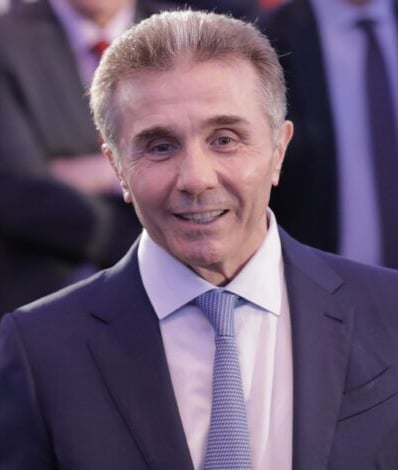
Bidzina Ivanishvili speaking at the 2025 Georgian Dream Congress. Photo via Geogian Dream social media.
The elections were subsequently won by Georgian Dream, which secured about 55 percent of the vote in what was Georgia’s first peaceful post-Soviet transfer of power. Founded earlier that year, Georgian Dream promised expanded social welfare, rural investment, balanced relations with Russia and the West, and an end to what it portrayed as Saakashvili’s authoritarianism.
The party was founded by Bidzina Ivanishvili, Georgia’s wealthiest individual, who amassed a fortune in Russia after the Soviet collapse. Though initially pledging cooperation, Ivanishvili quickly purged Saakashvili loyalists, jailing many on corruption and abuse-of-power charges. Saakashvili left Georgia before his successor’s inauguration to avoid charges himself. He later became a Ukrainian citizen and a high ranking official under President Volodymyr Zelensky. Saakashvili returned to Georgia in 2021 and has since remained in detention, staging hunger strikes in protest of the Georgian Dream government.
Economically, Georgia has experienced record investment and tourism. Between 2020 and 2025, GDP doubled, unemployment fell sharply, and wages rose. The government expanded ties with China, Russia, Saudi Arabia, and Central Asia, benefiting especially after 2022 as Georgia became exponentially better integrated to regional trade disrupted by the war in Ukraine.
Since 2012, Georgian Dream has steadily consolidated power, including attempts to pass “foreign agents” legislation targeting civil society. Mass protests in 2023–24 forced the law’s withdrawal, though the government has increasingly restricted protests and opposition activity with heavy-handed and often violent actions.
Georgian Dream has built deep organizational networks in rural Georgia, the first party to do so since the communists. This reshaped the country’s political landscape, especially as the party used Georgia’s rising revenues to fund long-neglected rural infrastructure projects, such as upgrading town water supplies or landscaping village parks, often hiring locals to perform much of the work. Although wages for these public works have been low, they have been a welcome relief in areas still plagued by unemployment and have created a sense of pride in community as locals work to resolve long-standing issues in and beautify their own localities.
-

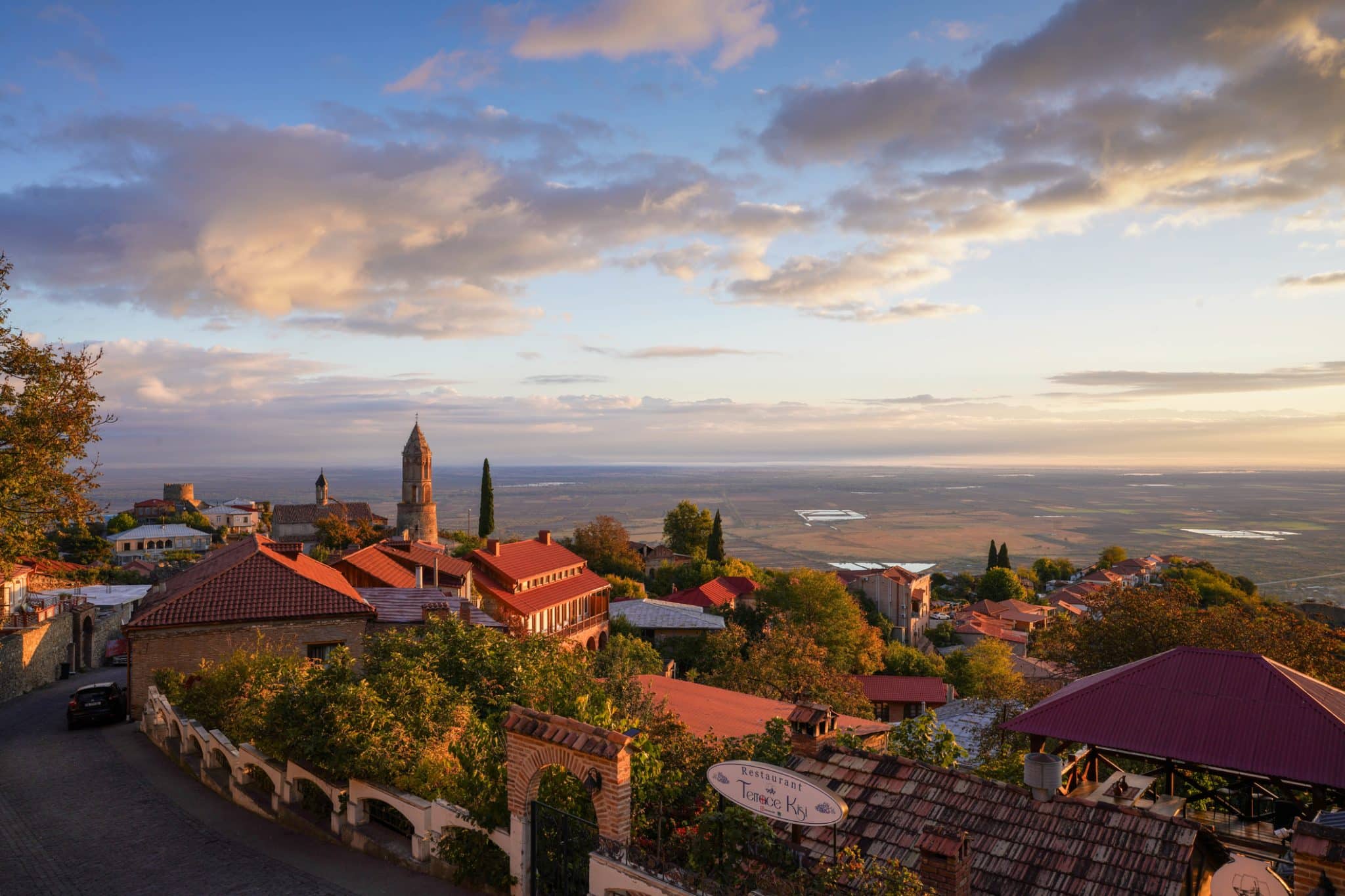
- Sighnaghi, Georgia, population 1500, has seen its economy boom in recent years with wine tourism.
-

- Georgian GDP, shown in billions of USD. Source: World Bank.

At the same time, Georgian Dream has relied on socially conservative messaging popular in rural areas and promoting conspiracy theories that political change will bring war with Russia or subjugation to liberal Europe. The party increasingly vilifies LGBTQ rights and migration while emphasizing what it espouses as traditional values and championing Georgia’s local, long-standing minorities.
In the 2024 parliamentary elections, Georgian Dream lost decisively in Tbilisi but dominated rural districts, retaining power overall. The opposition alleged widespread fraud, refused to recognize the results, and, backed by the European Union, boycotted the new government. Georgian Dream proceeded to govern alone, triggering a constitutional crisis that has continued into the present.
Despite this, the Georgian state has continued to function, foreign investment has risen, and economic growth has remained in the double digits.
Snapshot of Modern Georgia
SRAS offers a wide range of programming in Georgia. Click here to find out more.
Full demographic statistics for Georgia are complicated by the status of Abkhazia and South Ossetia. Although both are internationally recognized as part of Georgia, the Georgian government does not operate in these regions and does not recognize statistics produced by their de facto authorities. As a result, Abkhazia and South Ossetia are excluded from Georgia’s official data.
Georgia conducted a national census in 2024, but only preliminary results have been released, indicating a growing population of approximately 3.9 million, with 38% living in rural areas. The most recent detailed ethnic data date to 2014, when the population within Tbilisi-controlled territory was 86.8% ethnically Georgian, including sub-ethnic groups such as Mingrelians, Svans, Laz, and others. The largest national minorities were Azerbaijanis (6.2%) and Armenians (4.5%), concentrated mainly along the borders with Azerbaijan and Armenia.
The 2022 start of the War in Ukraine had a significant impact on Georgia. Around 30,000 Ukrainians relocated there, primarily to Tbilisi. Meanwhile, although Georgia’s post-independence Russian minority had declined to just 0.7% of the population by 2014, tens of thousands of Russians entered Georgia in 2022 to avoid conscription or feared persecution. As of 2024, roughly 60,000 officially remained, mainly in Tbilisi and Batumi. While modest in absolute terms, this represents about 2.5% of Georgia’s 2014 population. Further, given that Georgia’s population grew by approximately 200,000 between the 2014 and 2024 censuses, and fertility has averaged around two children per woman, many Georgians speculate that Russians may be undercounted, citing the growing presence of the Russian language in Georgia, particularly in Batumi.
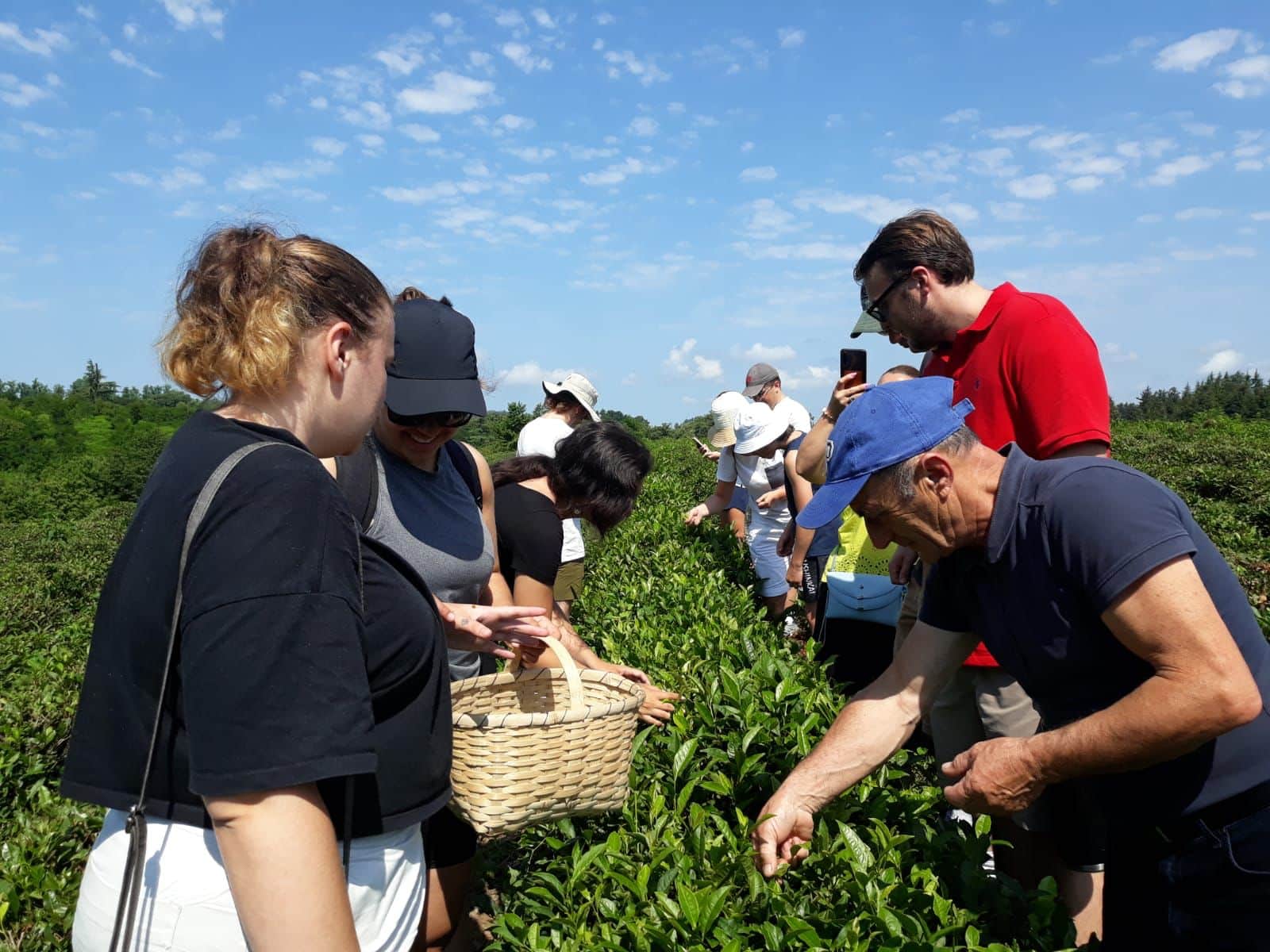
SRAS students learn how tea is grown in Georgia. Photo by SRAS Outreach Coordinator Alexandra Koteva.
Economically, about 40% of Georgians work in agriculture, forestry, or fishing, although these sectors contribute only around 6% of GDP, and subsistence farming remains common in some mountain areas. Most of Georgia’s largest companies are tied to oil and gas transit and services. While the country has minimal reserves, it is a key corridor for hydrocarbons moving from Azerbaijan and the Caspian Sea to Europe. Meanwhile, roughly 80% of Georgia’s electricity comes from renewables, mainly hydropower. Tourism contributes a growing 10–15% of GDP.
Georgia’s single largest export by value is refurbished cars — used vehicles imported from Europe, repaired, and re-exported. Rustavi, the country’s third-largest city (population ~130,000), is the main hub of this industry. Sanctions-related trade restrictions with Russia have hurt the sector, and, although the industry has not fully recovered, substantial exports have pivoted to Kyrgyzstan, Kazakhstan, and Azerbaijan.
Tbilisi dominates Georgia politically, economically, and demographically. Its metropolitan population of about 1.3 million accounts for roughly one-third of the national total, and most major corporations and institutions are headquartered there, including the Georgian Orthodox Church at Holy Trinity Cathedral.
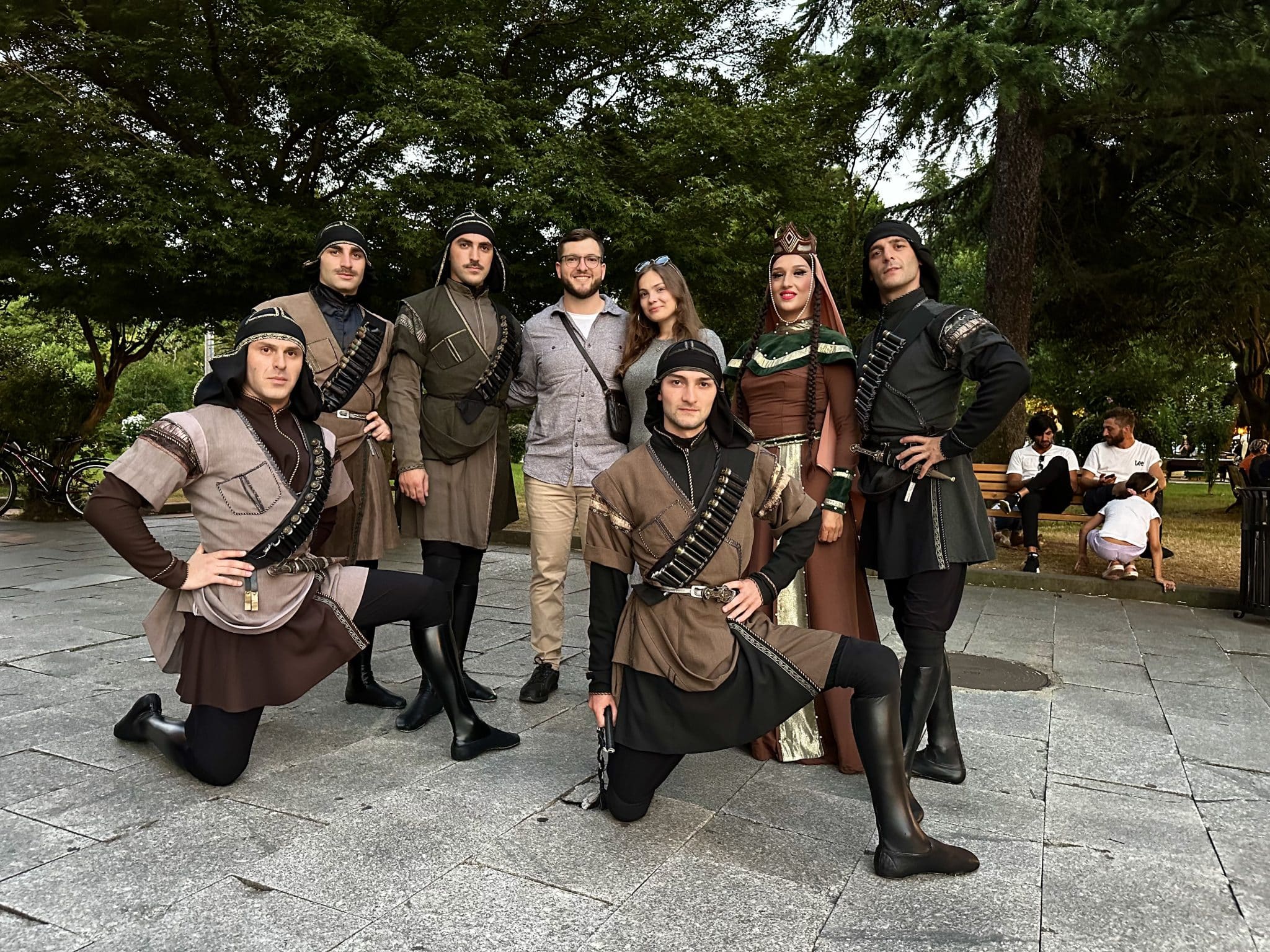
SRAS student and a local friend with Georgian dancers in Batumi, Georgia. Photo courtesy Justin Frigault.
Batumi, with about 250,000 residents, is a rapidly growing port, tourism center, and the capital of Adjara, whose Georgian-speaking population largely converted to Islam under Ottoman rule. Georgia’s most important port, however, is Poti, a city of about 40,000 that handles most container and hydrocarbon traffic and which is undergoing a $200 million expansion.
Kutaisi (population ~123,000), a former capital and industrial hub, declined sharply after the Soviet collapse, losing about half its population. However, it has seen renewed investment since 2006, including revived machinery production, a German solar panel factory, and two special economic zones that now host manufacturing from around the globe.
Mtskheta, the ancient capital, has only about 20,000 residents but is widely regarded as Georgia’s spiritual center.
Regionally, Georgia has leveraged its position along the Middle Corridor linking Asia and Europe, launching large-scale infrastructure projects. Around $7 billion is planned for highways, rail modernization, and airport development through 2032. The East–West Highway is being upgraded into a modern four-lane route connecting Azerbaijan and Turkey, with parallel rail improvements. The Kvesheti–Kobi Road, north of Tbilisi, aims to improve access to Russia while bypassing South Ossetia and providing year-round connectivity to previously isolated mountain regions.
Looking ahead, Georgia faces several risks. A potential lifting of sanctions on Russia could reverse migration and trade patterns that currently benefit Georgia’s economy. Political polarization, the current constitutional crisis, and the challenge of balancing relations with Russia, China, and the West also pose short- and long-term risks. At the same time, Georgia is growing rapidly and investing heavily in rural development, transport networks, and regional connectivity. All of these are projects intended to deliver durable, high-impact growth.


