


British Pathé produced newsreels of global historical events throughout the 20th century. They have digitized their archive of 82,000 documentary videos, produced between 1896 and 1976, and released it on YouTube. A Russian journalist, Vera Kichanova, with the then-independent Moscow-based, Russian-language publication Bolshoi Gorod, curated 10 interesting videos focused on Soviet Moscow. Her text below was translated into English by SRAS Translate Abroad intern Sophia Rehm. In certain places, information has been added or links to outside information inserted to try to make the text more useful to those readers who may not know the details of the history described.
This is most of interest to see what was interesting to British journalists at the time these reels were produced, how these events were covered, and which were chosen by a modern-day Russian journalist as most interesting.
1. Lenin’s Funeral
Here is a never-before-released silent video of Lenin’s funeral, on January 23, 1924. There is an endless flow of people on Red Square with banners reading “Lenin’s cause will outlive the century,” which, in black and white footage, are somewhat reminiscent of banners traditionally used in religious processions.
2. Winston Churchill Visits Moscow
In August 1942, at the height of the German offensive against Stalingrad, Winston Churchill pays an official visit to Moscow and meets with the Soviet Commander-in-Chief. Two rounds of negotiations took place between them, devoted mostly to opening a second front. Addressing the Soviet people with a solemn speech, the British prime minister promises “to continue the fight hand in hand like comrades and brothers.”
3. British Military State Visit
In January 1947, British Field Marshal Montgomery came on a visit to Moscow and met with Stalin. In the voice-over, a British broadcaster expresses the hope that this will be the beginning of a warming in Soviet-British relations. The Kremlin’s distinguished guest is given a uniform and overcoat.
4. May Day Parade on Red Square
Foreign reporting from the May Day Parade on Red Square, directed by the heavily-decorated Marshal Zhukov, (commander of the Soviet troops in Eastern Europe during WWII). The troops march first, then artillery cross square, then schoolgirls with white bows carry flowers to Khrushchev and other party leaders, then come the athletes, and finally Muscovites pour onto the square.
5. Soviet Elections
What were elections like under the Supreme Soviet of the Soviet Union? Like a holiday for Soviet people: donning their best clothes, they went to the polling centers with their families, and children were delighted when they were entrusted with dropping a ballot in the box. A portrait of Lenin surveys all this from the wall.
6. Moscow International Film Festival, 1959
The first Moscow International Film Festival took place in August 1959. Delegations from 25 of the world’s countries took part. Foreign guests drink champagne in the Moscow Hotel, talk with Kremlin guards, and dance the Ukrainian Hopak and play guitar with Soviet Young Pioneers. It’s practically celebrity reporting.
7. Visit to a Collective Farm
Foreign diplomats are shown an exemplary collective farm, given little piglets to snuggle, and then treated to fresh milk and fruit.
8. Soviet First Graders’ First Day
The first of September in a typical Moscow school. Excited first-graders are ready for the traditional first day of school. They are dressed in uniforms and carrying bouquets. They hurry to their first class, stand at a celebratory assembly, and then attend their first class with their first teacher.
9. British Stars Visit Moscow
Britons bring a performance of Othello with Sir Lawrence Oliver to Moscow – this is one of the most interesting videos, and clearly shows what life was like in Moscow in the 60s. The guests ride on the Moskva River, go to the GUM State Department Store facing Red Square (where they are amazed that Soviet cashiers use “the most ancient computers:” wooden abacuses), and stroll around Moscow’s exhibition center, VDNKh, or the Exhibition of Achievements of the People’s Economy. The reporter finds VDNKh’s attractions a pale imitation of European amusement parks. “This is a country that so often seems like yesterday, a country that sacrificed today for an ambitious tomorrow,” he concludes. Actors use automatic soda dispensers and telephone booths, view the Kremlin’s cathedrals (“If the Kremlin sounds frightening, it looks beautiful”), go to the circus, and finally, earn ovations at the Bolshoi Theater.
10. British Fashion in Moscow
New British fashion is displayed right on the streets of Moscow.
You Might Also Like

The Russian Far East: Gateway to Asia
Constituting over one-third of Russia’s territory, home to major natural resource deposits, and essential to maintaining increasingly valuable Asian trade routes, the Far East Federal…

Europe: Divisions and Unifications
The European continent is diverse. Many of its countries, though smaller than many US states, can be further broken into regions that differ from each…
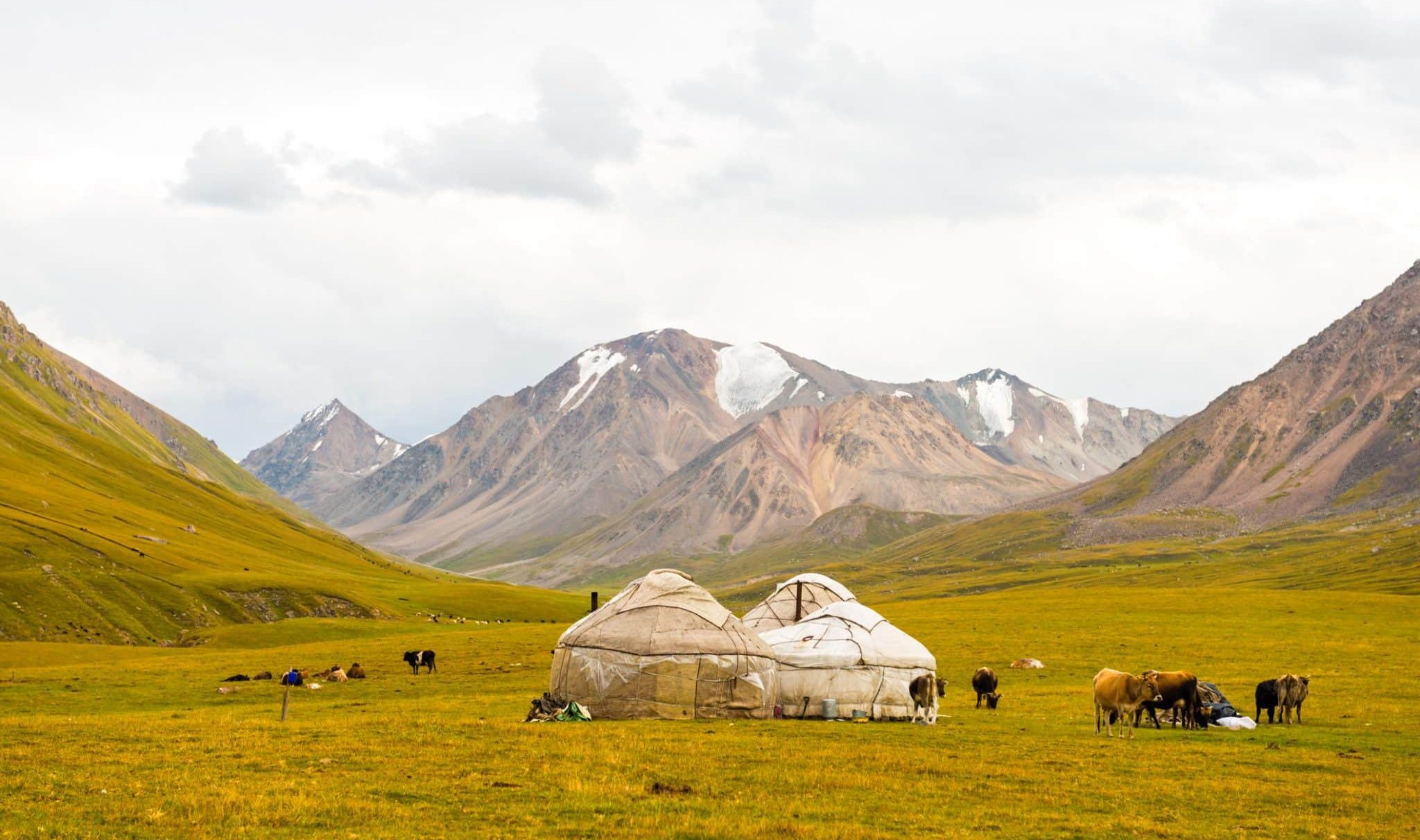
Kyrgyzstan: Nomadic Heritage, Modern Ambitions
Kyrgyzstan is a landlocked and highly mountainous country in Central Asia. Since gaining independence from the Soviet Union in 1991, Kyrgyzstan has faced a complex…

Abkhazia: Grandeur to Ruin… and Back Again?
With its precipitous mountains, subtropical climate, and pristine beaches, one would expect Abkhazia to be the Black Sea Riviera, attracting the wealthy and stylish from…

Origins of Russia: Moscow Becomes an Empire (Prehistory to 1584)
Moscow is not just a city. It was a fort that became a city, that became a state, that became an empire, that became a…
