

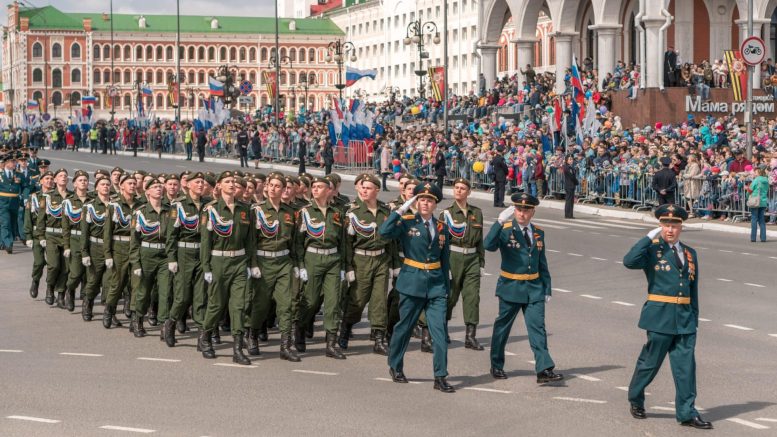
The armed forces are the largest and most important of Russia’s power agencies. They operate under the direct authority of the Министр обороны (Minister of Defense), who is advised by the Генеральный штаб (General Staff), commonly shortened to Генштаб (Genshtab), as well as by civilian advisors. Above them all stands the president of the Russian Federation, who serves as главнокомандующий (Commander-in-Chief).
The Russian Armed Forces currently include approximately 1.32 million военнослужащих действительной службы (active-duty personnel), supported by roughly 2 million резервистов (reservists) and an additional 250,000 военнослужащих военизированных формирований (paramilitary personnel).
Although President Vladimir Putin has signed decrees intended to expand the military to 1.5 million active troops, the armed forces have not yet reached this full комплектование (staffing). Major obstacles include draft evasion, recruitment challenges, and Russia’s ongoing demographic decline.
Service Terms
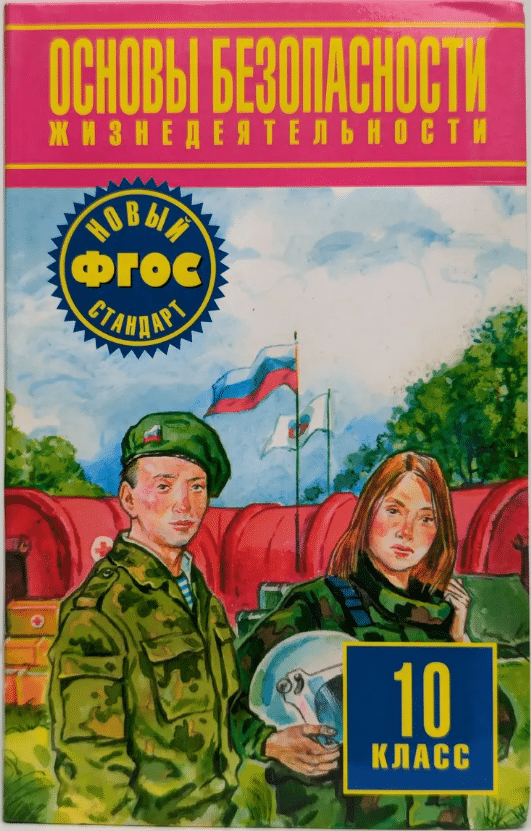
The cover of a 10th grade OBZh textbook.
All Russian citizens who are men, aged 18-30, have a legal obligation to complete военная служба (military service).
In preparation for this, high school and vocational colleges offer Основы безопасности и защиты родины (Foundation of Safety and Homeland Defense; abbreviated to ОБЗР), which until 2025 was called Основы безопасности жизнедеятельности (Foundations of Life Safety; often abbreviated to ОБЖ). This required course includes elements of emergency preparedness, civil defense, and introductory military instruction. It is sometimes referred to more broadly as военная подготовка (military preparation). The curriculum was developed by the Ministry of Defense and the Ministry of Emergency Situations. The subject begins in 5th grade with lessons on fire safety, basic first aid and CPR, etc.
The rules and pathways surrounding service have changed considerably over the last two decades. Options today include conscription, alternative civilian service, or volunteering as a contract soldier.
Conscription
Originally, like the USSR before it, Russia relied almost entirely on воинскую повинность (conscription; lit. “military duty”). In 1993, the law on the Russian Armed Services established that новобранцы (recruits) would serve eighteen months if they are sent to the сухопутные войска (land-based units), two years if sent to the военно-морской флот, ВМФ (navy), but only one year if drafted after receiving a college degree.
Amendments in 1996 raised this requirement to two years for all branches to support Russia’s war in Chechnya. Deeply unpopular, the law was changed again in 2006 and, as of 2008, all recruits in all branches now serve one year.
Russian men автоматически ставятся на воинский учет (are automatically registered for the draft) in the year they turn 17. In 2023, Russia fully automated and digitized this process with the Единый реестр воинского учета (Unified Military Registration Registry) that pulls data automatically from other state databases (such as tax and residency records), completely bypassing the need for in-person visits and paperwork mailed through the regular post.
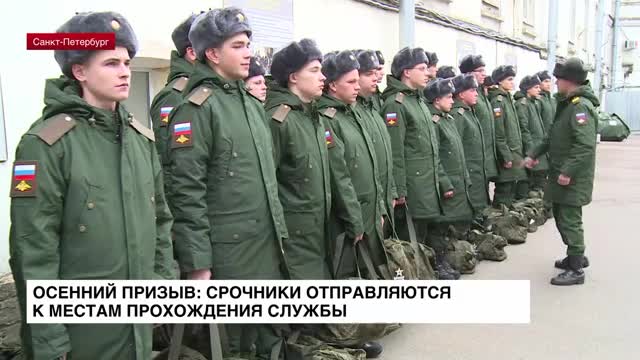
A still from a news report about new conscripts called up in St. Petersburg, Russia. They are wearing newly-issued winter gear.
At eighteen, the районный военкомат (regional draft board) can прислать повестку (send a draft notice) requiring отправиться к месту прохождения службы (the person to report to an assembly point). Russia is transitioning to a system of electronic draft notice through apps like Gosuslugi, the government’s unified online portal for most services. Drafted individuals запрещается покидать страну (are barred from leaving the country) immediately and those who fail to report as instructed рискуют лишиться водительских прав (risk losing their driver’s licenses) among other penalties.
Conscription offices now operate continuously. Enlistment boards can issue digital notices and conduct медицинские осмотры (medical evaluations) and и психологические обследования (psychological screenings) year-round. Conscripts are then subject to a biannual призыв (draft) which takes place from 1 April to 30 June and again from 1 October to 31 December, depending on how many призывники (draftees) are determined to be needed.
Avoiding Conscription
For young men hoping избежать призыва (to avoid conscription), there are few options.
An отсрочка (deferment) is most commonly obtained by получение высшего образования (enrollment in higher education). However, most individuals become eligible for conscription again after graduating. Advanced degrees have been traditionally exempt and, since about 2022, certain graduates who work in IT, telecommunications, and banking can also receive deferments. However, this is not written into legislation and is not considered guaranteed.
Young men may also qualify for освобождение (exemption) from the draft по семейным обстоятельствам (for family reasons). Brothers and sons of those killed during military service are exempt. Also exempt is anyone judged не годен к военной службе (unfit for military service) after the mandatory medical and psychological examinations. Rumors that doctors подкупают (are bribed) to declare applicants medically unfit are fairly common.
Эмиграция (emigration) has historically been the most reliable way to avoid military service. At the start of the Russia-Ukraine war in 2022—and especially ahead of the next autumn draft cycle—hundreds of thousands of young men fled the country.
Reasons for wanting to avoid the draft are several. While in the US, military service is seen as способ оплаты высшего образования (a way to pay for college) and приобрести ценные профессиональные навыки (learn valuable vocational skills), Russian conscripts generally complain that they receive little training outside of военного протокола (military protocol), строевой подготовки (marching), and обращения с оружием (weapons handling). They receive a meager stipend of 2000 rubles ($27) per month. While monthly надбавка за работу в опасных условиях (hazard pay) clearing mines, for instance, or надбавка за работу в тяжелых условиях (hardship pay) for serving abroad are available, they offer only another 1000 rubles per month. Thus, many potential conscripts feel their time would be better spent learning or earning as a civilian.
Further, conscripts can enter service with serious concerns for their health and safety. Russia’s military has struggled with дедовщина (hazing), in which деды (soldiers who have served longer; literally “grandfathers”) may dominate newer recruits through extortion and/or physical or psychological abuse. Reports have also described officers directing soldiers into manual labor from which the officers benefit financially, or demanding bribes for granting отпуск (leave), preferred назначение на службу (assignments), or even защиту (protection) from other soldiers.
Реформы (reforms) such as shortening conscription terms and increasing oversight of both troops and officers have reduced these concerns, but they remain present for conscripts and their families.
Soldiers who are drafted and then уйти в самоволку (go AWOL), become дезертиры (deserters) and are likely to попасть на гауптвахту (end up in the guardhouse) and not find their position improved upon being released.
Alternative Service
Альтернативная служба (alternative service) is guaranteed by the Constitution of the Russian Federation and defined in federal law as service performed in the interests of society and the state in place of compulsory military service.
In principle, this option is available to citizens чьи религиозные убеждения (whose religious beliefs) или личные взгляды (or personal convictions) противоречат военной службе (conflict with military service), as well as members of коренные малочисленные народы (indigenous minority groups) who maintain traditional internal economies.
Those choosing alternative service must serve 18 months if assigned to a военное учреждение (military institution; ie. military hospitals) or 21 months if assigned to a гражданскую организацию (civilian organization; ie. as social workers, postal employees, or in public education). These individuals are treated as regular employees of these organizations and receive wages under standard employment contracts.
Qualifying for alternative service requires extensive documentation and formal approval, which many applicants report is difficult to obtain. Placements are also generally low-paid, making alternative service less attractive than other avoidance methods.
Contract Military Service
Контрактная служба (contract military service) began in Russia in 1996. However it was not until reforms made after 2004 and funding caught up with promises in the 2010s that such service began to become competitive with the private sector. In 2014, Russia recruited more soldiers than it conscripted for the first time, with 70,000 контрактников (contract soldiers) enrolled.
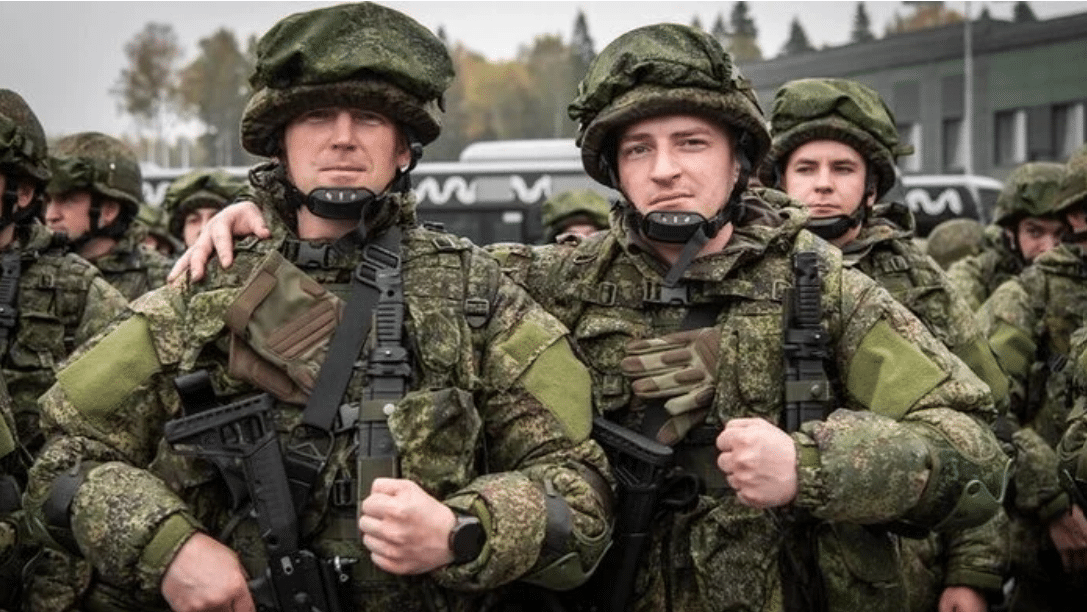
Russian contract soldiers in combat gear.
Contract soldiers sign up to serve for 1, 3, or 5 years. They begin by reporting to a пункт отбора (recruitment center). Those signing longer term contracts are generally given preference for повышение по службе (promotion). Contract soldiers are also preferred for more престижные должности (prestigious placements). These include Russia’s спецназ (special forces), арктические войска (arctic forces), and подразделения беспилотников (drone units).
Contract soldiers receive considerably better wages, training, housing, and social benefits which are considerably better than those afforded to conscripts. As of 2026, soldiers serving at the front lines receive a minimum monthly salary of 210,000 rubles from the federal government (and from 45,000 if not stationed at the front). Some regions, such as Moscow, supply an additional 50,000 rubles per month for front-line soldiers.
Выплаты при подписании контракта (signing bonuses) are marketed heavily. The federal government offers a 400,000 ruble one-time bonus and regions supplement this. For instance, Moscow offers an additional 1,900,000 rubles while Tuva, one of Russia’s poorest regions, offers an additional 400,000 rubles.
This structure allows payouts to be weighted based on Russia’s economically diverse regions where, for instance, the average wage for Moscow is nearly 200,000 rubles per month but Tuva’s is about a fifth of that.
Выплаты в случае смерти (death benefits) and выплаты в случае ранения (injury benefits) are also advertised as generous. The family of a contract soldier killed at the frontlines is offered a payment of some 14 million rubles split between payments from the presidential administrations, federal government, and state insurance fund. Additional regional payments can increase this to nearly 17 million rubles. This is in addition to a monthly federal пособие по случаю потери кормильца (survivors benefits) and other benefits.
Upon discharge, a contract soldier can receive a 400,000 ruble премию за завершение службы (completion of duty bonus) and a военную пенсию military pension if they served 20 years or more.
These sums are from multiple sources and each comes with its own application, documentation requirements, and fine print that soldiers and their families must carefully navigate.
Serving as a contact soldier eliminates the need to serve as a conscript. However, most contract soldiers signing up in 2026 are reportedly 30-40 years old with military training from having previously been conscripts.
Issued Uniforms and other Items
Each soldier is issued three uniforms: повседневная форма (lit. the “everyday” uniform); полевая форма (lit. the “field” uniform); and the парадная форма (lit. “parade” uniform). The field uniform is technically known as a всесезонный комплект полевого обмундирования (all-season field uniform set), or ВКПО (VKPO) for short. Uniforms for conscripts and contract soldiers are issued under different regulations, but contain most of the same items, just in different quality and different amounts.
What soldiers are issued is also determined by the service branch and specific units that they enter and where they will serve. For instance, those serving in the Navy are issued тельняшки, the distinctive striped shirts that make seeing sailors that have fallen overboard easier. Soldiers serving in the arctic are issued синяя цифра (a blue-on-blue camouflage) while those serving at the front lines in Ukraine are issued a green-and-brown camouflage first developed in the US called камуфляж мультикам (multicam camouflage).
Some specific items of clothing issued for those heading to the army include a фуражка (forage cap; the flat-topped military dress hats), a гимнастёрка (service blouse) and either a мундир or a китель (both types of jackets). For cold weather, there is an ушанка (hat with ear-flaps) and a ватник (quilted work coat). There’s a ремень (waist-belt), and ботинки (boots) that should be kept до блеска (spitshined; literally, until they sparkle).
As in the US Army, initial hygiene items (like a toothbrush, razor, and soap) can be issued with the uniform. After this, soldiers (contract or conscript) are responsible for restocking their own toiletries using their standard monthly pay and allowances.
Белье (underwear), полотенце (a towel) and носки (socks) are also issued. The Russian army was once well known for continuing to use tsarist-era портянки (foot-wrappings) instead of socks. These were faster to dry when wet, and could be more easily repaired or improvised. However, they were discontinued in the Russian army in 2013.
When a soldier is discharged, he keeps most of his uniform. Men in rural, poorer areas will often wear their ватник (quilted work coat) for years after their service ends. The word is also used to refer to poorer, rural, lower-educated people as a derogatory term roughly equivalent to the American “redneck” or “hick.”
Life in Training
Начальная военная подготовка, НВП (basic military training) is led by офицеры (officers) and старшины (noncommissioned officers). Each is generally a выпускник военного училища (graduate of a military academy).
Training takes place at a полигон (training ground). A soldier must know not only how to маршировать (march) in a колонна (formation), he must also take part in полевые учения (field-training exercises). During down time he can study the устав (regulations).
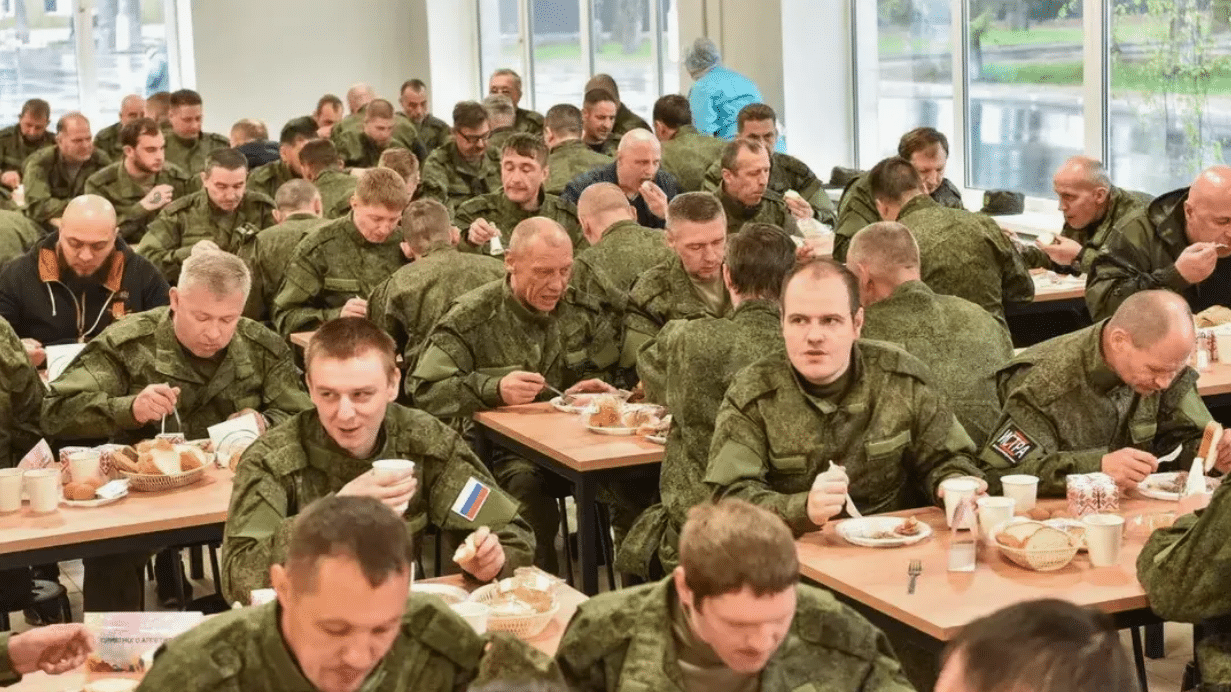
Russian contract soldiers tend to be older males who have already served in the military.
Contract soldiers and conscripts are typically housed в казармах (in barracks), but their condition might differ substantially. Conscripts sleep in large, open rooms with 30-120 коек (cots). Contract soldiers may share much smaller 2 to 4-man rooms. Some newer barracks are 3-4 stories, and house hundreds of soldiers in different formations.
Soldiers rise at about 6am to подъём (reveille), stand for поверка (roll call), do their физзарядка (calisthenics), to get ready for осмотр (inspection) or, if its a special occasion, a торжественный смотр (military review).
Training is generally an all-day affair. By official regulations, all soldiers are to be offered over 4000 calories per day, spread out over three meals. If a soldier is stationed at a barracks, these are hot meals, served by дежурные по кухне (kitchen duty officers) in the столовая (messhall). If a soldier is in the field, they might be portable rations. Food is often referred to in military jargon as похлёбка (chow). Of course, maintaining this means поддержание систем снабжения (maintaining provisioning systems) and, for soldiers in the field especially, линий снабжения (supply lines).
The day is not done till вечерняя поверка (evening roll call) and отбой (taps) at around 10 pm.
Learning Commands
A soldier needs to know battle commands such as:
- Есть! (Yes, sir!)
- Бегом! (Double-time!)
- В укрытие! (Take cover!)
- Огонь! (Open Fire!)
- Гранатами огонь! (Grenade fire!; A command to throw grenades)
- За мной! (Follow me!)
- Заряжай! (Fire away!; lit.: Load!)
- К бою готовься! (On guard!)
- Целься! (Take aim!)
- Штык-нож (штык) – примкнуть! (Affix bayonets!)
- Стой! Кто идёт? (Stop, Who goes there?)
- Руки вверх! (Hands up!)
A soldier also needs to learn marching commands:
- Смирно! (Attention!)
- Вольно! (At ease!)
- В колонну (по 2, по 4) становись! (Form (2, 4) columns!)
- В колонну по одному становись! (Fall in – single file!)
- В ружьё! (Take up arms!)
- За спину! (Sling arms)
- К ноге! (Order arms!)
- На караул! (Present arms!)
- На месте шагом марш! (Mark time!)
- Шагом марш! (March!)
- Направо! (To the right!)
- Налево! (To the left!)
- Равнение направо/налево (Eyes right/left!)
- Разойдись! (Fall out!)
- Сомкнись! (Close on center/flanks)
Women in the Russian Military
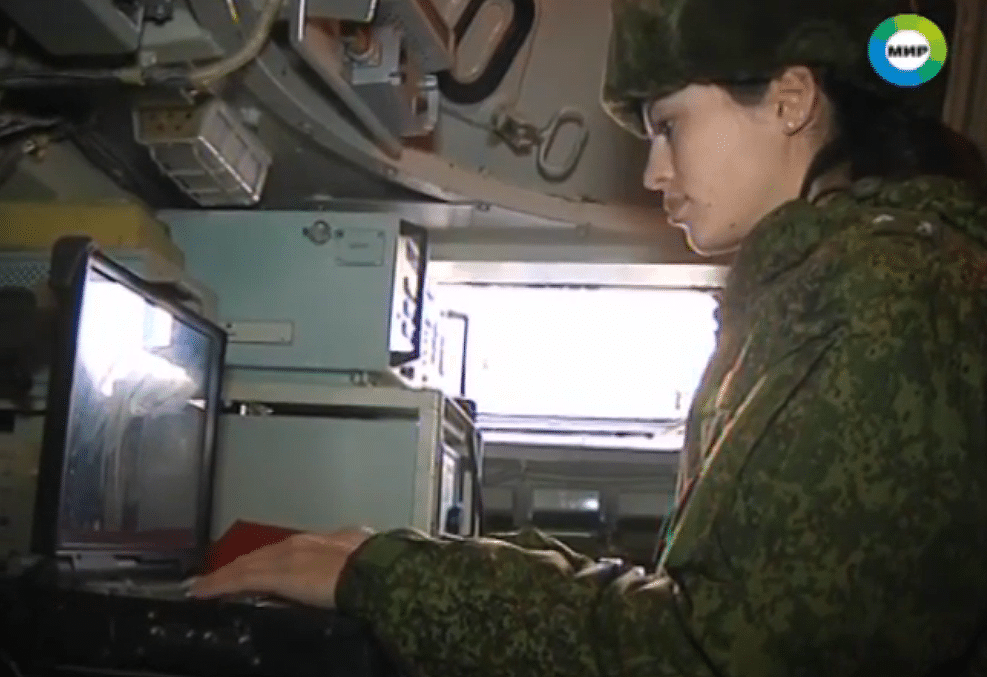
A still from a news report about a Russian female lieutenant who leads a communications platoon.
Women are not subject to conscription, but can sign up as contract soldiers.
They are specifically prohibited from serving as marksmen, snipers, field engineers, drivers, mechanics, and tank operators, among other specialties. This is in line with the Russian labor code that prohibits women from working jobs that require heavy lifting and explained by theories that such strenuous labor has adverse effects on female fertility.
Women instead serve in positions such as медсёстры (nurses), специалисты по радиотехнике (radio engineering specialists), переводчицы (interpreters), специалисты по логистике (logistics specialists), etc.
As of March, 2025, some 37,500 women served in the Russian military in such positions. Lawsuits have attempted to open other positions to women, but the courts have generally sided with the Ministry of Defense on the issue.
The Military as a Source of Identity and Humor
With conscription still actively practiced, military life is a large part of the Russian collective experience. For instance, the holiday Defenders of the Fatherland Day, celebrated since Soviet times, is essentially Russia’s Father’s Day but celebrates all men in their capacity as soldiers. This is to say nothing of the role that the memory of WWII plays in the formation of Russian identity.
Given how ingrained it is into Russian identity, it is also not surprising that jokes and terminology from military life are common in popular culture.
- Всех отсутствующих построить в одну шеренгу!(Line up all the missing men in one column!)
- И не делайте умное лицо, не забывайте, что вы будете офицеры. (Don’t try to look intelligent. Don’t forget that you are future officers.)
- Курсант, если вы хотите что-нибудь сказать, то лучше молчите. (Cadet, if you want to say something, you’d better keep quiet.)
- Все в окопы, остальные за мной! (Everyone into the trenches! The rest follow me!)
Credits
The preceding resource began as a lesson originally written by Dr. Lawerence Mansour, West Point and published in The Russian Context: The Culture behind the Language, edited by Genevra Gerhart and Eloise M. Boyle, published in 2002. The lesson appeared, with permission, on SRAS.org in 2005. The version presented here has been greatly expanded and updated by Josh Wilson and Andrei Nestrov, both of SRAS, as of June, 2026. Some language from the original remains.
More Russian for Wonks

Russian for Wonks: Demographics and Childbirth
Russian demographics have been a major policy issue for the Russian state since its formation in 1991. As the population continues to age and fertility…

Russian for Wonks: The Geopolitics of Summer Camp
For many Russian children, summer camp is a cherished rite of passage—an escape from school routines into a world of bonfires, games, and shared songs….

Russian for Wonks: International Relations and Related Issues
In international relations (IR), language is more than a tool. Language, along with culture and history, is central to most national identities. Demonstrating genuine engagement…

Renting in Russia: Language, Legalities, and Culture
The word for “landlord” in Russian is actually the same as the word for “host” – . Renting in Russia, whether apartments or rooms, comes…

Russian for Wonks: Russian Labor Market
This resource is intended to serve as a map for the Russian labor market both in terms of official and unofficial labor practices and with…

