


Study abroad with SRAS in locations across Eurasia.
Political scientists studying a foreign country must be able to understand its politics at a local level. How do elections function? What motivates voters? What barriers do candidates face? Language can play a key role in this process, allowing researchers to interpret how participants express themselves and understand the context behind their views. While English is widely spoken worldwide, the vast majority of voters in most countries are unlikely to express themselves in English.
This resource introduces federal elections in Russia, covering voting procedures, campaign practices, and how elections are structured. By integrating language with real-world political concepts, it is designed for intermediate to advanced language learners interested in political science. It should also serve as a useful primer for students preparing for SRAS study abroad programs focused on politics or policy.
Running For Office and Procedural Hurdles
In the Russian Federation, президентские выборы (presidential elections) and выборы в Государственную Думу (State Duma elections) form the core mechanisms through which political authority формально легитимизируется (is formally legitimized).
Individuals hoping to баллотироваться (run for office) must meet strict требования к кандидатам (eligibility requirements), including минимальный возраст (minimum age), требование о постоянном проживании (residency requirement), and требование о гражданстве (citizenship requirement). For instance, баллотироваться на пост президента России (to run for Russia’s presidency), a candidate must be a Russian citizen, at least 35 years old, have resided permanently in Russia for at least 25 years, and must never have held foreign citizenship or a foreign residence permit.
There are also процедурные препятствия (procedural hurdles) that tend to change often. For instance, сбор подписей (signature collection) in for presidential candidates registering in 2023 required независимые кандидаты (independent candidates), also sometimes referred to as самовыдвиженецы (self-nominated candidates), to collect at least 300,000 and no more than 315,000 signatures, with no more than 7,500 signatures per избирательный округ (electoral district). Candidates баллотирующиеся от политических партий (running as part of a political party) not represented in the Duma had to collect at least 100,000 and no more than 105,000 signatures with no more than 2,500 signatures per electoral district. Meanwhile, those running as representatives of parties представленными в Государственной Думе (represented in the Duma) had no signature requirement.
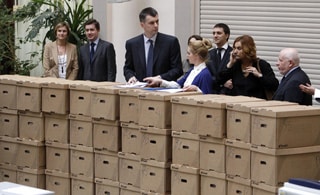
Mikhail Prokhorov (center) standing with the two million signatures he gathered to register as an independent candidate for president.
In the 2012 elections, however, independent candidates had to submit at least two million signatures, gathered in less than 20 days, with every one of Russia’s then-83 субъекты (constituent territories) represented. Only billionaire Mikhail Prokhorov managed to do this, using an army of lawyers and a fleet of private planes.
While requirements have obviously eased, the actual регистрация кандидатов (registration of candidates) still depends on утверждения избирательной комиссией (election commission approval). Requirements are highly specific and numerous. Any flaw can and often does result in дисквалификации (disqualification).
Избирательная кампания (election campaigns) are managed from a предвыборный штаб (campaign headquarters). Candidates might hold предвыборные митинги (campaign rallies), participate in выступления на телевидении (television appearances), and may engage in политические дебаты (political debates). Grassroots outreach includes обход избирателей (canvassing), supported by предвыборная агитация (campaign advertising). Public opinion is tracked through опрос общественного мнения (opinion poll) data, which often tracks a candidate’s рейтинг популярности (approval rating).
All of this activity depends on финансирование кампании (campaign financing), which is regulated by the elections commission but is unevenly enforced. A candidate’s success can also partly depend on their энергии и харизмы (energy and charisma). For instance, during his campaign for mayor of Moscow, opposition candidate Alexei Navalny actively stumped across the city, delivering frequent, often impromptu speeches at metro stops and other public spaces. Although he did not win, he secured a significantly higher share of the vote than expected.
Single Mandate and Proportional Representation
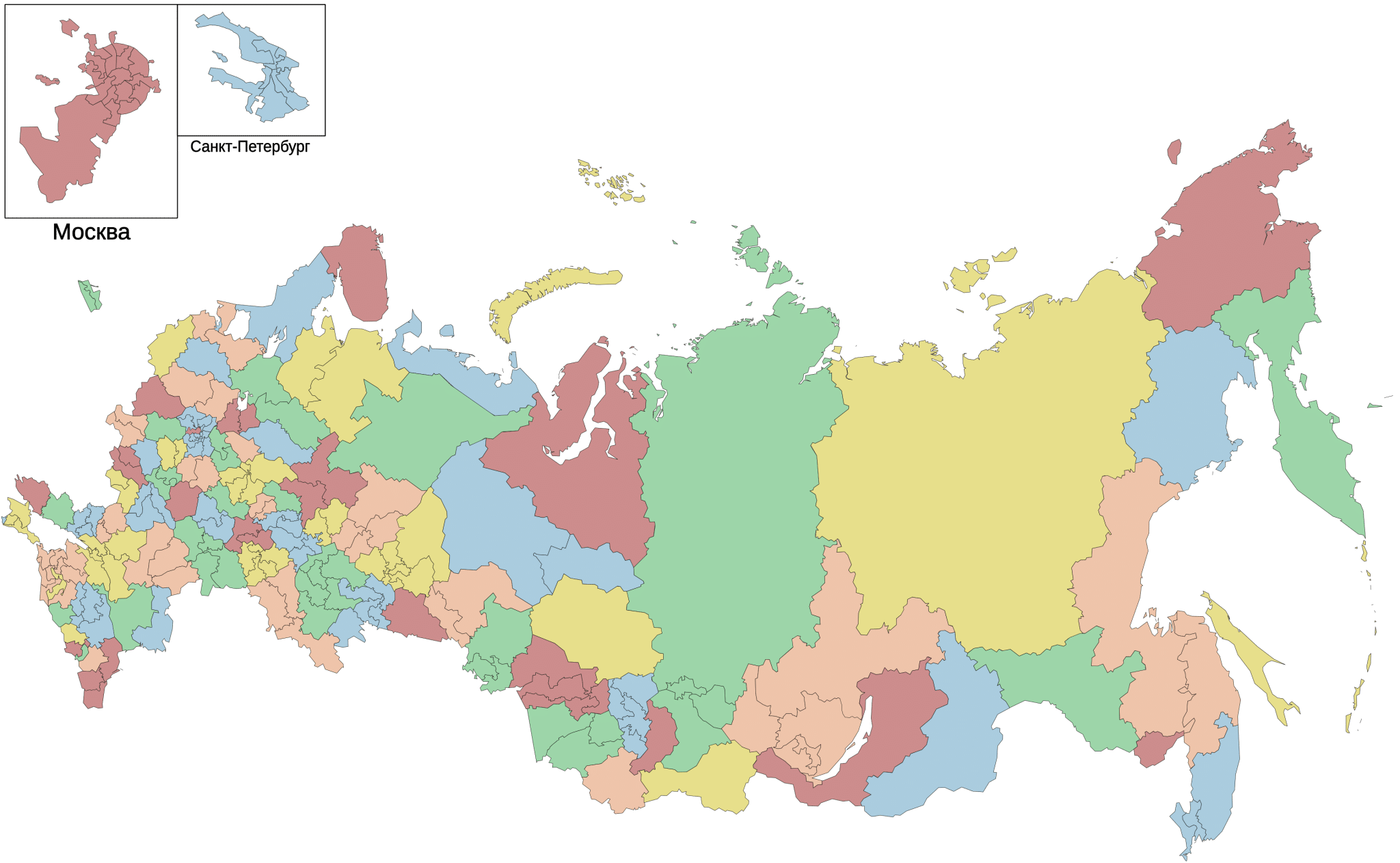
Russia’s electoral districts for the 2026 Duma Elections cover Crimea and four other disputed territories in Ukraine.
In Duma elections, Russia employs a смешанная избирательная система (mixed electoral system), with 50% of seats from одномандатные округа (single-mandate districts) and 50% from пропорциональное представительство (proportional representation) contests.
Single-mandate districts operate much like in the American system, where individual candidates campaign for direct votes inside a specific district. Like in Russia’s presidential elections, candidates are elected по мажоритарной системе относительного большинства (in a first-past-the-post system), where the first to win more than 50% of the vote wins. If no candidate wins more than 50%, проводится второй тур выборов (a run-off election is held).
In districts with proportional representation, voters support only political parties. Each party that surpasses the избирательный барьер (electoral threshold) of 5% can then assign seats proportional to its corresponding vote share to candidates on its партийный список (party list), which is published before the election.
All candidates in both district types must meet current requirements and be approved by the relevant election commission.
Voting and Rigging Elections
To проголосовать (vote) in Russia, one needs only be 18 years or older and to present one’s внутренний паспорт (internal passport). Every Russian citizen is issued this ID at age 12. No special регистрация избирателей (voter registration) is required. Voting takes place at one’s local избирательный участок (polling station), often at a nearby school and almost always on a weekend where one will receive an избирательный бюллетень (ballot) to take to a отдельную кабину для голосования (private voting booth), заполнить (mark), and then place in the урну для голосования (ballot box).
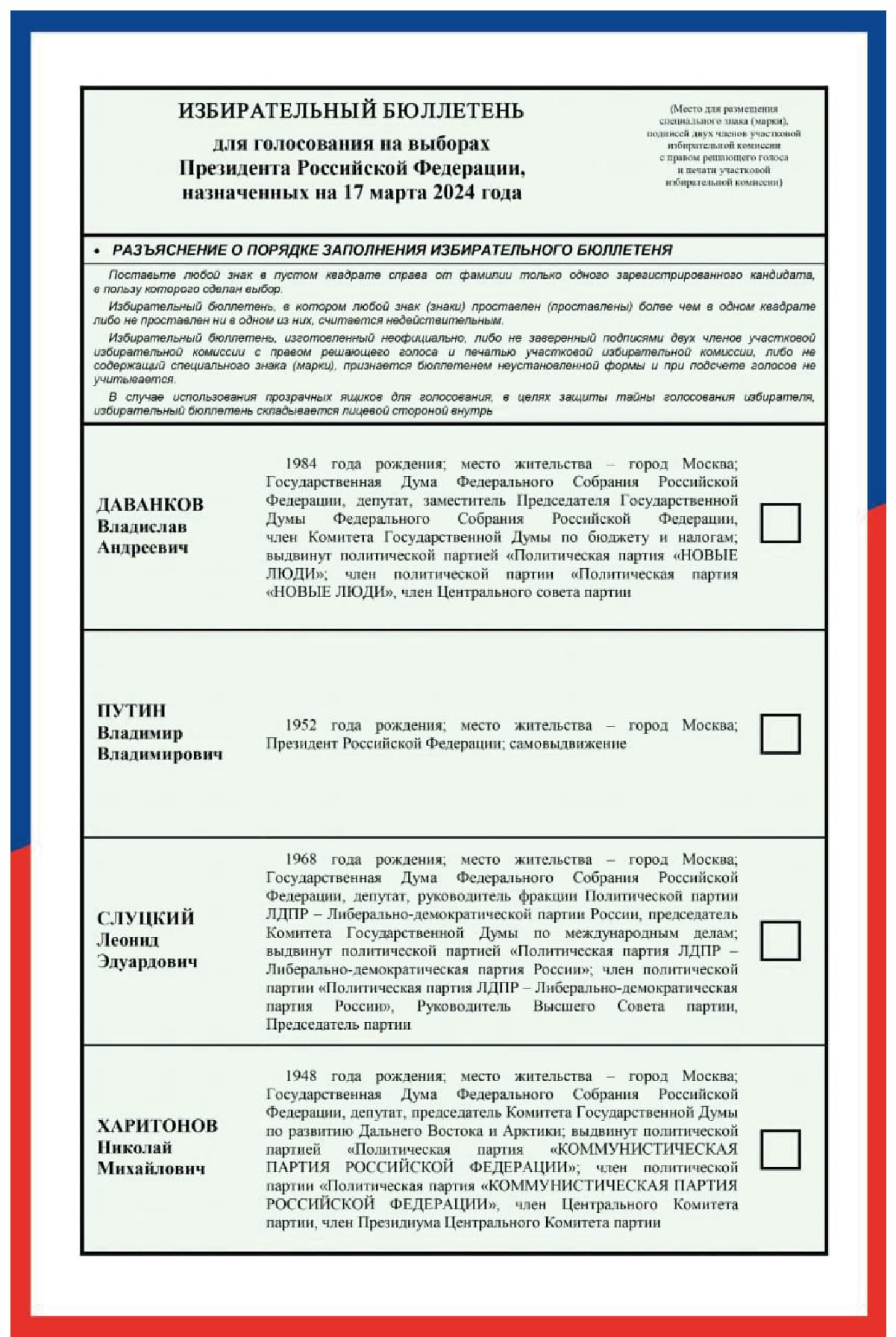
An example of the ballot used in the 2024 Presidential Elections. Putin ran as an independent against representatives from the Communists, the right-wing LDPR, and the more centrist New People Party.
In recent years, Russia has reformed its voting process with expanded досрочное голосование (early voting) and электронное голосование (electronic voting). “Голосования на пеньке” or “stump voting,” has also become increasingly common, where pop-up or mobile voting stations appear in parks, busses, workplaces, and other high-trafficked areas. The authorities argue this is an удобства для избирателей (convenience for voters) and vastly повышает эффективность работы государственных органов (is more efficient for the state). Electronic voting especially is shown as helping deeply rural voters that had to be serviced by helicopter in the past. Critics, however, argue that these reforms не поддающимися мониторингу (have made election monitoring impossible) and made most фальсификации на выборах (election fraud) purely digital and untraceable to the public.
Another concern is использование административного ресурса (abuse of administrative resources), by which state power can benefit certain candidates. This can be as simple as calling for досрочные выборы (early elections), which will favor any действующий кандидат (incumbent), who voters are likely familiar with, and disadvantage any оппозиционный кандидат (challenger candidate), who then has less time to campaign.
This can also include вброс бюллетеней (ballot stuffing) or the slightly more sophisticated карусельное голосование (carousel voting), wherein groups caravan between multiple voting locations and are illegally allowed to cast ballots at each. Both actions can technically only be done при соучастии государства (with the complicity of the state), which controls the подсчет голосов (vote count) and, in Russia, the distribution of ballots based on passport number and place of residence.
Both practices lead to завышенная явка (inflated turnout); sudden скачки (spikes) in turnout are commonly cited as evidence of fraud. Some недовольные (disaffected) voters will go to polling stations to испортить (spoil) their ballots or cast протестные голоса (protest votes) for minor parties. This signals their disapproval of the government and, by using up the limited number ballots, can make fraudulent activity more visible.
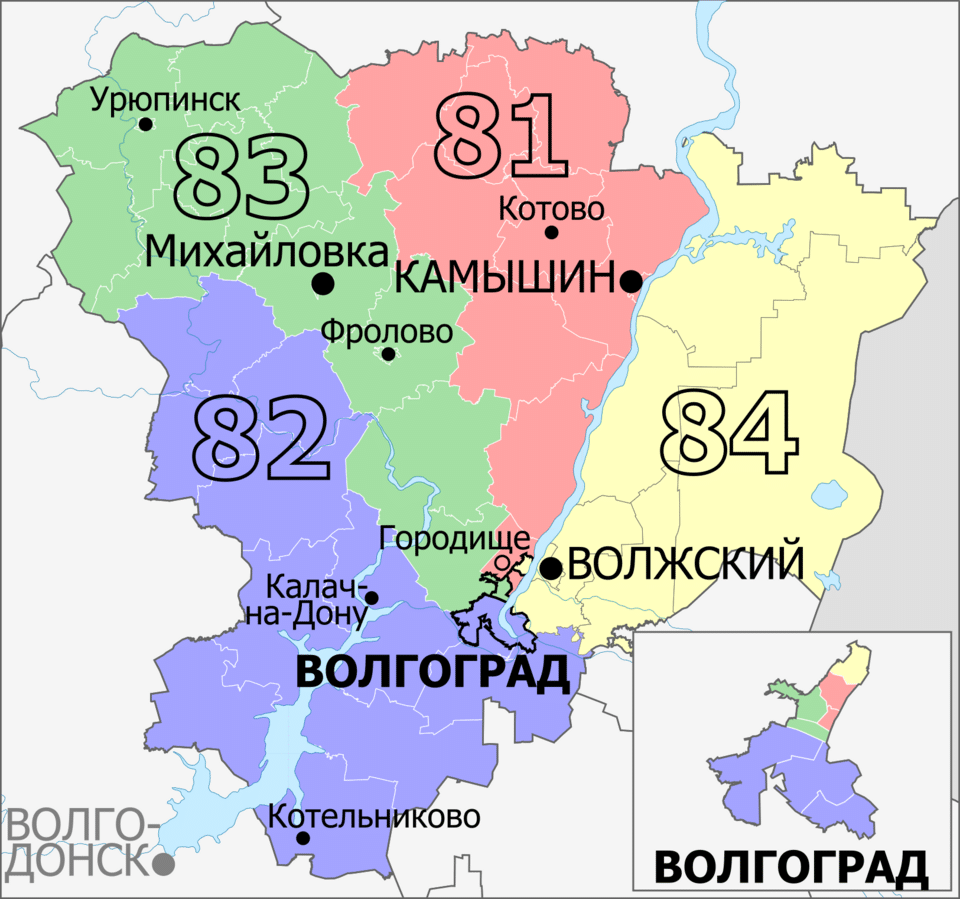
An example of “petal” distracting. The city of Volgograd, with a population of about one million, is broken into four districts that additionally cover the rest of the Volgograd region.
The state can also engage in манипуляция границами округов (gerrymandering). In the US, this most famously results in thin, winding districts. In Russia, gerrymandered “лепестковой” (“petal”) districts fan out from urban areas, dispersing more либерально настроенных избирателей (liberal voters) with expansive swaths of rural and more консервативно настроенных избирателей (conservative voters).
Abuse of administrative resources in Russia also applies in accusations of принуждение избирателей (voter coercion) commonly levied at the military, state-owned corporations, and state hospitals, where special voting stations are often opened solely for these dependent populations.
Also significant is контроль государства над СМИ (the state’s control of mass media). Благожелательное освещение в СМИ (favorable media coverage) allows incumbents, who largely принадлежат к правящей партии (are from the ruling party), to avoid active campaigning, instead relying on state television to portray them as professional and focused problem-solvers. Televised debates often feature only opposition candidates, who then appear combative and theatrical by contrast. In a system where стабильность (stability) remains a key voter priority, this contrast can be decisive.
While stability remains a major motivator for voters who remember the chaotic 90s, many younger voters are shifting focus to экономическое процветание (economic prosperity). Vulnerable groups are often motivated more specifically by пенсионная стабильность (pension security) and социальная поддержка (social welfare). Political messaging often appeals to voter concerns for борьба с коррупцией (fighting corruption), патриотизм (patriotism), and национальная безопасность (national security).
Terms and Protests
After elections, candidates are sworn into their offices after принеся присягу (taking an oath) to служить Конституции, государству и народу (serve the constitution, state, and people). Elected officials serve a defined срок полномочий (term of office), which generally follows the regular избирательный цикл (election cycle). The президентский срок (presidential term) is currently six years while all 450 Duma seats are elected every five years.
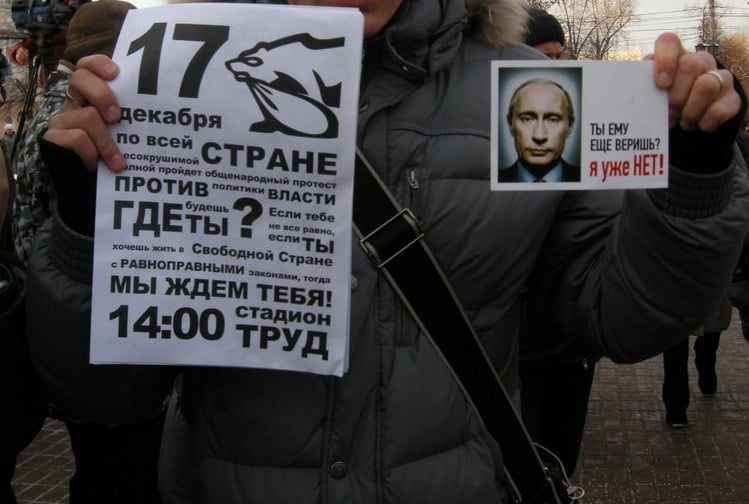
Advertisement for a planned protest in Irkutsk, 2011.
Russia has no real ограничения сроков (term limits) for any federal post. Constitutionally, the president can serve only two идущие сроки подряд (consecutive terms). This explains why President Putin, having served two terms beginning in 2000, became Prime Minister for one term before his переизбрание (re-election) as president in 2012. Due to конституционные поправки (constitutional amendments) passed in 2008, that term was first in Russia to extend to six years. Additional constitutional amendments passed in 2020 left in place the two consecutive term limits, but also specifically reset the clock to not count terms begun before the amendments passed. Thus, Putin was elected to a third consecutive term in 2024. He will likely stand for elections again in 2030 and could be in office until 2036 under the current rules. He then will be 83 and, if still in office, Russia’s longest-serving ruler, breaking the record that Catherine the Great achieved by serving 34 years.
Protests have sometimes followed elections. The largest in recent history occurred after the 2011 Duma elections, sparked by allegations of массовые фальсификации (mass electoral fraud). Discontent also formed around Vladimir Putin’s announcement that he would run for president again in 2012. Tens of thousands rallied in Moscow and other cities in some of the largest rallies seen since 1991. They demanded честные выборы (fair elections), политической конкуренции (political competition), and an end to коррупции (corruption).
The government largely tolerated these demonstrations at the time and even offered some reform, such as the installation of web cameras at polling stations. However, in the years following, the state strengthened механизмы политического контроля (mechanisms of political control), including extending законов о клевете (libel laws) to protect the state from offensive speech, strengthening требований к регистрации протестных акций (protest registration requirements), and launching уголовные дела (criminal cases) against prominent opposition organizations.
According to opinion polls, the Russian president, prime minister, and (to a lesser extent) ruling party remain broadly popular and would likely resoundingly win any near-term election in a сокрушительную победу (landslide victory). Political scientists debate, however, the effects that media control, political structures, and gatekeeping mechanisms have on these poll numbers.
More Russian for Wonks

Russian for Wonks: International Relations and Related Issues
In international relations (IR), language is more than a tool. Language, along with culture and history, is central to most national identities. Demonstrating genuine engagement…

The Dacha in Modern Russian History and Legislation
The Russian word “дача” is often translated into English as “summer residence” or “cottage,” but the best translation is simply a transliteration to English: “dacha.”…

Russian MiniLessons: Землетрясения и российской помощи – Earthquakes and Russian Foreign Aid
The following bilingual Russian MiniLesson is meant to build your vocabulary by providing Russian phrases within English text. Hover over the bold Russian to reveal…

Russian For Wonks: Elections and Voting
Political scientists studying a foreign country must be able to understand its politics at a local level. How do elections function? What motivates voters? What…

Russian MiniLessons: Civil War in Syria
The <strong>сирийский</strong> <strong>кризис</strong> (Syrian crisis) is a conflict between <strong>п</strong><strong>овстанцы</strong> (rebels) who are seeking to <strong>свергнуть</strong> <strong>правительство</strong> (oust the government) and <strong>проправительственные</strong> <strong>силы</strong> (pro-government forces)….

